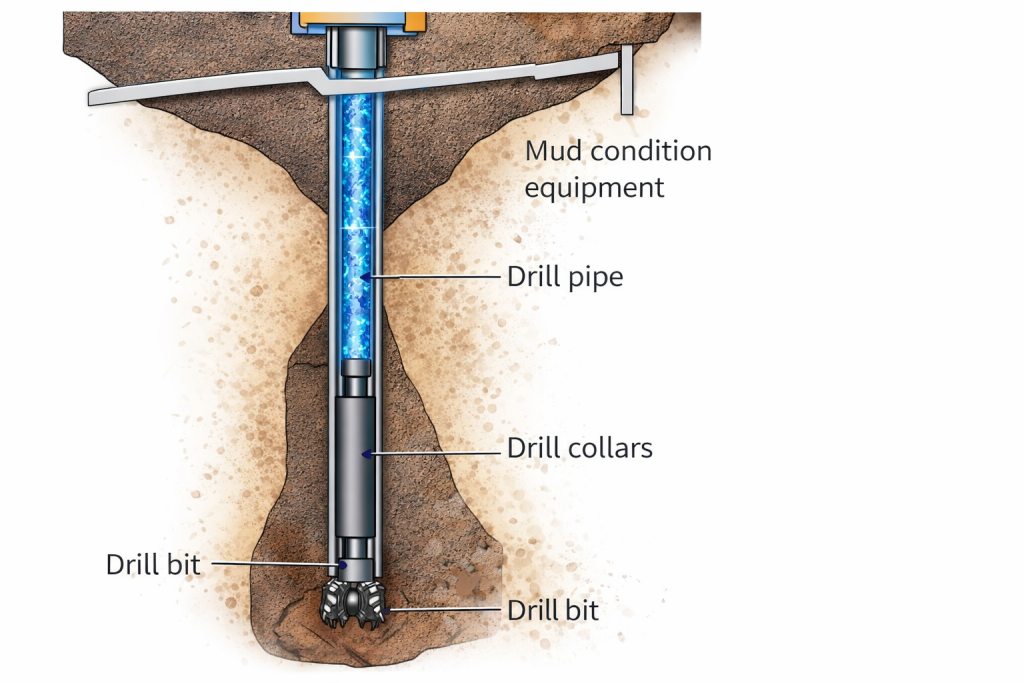
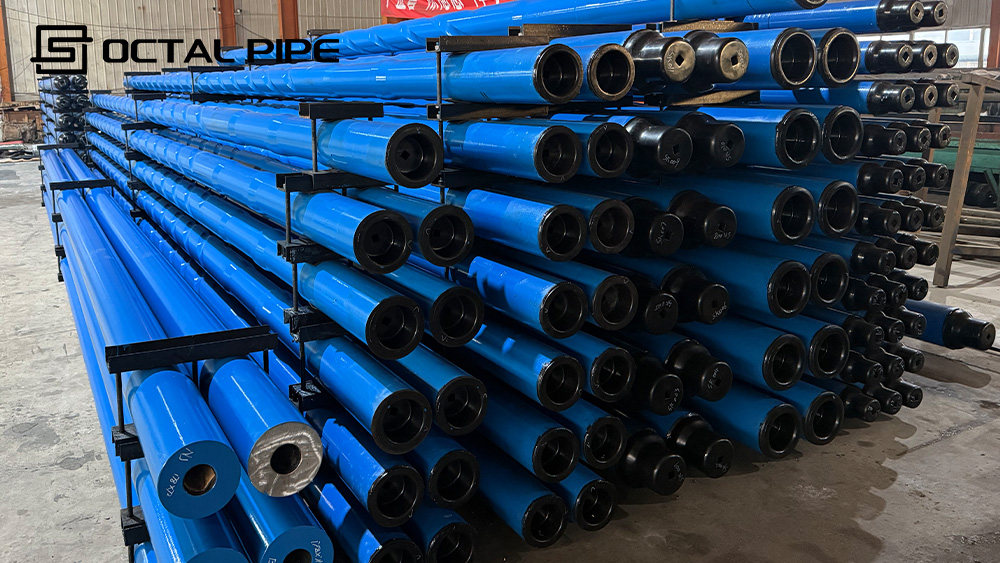
What is drill pipe?
Drill pipe is the main tubular component used to transmit rotary torque, circulate drilling fluid, and connect the surface system with the bottom hole assembly during drilling operations. In actual service, drill pipe works under combined loads rather than a single load case. Internal pressure, external pressure, torque, bending, tension, vibration, and repeated make-and-break all affect service life and connection reliability. That is why drill pipe selection is not based on OD and grade alone. Buyers also need to evaluate upset type, thread connection, length range, weld quality, inspection scope, and field suitability.
Octal supplies API 5DP drill pipe in common grades, sizes, and thread connections for onshore and offshore drilling applications. This page brings together the main specification points buyers usually need to review, including grades, sizes, thread types, heavy weight drill pipe, inspection methods, and common service considerations.
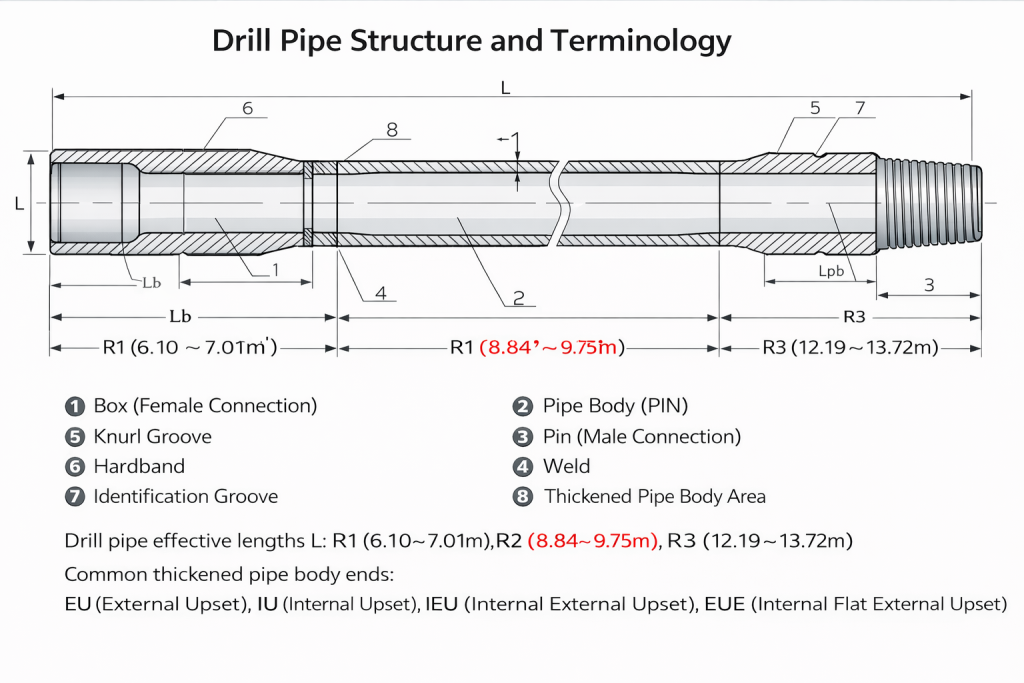
Drill Pipe Sizes and Common Configurations
Drill pipe sizes are one of the most searched drill pipe topics because OD, wall thickness, and tool joint combination directly affect hydraulic performance, string weight, torque capacity, and connection selection.
Below are common drill pipe size and configuration examples used in API 5DP supply:
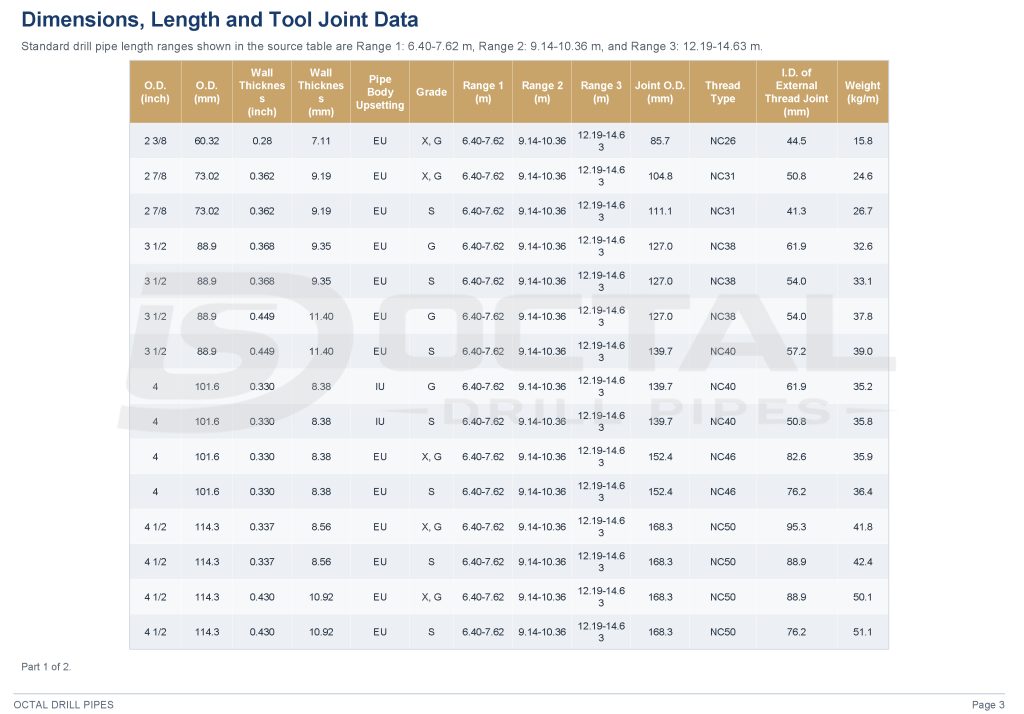
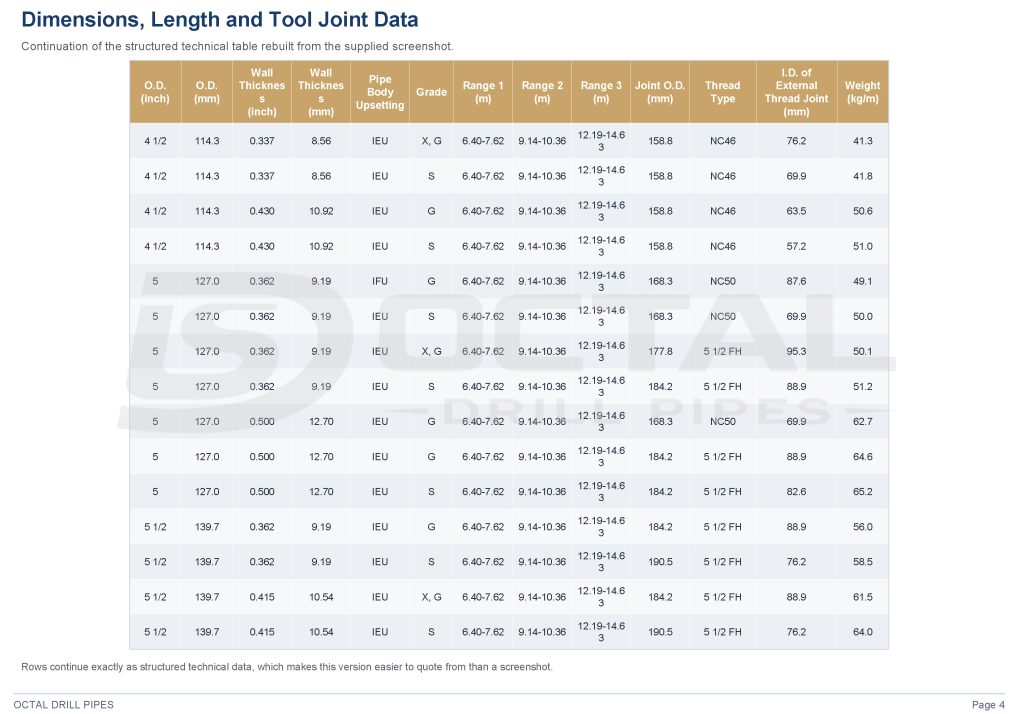
This is why a “drill pipe” inquiry is usually incomplete if it includes only OD. In most cases, buyers should also define grade, upset type, connection, range, and intended service condition.
API 5DP Drill Pipe Grades
For most drilling programs, API 5DP drill pipe is selected by grade first and then matched with the required size, wall thickness, and connection. Common grades include E75, X95, G105, S135, and V150. E75 is typically used in lighter-duty drilling or less demanding load conditions. X95 is often chosen when buyers need a practical balance between strength and cost. G105 is one of the most common grades for general drilling applications where higher strength is required than E75 or X95 can provide. S135 is widely used in deeper wells and more demanding drilling environments because it offers higher tensile performance and better suitability for heavier loads. V150 is a higher-strength option used in more severe service conditions when the drilling program calls for additional performance margin.
In procurement, grade selection should always be reviewed together with drilling depth, well profile, torque demand, connection type, fatigue exposure, and overall cost target. A higher grade is not automatically the better choice if the real operating condition is controlled by connection capacity, service life, or budget. In practice, buyers usually evaluate drill pipe grade together with the expected drilling load and the full string design rather than treating grade as a standalone specification.
Drill Pipe Threads and Connections
Drill pipe threads are one of the most important selection points because connection failure often causes more severe field problems than pipe body wear. Common rotary shouldered drill pipe connections include:
- NC26
- NC31
- NC38
- NC40
- NC46
- NC50
- NC52
- 5 1/2 FH
- 6 5/8 FH
The connection choice affects torque capacity, shoulder contact stability, make-up behavior, and field compatibility. For example, a buyer asking for NC50 drill pipe is not just asking for a thread name. They are defining part of the connection performance envelope. That is why drill pipe threads should always be matched with OD, grade, and application rather than selected in isolation.
API 5DP Drill Pipe Manufacturing and Quality Control
Reliable drill pipe depends on more than raw material. The production route and inspection discipline are equally important. In a typical drill pipe manufacturing workflow, the pipe body and tool joints go through controlled forming, machining, heat treatment, friction welding, dimensional verification, and non-destructive inspection before final release.
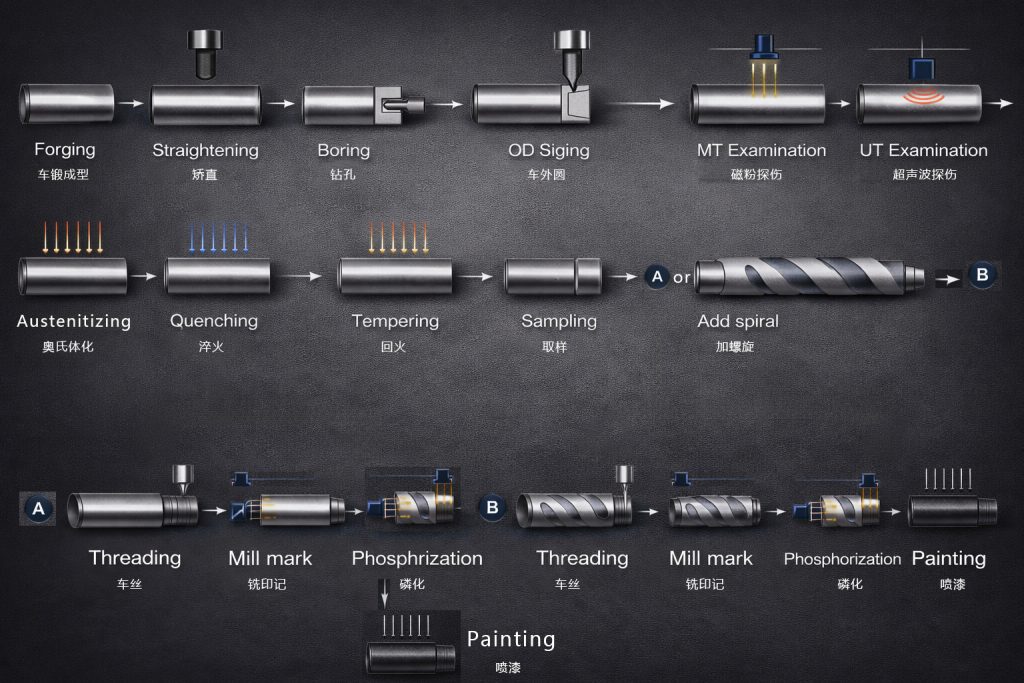
For buyers, the most important quality control areas usually include:
- tool joint machining accuracy
- upset quality
- friction weld integrity
- heat treatment consistency
- thread profile accuracy
- hardness control
- dimensional stability
- product traceability
This is also where a serious drill pipe manufacturer can distinguish product quality beyond basic specification matching.
Heavy Weight Drill Pipe
Heavy Weight Drill Pipe (HWDP) is used between standard drill pipe and drill collars to provide a smoother stiffness transition in the drill string. It helps reduce abrupt load change between lighter and heavier components and improves string behavior in directional and deeper drilling programs.
In practical selection, HWDP is commonly considered when the drilling program requires better weight transfer, improved transition strength, and reduced fatigue concentration in the string. On a commercial page like this, HWDP should be included as part of the overall drill pipe supply scope because many buyers consider it together with standard drill pipe rather than as a completely separate category.