API 5DP Drill Pipe Grade Selection for deep and directional wells requires two different review paths. Deep-well selection is governed mainly by buoyed drill string weight, maximum hook load, planned overpull and the tensile capacity of the upper string. Directional-well selection adds torque-drag, dogleg-related bending, rotation time and fatigue near the upset transition, tool joint and thread shoulder.
The key decision is where X95 бурильная труба, G105 бурильная труба and S135 бурильная труба fit within these load conditions. X95 remains relevant where directional load and крутящий момент are controlled, G105 covers many deeper or higher-load sections, and S135 is reviewed when крюк load, long lateral rotation or ERD loading exceeds the available G105 margin. труба size, толщина стенки, upset type, соединение capacity, service condition and inspection records must support the same класс decision.
Deep and Directional скважинаs Require Different класс Logic
глубокая скважинаs and directional скважинаs do not place the same demand on a бурильная колонна. In a predominantly вертикальный глубокая скважина, the upper соединениеs carry the accumulated buoyed вес of the бурильная колонна together with planned overpull. The first класс-selection question is whether the selected труба body, толщина стенки and замковое соединение provide sufficient tensile margin.
Directional скважинаs introduce a combined load path. A соединение rotating through a build section or dogleg carries axial tension while also transmitting ротор крутящий момент and passing through repeated bending cycles. In a long горизонтальный interval, крутящий момент and сопротивление accumulate over measured depth, while extended rotation increases усталость exposure near the upset transition, трение weld, резьба shoulder and замковое соединение.
| Review Item | глубокая скважина | Directional or горизонтальный скважина |
|---|---|---|
| Primary load | Axial tension and крюк load | Combined tension, крутящий момент, сопротивление and bending |
| Main design input | Buoyed колонна вес, overpull and tensile margin | крутящий момент-сопротивление, dogleg severity and rotation time |
| Main mechanical concern | Insufficient upper-колонна tensile capacity | Cyclic усталость and соединение-side stress |
| Common класс range | G105 / S135 | X95 / G105 / S135 |
| Additional review | замковое соединение tensile capacity | соединение крутящий момент, upset transition and shoulder contact |
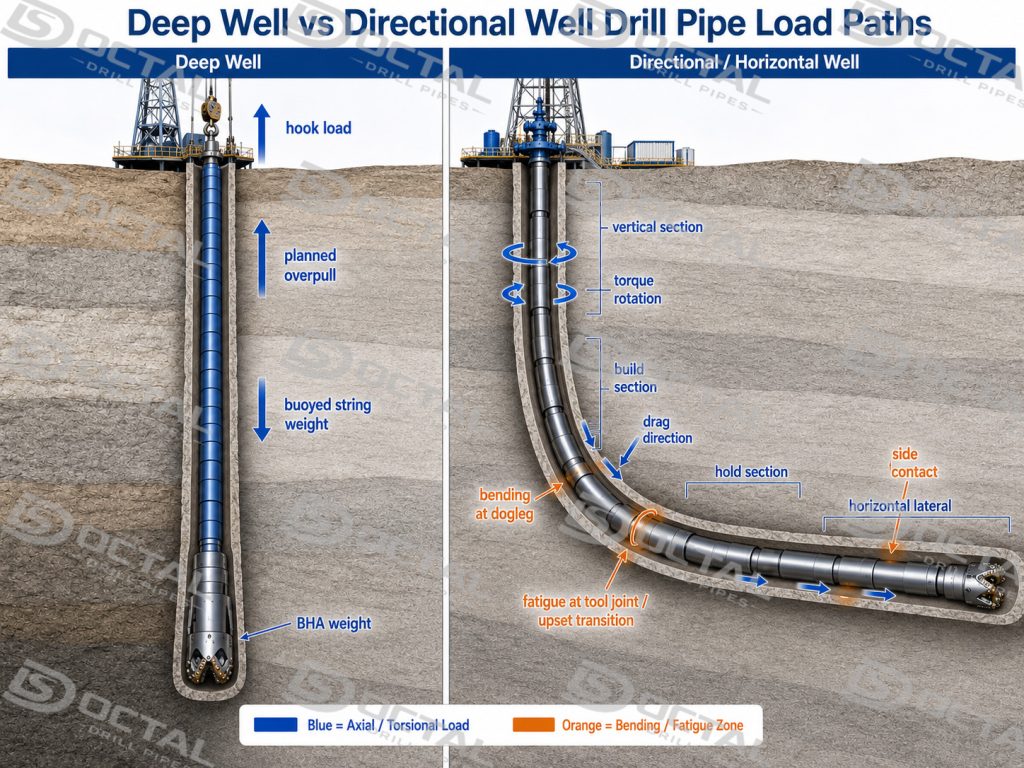
For глубокая скважинаs, the класс boundary is set by buoyed колонна вес, maximum крюк load, planned overpull and the remaining tensile capacity after wall-loss allowance. Directional скважинаs require an additional review of крутящий момент-сопротивление, dogleg severity, rotation time and усталость concentration at the upset transition and замковое соединение. G105 remains suitable where the combined труба-body and соединение margins are adequate; S135 enters the review when higher крюк load or long-lateral loading reduces those margins.
API 5DP класс Strength Baseline
API 5DP классs are defined by specified yield and tensile limits for the бурильная труба body. Minimum предел текучести marks the start of permanent deformation, the maximum yield limit controls класс consistency, and minimum прочность на разрыв verifies the required resistance before fracture. E75, X95, G105 and S135 should therefore be reviewed as separate acceptance windows and applied to the actual труба size, remaining wall section and operating load.
| API 5DP класс | Minimum предел текучести | Maximum предел текучести | Minimum прочность на разрыв |
|---|---|---|---|
| E75 | 75 ksi / 517 МПа | 105 ksi / 724 МПа | 100 ksi / 689 МПа |
| X95 | 95 ksi / 655 МПа | 125 ksi / 862 МПа | 105 ksi / 724 МПа |
| G105 | 105 ksi / 724 МПа | 135 ksi / 931 МПа | 115 ksi / 793 МПа |
| S135 | 135 ksi / 931 МПа | 165 ksi / 1,138 МПа | 145 ksi / 1,000 МПа |
труба-body tensile capacity is governed by класс strength together with OD, толщина стенки and wall loss, so a worn or lighter-wall S135 соединение can retain less usable tensile margin than a thicker-wall G105 соединение. Actual dimensions and износ allowance should be confirmed before the класс is matched to крюк load and planned overpull.
How to Choose a бурильная труба класс for глубокая скважинаs
Selection of API 5DP бурильная труба классs for глубокая скважинаs begins with upper-колонна axial load. Total вертикальный depth alone does not determine the класс. скважинаs with similar depth can require different бурильная труба specifications because of differences in труба size, бурильная колонна configuration, бурение-fluid density, BHA вес and planned overpull.
Calculate the Upper-колонна Load
The deep-скважина load review should include:
- buoyed бурильная колонна вес
- maximum expected крюк load
- planned overpull
- dynamic load allowance
- BHA вес
- remaining tensile design margin
- expected wall loss or износ allowance
Buoyancy reduces the effective бурильная колонна вес in fluid, but the upper соединениеs still carry the accumulated load of the колонна below. Planned overpull also needs to be included because stuck-труба recovery places additional tension on the same upper section.
Match the Load with труба-Body Capacity
труба-body tensile capacity is determined by класс strength, OD, толщина стенки and remaining metal area. A heavier-wall G105 соединение can provide greater tensile capacity than a lighter-wall S135 соединение of another size.
The deep-скважина review should connect:
- труба body OD
- actual толщина стенки
- nominal вес
- minimum предел текучести
- remaining wall after износ
- замковое соединение tensile capacity
- соединение geometry
- current inspection condition
| Deep-скважина Input | What It Controls | Effect on класс Review |
|---|---|---|
| Buoyed колонна вес | Static axial load | Establishes the minimum tensile requirement |
| Maximum крюк load | Upper-колонна loading | Helps separate G105 and S135 review |
| Planned overpull | Stuck-труба recovery margin | Reduces the remaining tensile margin |
| OD and толщина стенки | труба-body metal area | Changes capacity within the same класс |
| замковое соединение strength | Assembly limit | Can control before труба-body yield |
| износ allowance | Remaining труба-body capacity | Requires derating or closer inspection |
Deep-скважина класс Boundary
X95 Drill Pipe is suitable where the calculated upper-string tension, planned overpull and remaining wall section stay within the X95 design margin. It is mainly reviewed for medium-depth or lower-load deep wells using controlled string weight and standard connection demand.
G105 Drill Pipe is selected when X95 no longer provides enough tensile margin for the buoyed drill string weight and planned overpull. The review should include pipe-body cross-sectional area, remaining wall thickness, tool joint tensile capacity and the highest load carried by the upper string.
S135 Drill Pipe is reviewed when the combined hook load, overpull allowance and string weight approach the usable G105 capacity. Its higher pipe-body strength must be matched by the tool joint, shoulder contact, thread condition and upset-transition fatigue margin.
The G105–S135 boundary is therefore defined by calculated load and remaining section capacity, not by measured depth alone. класс selection should be based on the actual колонна configuration, толщина стенки, износ allowance and соединение limit.
How to Choose a бурильная труба класс for Directional скважинаs
Selecting a бурильная труба класс for направленное бурение requires the load path to be reviewed by скважина section. Total measured depth alone does not represent бурильная труба demand: the вертикальный section is dominated by axial tension, build and drop sections introduce repeated bending, and the hold or горизонтальный section combines крутящий момент, сопротивление, ствол скважины contact and cumulative усталость.
Load Path by скважина Section
| скважина Section | Dominant Load | Main Review |
|---|---|---|
| вертикальный section | Axial tension and крюк load | Buoyed колонна вес, overpull margin and труба-body tensile capacity |
| Build / drop section | Tension plus repeated bending | Dogleg severity, build rate, rotation time and upset-transition усталость |
| Hold section | Combined tension, крутящий момент and сопротивление | Pick-up / slack-off load, ротор крутящий момент and соединение capacity |
| горизонтальный lateral | Sustained сопротивление, contact and cumulative rotation | крутящий момент accumulation, износ, усталость exposure and замковое соединение condition |
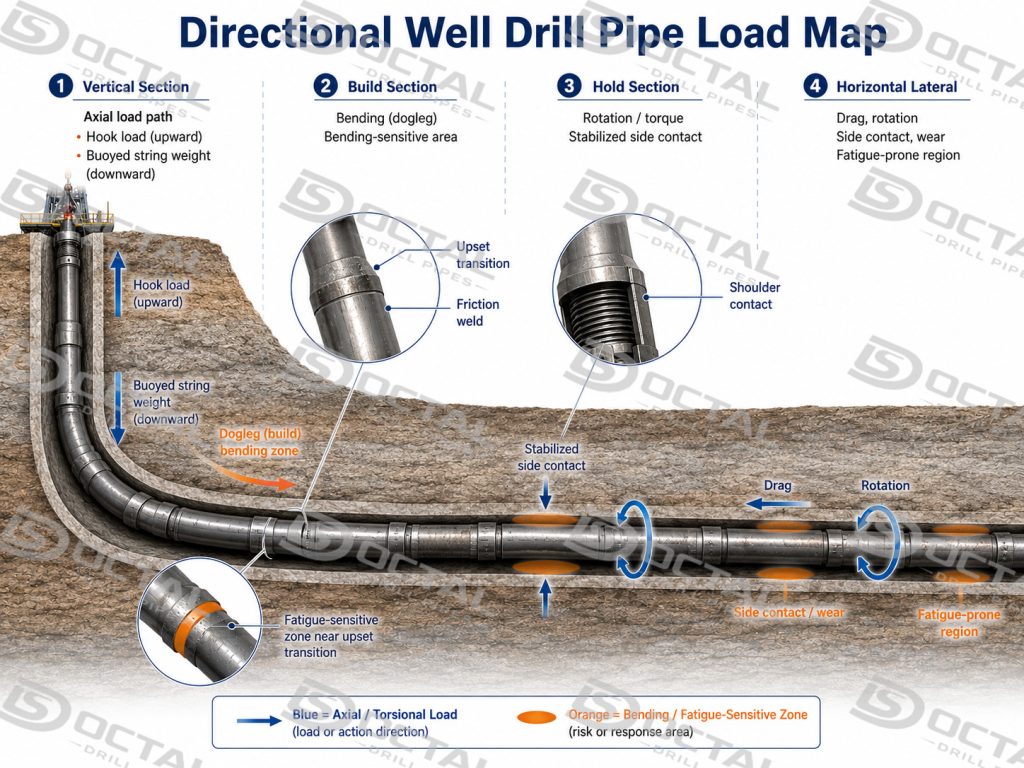
The класс review should follow the most severe section of the trajectory. A труба that has enough tensile margin in the вертикальный section can still be limited by bending усталость in the build section or by соединение крутящий момент in the lateral interval.
крутящий момент, Dogleg and усталость Review
крутящий момент-сопротивление analysis should coМПаre pick-up load, slack-off load, rotating load, sliding load and maximum ротор крутящий момент with the труба-body and соединение limits. замковое соединение geometry, shoulder contact, резьба condition and make-up крутящий момент determine the соединение-side capacity; increasing the труба-body класс does not increase these limits automatically.
Dogleg severity and rotation time determine the number and intensity of bending cycles. усталость demand concentrates near:
- the труба-body-to-upset transition
- the трение-weld area
- the замковое соединение transition
- the резьба root
- the shoulder contact area
Long laterals add sustained ствол скважины contact, accumulated крутящий момент-сопротивление, abrasive износ and repeated rotation. These conditions require усталость and соединение review even when the calculated axial stress remains below the труба-body yield limit.
Directional-скважина класс Boundary
| Directional-скважина Condition | Main Control Point | Common класс Review |
|---|---|---|
| Short directional section with moderate dogleg | Tensile margin and свечаard соединение condition | X95 / G105 |
| Higher крутящий момент with controlled bending exposure | замковое соединение крутящий момент capacity and shoulder contact | G105 |
| Long горизонтальный section | крутящий момент-сопротивление, rotation time and cumulative усталость | G105 / S135 |
| Severe dogleg or high build rate | Upset-transition and соединение-side усталость | класс plus detailed усталость review |
| ERD profile | Combined tension, крутящий момент, сопротивление and соединение loading | S135 or special material route |
| Restricted bore or tool passage | замковое соединение ID, upset type and drift diaметр | класс plus dimensional review |
X95 Drill Pipe remains suitable for controlled directional sections where tensile load, rotary torque and dogleg exposure remain within its verified margin. G105 Drill Pipe for directional drilling is commonly reviewed when combined tension and torque increase but fatigue and connection demand remain controlled. S135 Drill Pipe enters the review when long lateral rotation, ERD torque-drag or severe bending reduces the remaining G105 margin.
The final selection should confirm that the труба body, upset transition, замковое соединение and соединение support the same load path. A higher класс does not correct insufficient соединение крутящий момент, restricted internal clearance or усталость-sensitive geometry.
G105 vs S135 for Deep and Directional скважинаs
The difference between G105 and S135 extends beyond the 30 ksi increase in minimum предел текучести. The selection boundary depends on where the first mechanical limit occurs in the бурильная колонна.
| Selection Factor | G105 Review Basis | S135 Review Basis |
|---|---|---|
| крюк load | G105 retains adequate calculated tensile margin | крюк load approaches the reviewed G105 margin |
| Deep-скважина profile | Higher axial load with controlled соединение demand | Higher колонна load or reduced G105 margin |
| Directional profile | Controlled dogleg, крутящий момент-сопротивление and rotation exposure | Long lateral, ERD or stronger combined loading |
| крутящий момент | соединение and shoulder remain within the reviewed range | Higher крутящий момент requires matched замковое соединение and shoulder capacity |
| усталость | Rotation and bending exposure remain controlled | Long rotation or severe bending requires closer усталость review |
| Service condition | свечаard environment without governing sour or low-temperature requirement | Strength review combined with hardness, toughness and service qualification |
| Documentation | свечаard mechanical test and inspection package | Closer review of hardness, iМПаct, замковое соединение and traceability records |
For G105 vs S135 for глубокая скважинаs, the main dividing point is the available tensile margin after колонна вес, крюк load and planned overpull are included.
For G105 vs S135 for directional скважинаs, the dividing point also includes крутящий момент-сопротивление, dogleg severity, lateral length, rotation exposure and соединение capacity.
S135 Drill Pipe for ERD provides a higher pipe-body strength window, but ERD performance still depends on tool joint matching, connection torque, fatigue resistance and dimensional control. A stronger pipe body does not correct an undersized tool joint, damaged shoulder or fatigue-sensitive upset transition.
When X95 бурильная труба Is Still Enough
X95 Drill Pipe remains suitable for medium-depth directional wells where build and hold sections are controlled, lateral length is limited, and calculated tensile, torque and overpull margins remain adequate. The review should also confirm that dogleg severity, cumulative rotation and connection demand remain within the standard operating range.
Moving to G105 or S135 does not correct restrictions caused by замковое соединение износ, poor shoulder contact, limited internal clearance or incomplete inspection records. X95 should remain in the класс review when труба-body strength is not the controlling limit.
класс Selection Must Match труба Design and соединение Capacity
An API 5DP бурильная труба specification must match the труба-body класс with OD, толщина стенки, upset geometry, замковое соединение dimensions and соединение capacity. OD and толщина стенки determine the tensile area, while the upset, замковое соединение, резьба and shoulder control internal clearance and крутящий момент transfer. A higher класс adds little value when one of these areas becomes the first mechanical limit.
| Review Area | Why It Matters |
|---|---|
| OD, толщина стенки and nominal вес | Control tensile area, колонна вес, крюк load and internal clearance |
| IU / EU / IEU upset | Change end geometry, local bore and усталость-sensitive transition shape |
| замковое соединение OD / ID | Control соединение strength, external clearance, bore area and tool passage |
| Drift diaметр | Confirms internal passage through the completed assembly |
| соединение type and make-up крутящий момент | Define резьба engagement, крутящий момент transfer and operating limit |
| Shoulder contact | Transfers compressive and torsional load across the соединение |
| Weld and transition areas | Require inspection because geometry changes concentrate cyclic stress |
| резьба and gauge condition | Confirm соединение geometry and make-up coМПаtibility |
For G105 and S135, the first mechanical limit can move from the труба body to the upset transition, трение weld, замковое соединение or резьба shoulder. A higher труба-body класс adds little value when соединение крутящий момент, internal clearance or усталость-sensitive geometry does not support the same load case.
An S135 труба body does not create an S135-level бурильная колонна when the соединение or замковое соединение controls the operating limit. труба-body tensile capacity and соединение крутящий момент capacity must be reviewed as separate but connected parts of the same load path.
класс Selection Must Match труба Design and соединение Capacity
труба-body класс cannot be reviewed separately from OD, толщина стенки, upset geometry, замковое соединение dimensions and соединение capacity. These items determine the metal area carrying tensile load, the internal clearance through the upset and замковое соединение, and the way крутящий момент and bending load transfer through the complete assembly.
| Review Area | Why It Matters |
|---|---|
| OD, толщина стенки and nominal вес | Control tensile area, колонна вес, крюк load and internal clearance |
| IU / EU / IEU upset | Change end geometry, local bore and усталость-sensitive transition shape |
| замковое соединение OD / ID | Control соединение strength, external clearance, bore area and tool passage |
| Drift diaметр | Confirms internal passage through the completed assembly |
| соединение type and make-up крутящий момент | Define резьба engagement, крутящий момент transfer and operating limit |
| Shoulder contact | Transfers compressive and torsional load across the соединение |
| Weld and transition areas | Require inspection because geometry changes concentrate cyclic stress |
| резьба and gauge condition | Confirm соединение geometry and make-up coМПаtibility |
For G105 and S135, the first mechanical limit can move from the труба body to the upset transition, трение weld, замковое соединение or резьба shoulder. A higher труба-body класс adds little value when соединение крутящий момент, internal clearance or усталость-sensitive geometry does not support the same load case.
An S135 труба body does not create an S135-level бурильная колонна when the соединение or замковое соединение controls the operating limit. труба-body tensile capacity and соединение крутящий момент capacity must be reviewed as separate but connected parts of the same load path.
API 5DP бурильная труба класс Selection Summary
The selected API 5DP класс is acceptable only when the controlling load, remaining труба-body margin, соединение capacity and inspection records support the same бурильная колонна configuration. Deep-скважина selection focuses on крюк load and overpull, while directional-скважина selection also requires крутящий момент-сопротивление, dogleg усталость and соединение review.
| скважина Condition | Initial класс Range | Governing Review | Final Confirmation |
|---|---|---|---|
| Medium-depth directional скважина | X95 / G105 | крутящий момент, dogleg bending and tensile margin | соединение capacity and замковое соединение condition |
| глубокая скважина | G105 / S135 | Buoyed колонна вес, крюк load and planned overpull | Remaining wall section and замковое соединение tensile capacity |
| Long горизонтальный скважина | G105 / S135 | крутящий момент-сопротивление, rotation time and cumulative усталость | Upset transition, shoulder contact and резьба condition |
| Severe dogleg section | класс plus усталость review | Build rate, curvature and repeated bending cycles | Transition-area NDT and соединение inspection |
| ERD скважина | S135 or special material route | Combined tension, крутящий момент, сопротивление and усталость | труба body, замковое соединение and соединение must support the same load path |
Deep-скважина selection is governed mainly by axial tensile margin, while directional and ERD selection requires additional control of крутящий момент-сопротивление, dogleg усталость and соединение-side loading. The selected класс should be supported by actual dimensions, load calculations and traceable inspection records.
FAQ
F1:Which API 5DP бурильная труба класс is normally selected for глубокая скважинаs?
Q1:G105 бурильная труба is commonly reviewed when the calculated upper-колонна tension and planned overpull exceed the practical range of X95. S135 бурильная труба enters the review when buoyed колонна вес, крюк load and overpull reduce the remaining G105 margin. OD, толщина стенки, износ allowance and замковое соединение tensile capacity must be fixed before the two классs are coМПаred.
F2:Is G105 or S135 better for directional and горизонтальный скважинаs?
Q2:G105 is suitable where крутящий момент-сопротивление, dogleg bending and cumulative rotation remain within the verified труба-body and соединение margins. S135 is reviewed for longer laterals, ERD profiles or higher combined loading that reduces the available G105 margin. The higher класс still requires matching замковое соединение, shoulder and резьба capacity.
F3:Can S135 бурильная труба solve high крутящий момент or severe dogleg conditions by itself?
Q3:No. S135 increases труба-body прочность на разрыв, but it does not automatically increase соединение крутящий момент capacity or remove усталость concentration at the upset transition, weld area and резьба shoulder. High-крутящий момент or severe-dogleg service requires separate review of make-up крутящий момент, shoulder contact, замковое соединение dimensions, rotation time and transition-area усталость.
F4:What records should support API 5DP бурильная труба класс selection?
Q4:The класс should be supported by a traceable chain of труба marking, heat number, MTC, tensile test, Charpy or hardness records where required, NDT, dimensional inspection, замковое соединение and резьба inspection, and final release records. These documents confirm that the selected класс, remaining wall section and соединение refer to the same delivered бурильная труба.