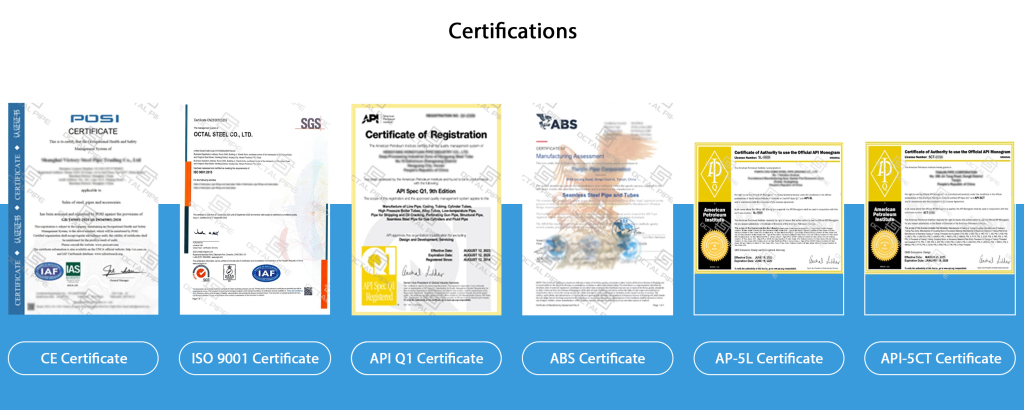
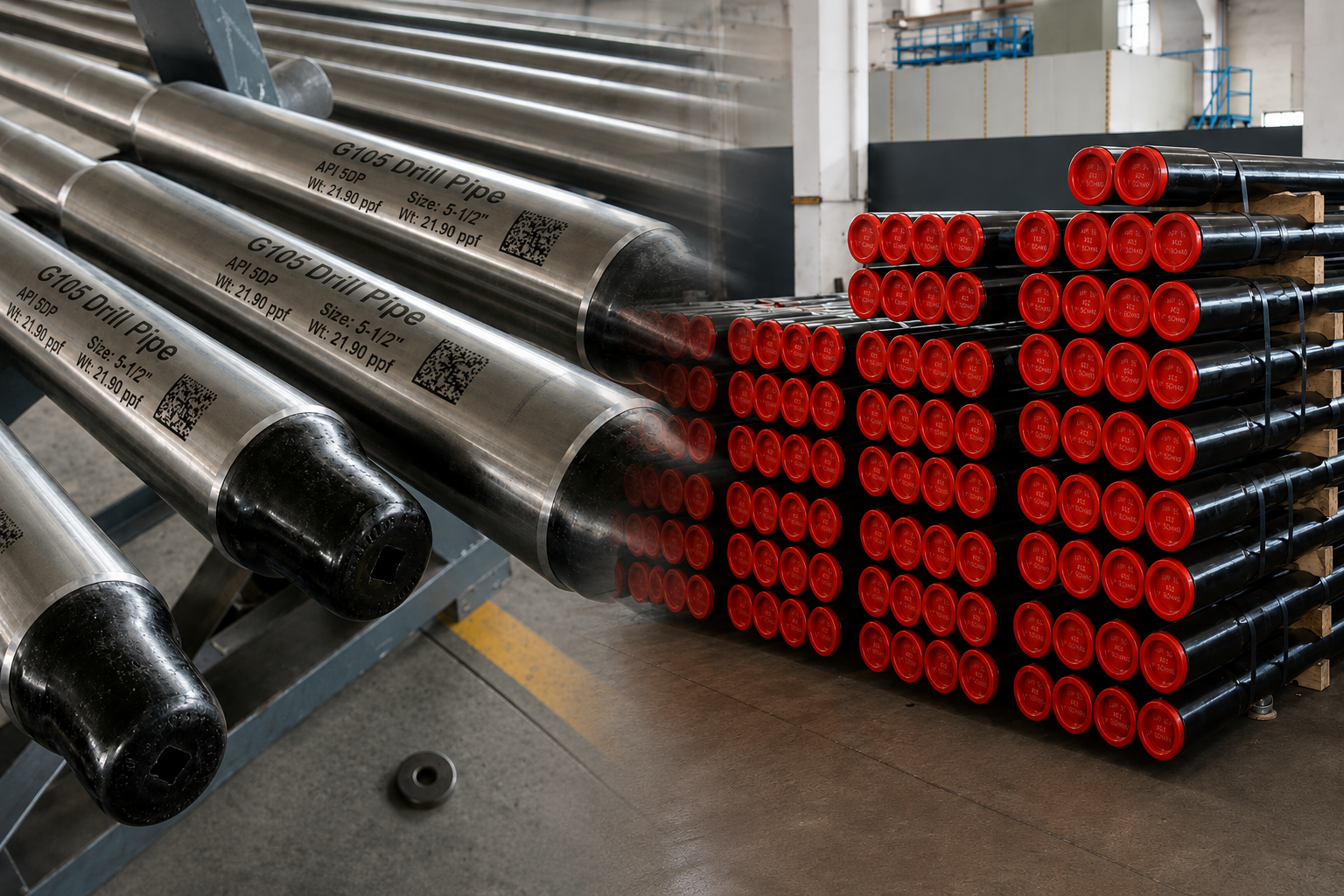
G105 бурильная труба and S135 бурильная труба are high-strength API 5DP бурильная труба классs used in ротор бурение колоннаs to carry axial load, transmit крутящий момент, circulate буровой раствор and connect the буровая установка to the bottom-скважина assembly. Both are normally manufactured from heat-treated seamless alloy steel труба bodies with upset ends, then трение-welded to alloy steel замковое соединениеs with ротор shouldered соединениеs. G105 has a 105 ksi minimum предел текучести, while S135 has a 135 ksi minimum предел текучести.
The difference between G105 and S135 is not only a strength number. S135 provides higher tensile and крутящий момент margin, but the final selection should also consider скважина depth, крюк load, dogleg severity, усталость exposure, соединение capacity, sour-service risk, замковое соединение condition and inspection documents. For controlled medium-to-глубокая скважинаs, G105 may be enough; for deeper, longer or higher-крутящий момент бурение sections, S135 may be required.
Quick Answer: When to Choose G105 or S135 Drill Pipe
| Selection Question | G105 Drill Pipe | S135 Drill Pipe |
| Strength level | 105 ksi minimum предел текучести | 135 ksi minimum предел текучести |
| Best fit | Medium-to-глубокая скважинаs, directional скважинаs, controlled high-load sections | глубокая скважинаs, high-крутящий момент бурение, extended-reach and complex скважина profiles |
| Main advantage | Balanced strength, availability and cost control | Higher tensile capacity and stronger load margin |
| Main caution | Still needs усталость and соединение review | Higher strength does not remove усталость, H₂S or соединение risk |
| Typical review point | Whether X95 is not enough but S135 is not necessary | Whether G105 leaves insufficient load or крутящий момент margin |
| Inspection focus | MTC, dimensional report, NDT, резьба gauge record, замковое соединение check | MTC, iМПаct/hardness review, NDT, резьба inspection, weld-zone and замковое соединение control |
If the скважина has moderate depth, controlled dogleg severity and no extreme крутящий момент demand, G105 may be enough. If the скважина has high suspended колонна вес, high overpull risk, long горизонтальный displacement or severe ротор крутящий момент, S135 should be reviewed.
API 5DP Strength Difference Between G105 and S135
In API 5DP бурильная труба классs, the number in G105 and S135 refers to the specified minimum предел текучести in thousands of psi. G105 means a 105 ksi minimum предел текучести класс, while S135 means a 135 ksi minimum предел текучести класс.
| Grade | Minimum Yield Strength | Maximum Yield Strength | Minimum Tensile Strength | Practical Meaning |
| G105 | 105,000 psi / 724 МПа | 135,000 psi / 931 МПа | 115,000 psi / 793 МПа | Higher-load бурение where X95 may not provide enough margin |
| S135 | 135,000 psi / 931 МПа | 165,000 psi / 1138 МПа | 145,000 psi / 1000 МПа | Deep, high-tension, high-крутящий момент and extended-reach бурение |
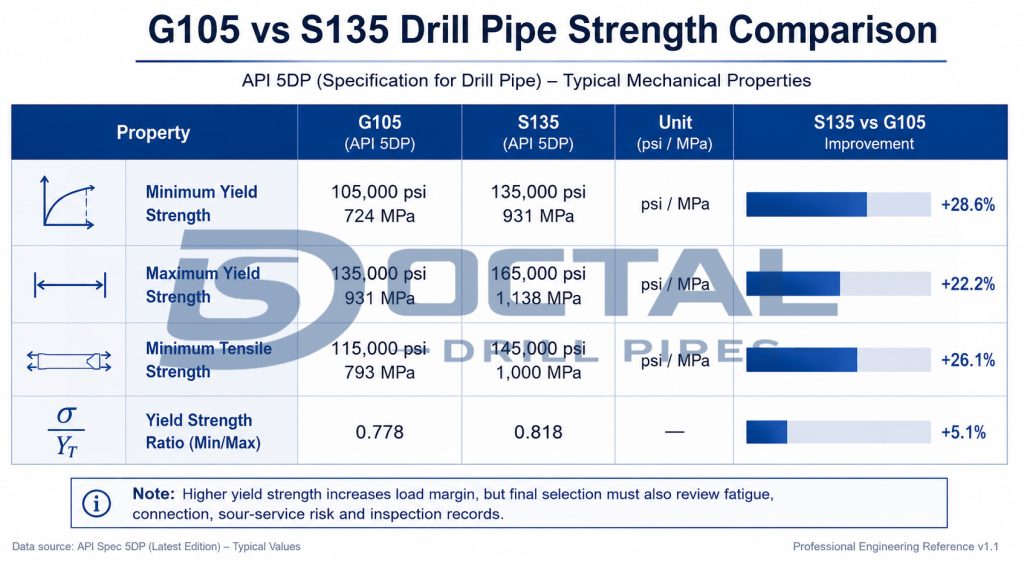
This strength gap is important, but it is only the first layer of selection. A бурильная труба колонна is not loaded by static tension alone. During бурение, the труба body works under combined tension, крутящий момент, internal pressure, bending stress, vibration, contact износ and repeated make-up / break-out cycles.
That is why a stronger класс cannot be treated as a universal upкласс. If the соединение is mismatched, the замковое соединение shoulder is worn, the hardbanding is damaged, or the бурильная труба lacks traceable inspection records, higher предел текучести will not solve the field acceptance problem.
G105 and S135 бурильная труба Selection by Strength and Service Demand
G105 and S135 бурильная труба are both high-strength API 5DP классs, but they are usually selected for different бурение demands. G105 is often used when the бурение program needs higher strength than X95, while S135 is selected when deeper скважинаs, longer горизонтальный sections or higher крутящий момент demand require a stronger труба body. The selection should not be based on класс name alone. скважина depth, tensile load, крутящий момент, усталость exposure, соединение type, замковое соединение dimensions and inspection records should be reviewed together.
G105 бурильная труба for Controlled High-Load бурение
G105 drill pipe is commonly selected when the drilling string needs more strength than X95, but the full drilling program does not require S135. It is suitable for medium-to-deep wells, directional sections, build-and-hold intervals and controlled high-load drilling conditions where tensile load, torque and bending fatigue are higher than conventional service.
The main value of G105 is balance. It provides a useful strength increase while keeping the specification close to common API бурильная труба supply ranges. For many бурение programs, this avoids unnecessary класс escalation when the скважина profile is demanding but still controlled.
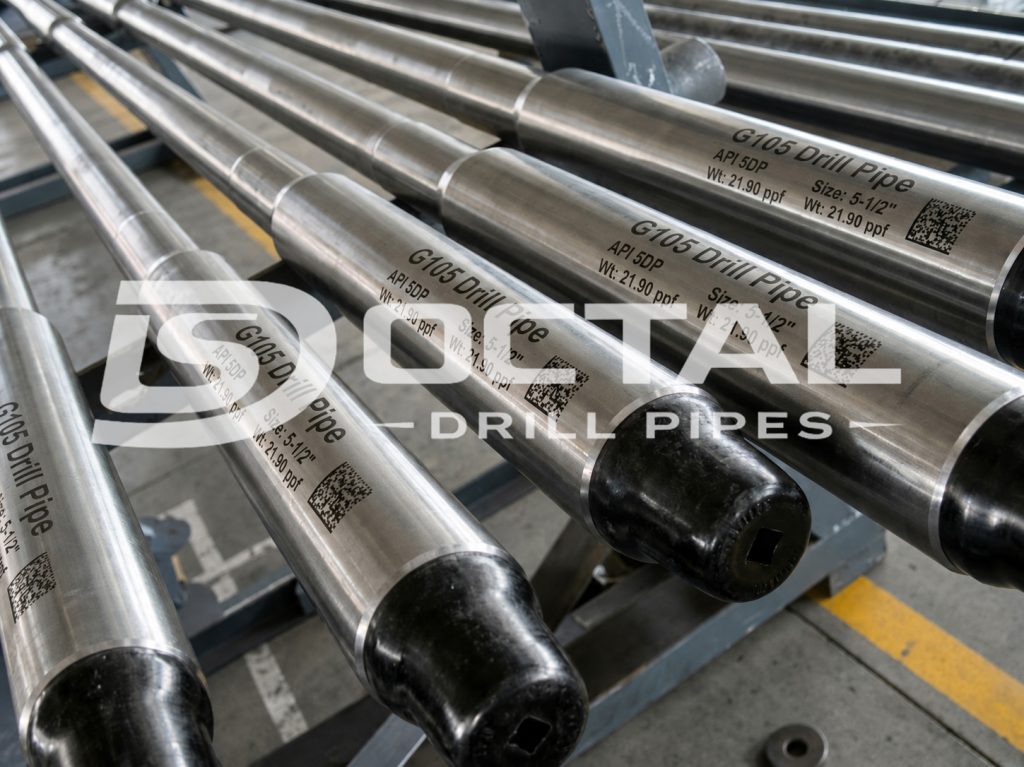
G105 drill pipe is often reviewed for:
- deeper вертикальный скважинаs where X95 leaves limited tensile margin;
- directional скважинаs with combined axial load and bending усталость;
- build sections where крутящий момент and сопротивление increase;
- бурение колоннаs that need higher load capacity without moving directly to S135;
- replacement or mixed-колонна orders where соединение coМПаtibility is a major control point.
The key risk for G105 is not only whether the труба body meets the класс requirement. усталость may start at slip marks, коррозия pits, hardbanding defects, резьба shoulder damage or the upset transition area. A G105 order should therefore be checked by OD, nominal вес, толщина стенки, range, upset type, соединение, замковое соединение OD/ID, drift diaметр, hardbanding condition and inspection class.
S135 бурильная труба for Deep and High-крутящий момент скважинаs
S135 drill pipe is the higher-strength option in this comparison. It is normally selected when the drilling program needs more tensile capacity, more torque reserve or a higher safety margin under complex well conditions. Compared with G105, S135 provides a stronger pipe body, but it also requires closer control of toughness, hardness, connection condition and traceability documents.
S135 бурильная труба is often reviewed for:
- deep and ultra-глубокая скважинаs with high suspended колонна вес;
- long горизонтальный sections and extended-reach бурение;
- high-крутящий момент ротор бурение and reaming operations;
- high overpull risk during tripping or stuck-труба recovery;
- complex directional скважинаs with severe dogleg or long build sections;
- бурение programs where G105 does not provide enough load margin.
S135 can improve the strength margin of the бурильная колонна, but it should not be treated as an automatic upкласс. Higher-strength бурильная труба still needs careful review of усталость exposure, sour-service risk, трение weld quality, резьба condition, замковое соединение performance and make-up крутящий момент control.
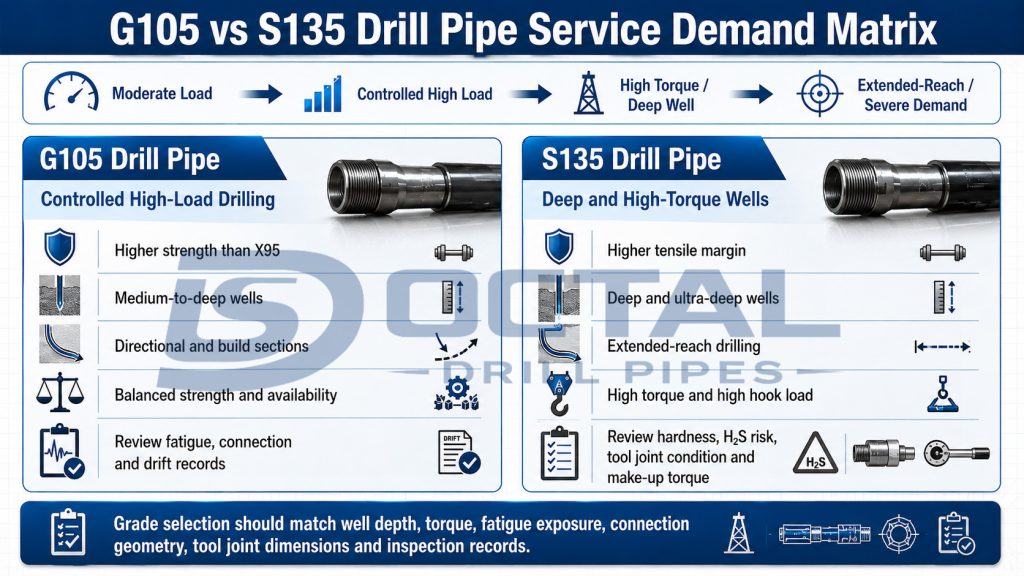
For S135 бурильная труба, the full specification should include труба size, nominal вес, толщина стенки, range, upset type, соединение, замковое соединение OD/ID, drift requirement, internal coating, hardbanding, make-up крутящий момент, inspection свечаard and document package. The класс name is only one part of the technical description. Field acceptance depends on whether the complete бурильная труба соединение matches the бурение program and the required inspection records.
Load, Torque and Fatigue Factors in G105 and S135 Drill Pipe Selection
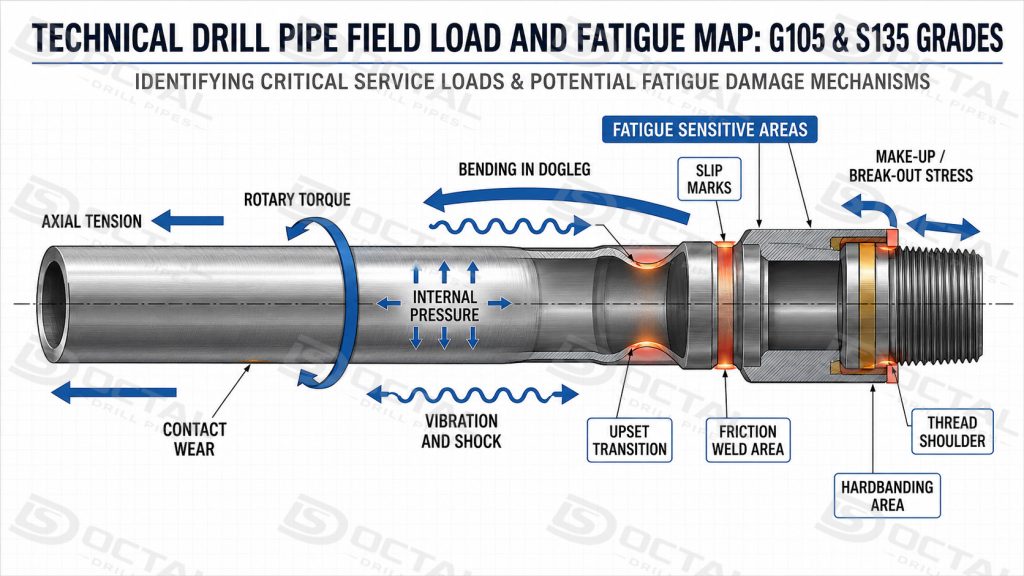
G105 and S135 бурильная труба should be coМПаred under real бурение loads, not only by предел текучести. In the буровая установка, the труба body and соединение may work under axial tension, ротор крутящий момент, internal pressure, bending, vibration, contact износ and repeated make-up / break-out cycles. These loads often act together in directional, горизонтальный and extended-reach скважинаs.
| бурение Condition | Main Load Concern | G105 Review Point | S135 Review Point |
|---|---|---|---|
| Deeper вертикальный скважинаs | Suspended колонна вес and overpull margin | Suitable when the load is higher than X95 can comfortably handle but still controlled | Reviewed when колонна вес, overpull risk or safety margin requires a stronger труба body |
| Directional and горизонтальный скважинаs | крутящий момент, сопротивление and bending усталость | Check dogleg severity, соединение capacity, замковое соединение condition and усталость-sensitive areas | Consider when крутящий момент, сопротивление and repeated bending exceed the comfortable margin of G105 |
| Extended-reach бурение | High крутящий момент and long lateral displacement | May be limited when горизонтальный displacement and крутящий момент increase | Often reviewed for higher tensile and крутящий момент reserve, but still depends on соединение and замковое соединение control |
| Replacement or mixed-колонна orders | CoМПаtibility with the existing колонна | Must match OD, вес, range, соединение, замковое соединение OD/ID and drift | Must also match make-up крутящий момент, shoulder condition, hardbanding and inspection class |
усталость-sensitive areas should be reviewed carefully. Slip marks, hardbanding edges, коррозия pits, upset transitions, трение weld zones and резьба shoulders can become initiation points under repeated bending or vibration.
A скважина-specified G105 колонна may perform better than a poorly matched S135 колонна if the соединение, inspection class and усталость exposure are properly controlled. A труба that is correct by класс but wrong by соединение or замковое соединение dimension may still fail field matching.
Sour Service and H₂S Risk in G105 and S135 Drill Pipe
H₂S exposure changes the selection logic. In sour or H₂S-containing бурение conditions, higher-strength steels can become more sensitive to sulfide stress cracking and hydrogen embrittlement. This does not mean G105 or S135 can never be used in such environments. It means the класс cannot be selected by strength alone.
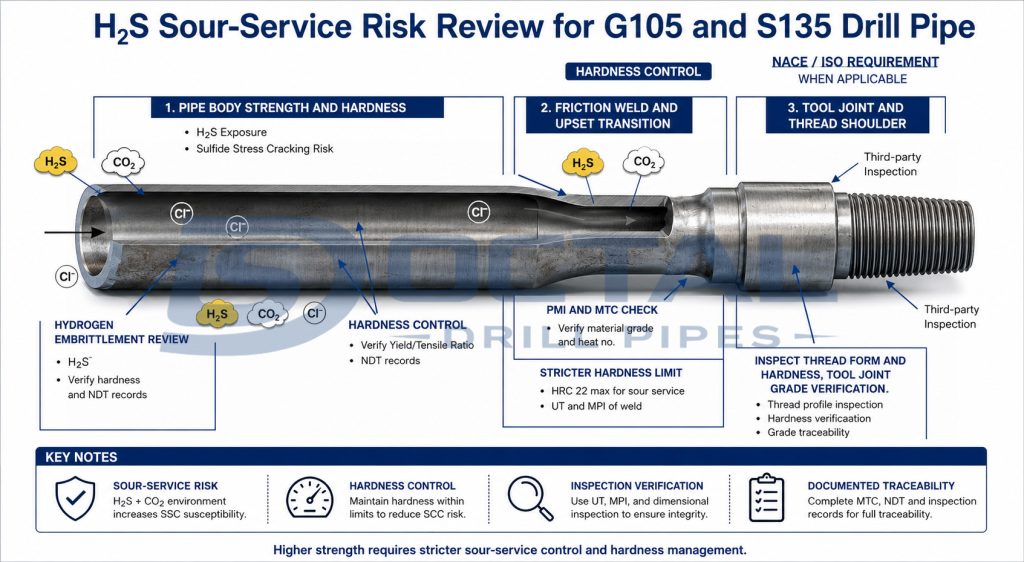
For G105 and S135 бурильная труба, sour-service review should consider:
- H₂S partial pressure and exposure condition;
- CO₂, chloride, temperature and буровой раствор chemistry;
- hardness control of труба body, замковое соединение and weld zone;
- surface condition, коррозия pits and mechanical damage;
- NACE / ISO sour-service requirement, when applicable;
- PMI, MTC, hardness records and third-party inspection;
- whether a sour-service or special material бурильная труба route is required.
S135 has higher strength than G105, but in H₂S conditions that higher strength can also require stricter crack-resistance review. For this reason, S135 should not be treated as an automatic solution for sour скважинаs. If the project specification includes H₂S, CO₂, chloride or high temperature, the material route, hardness limit, inspection class and document package should be confirmed before order release.
Connection and Tool Joint Control
G105 and S135 бурильная труба are not only труба bodies. A complete бурильная труба соединение includes the seamless труба body, upset transition, трение weld zone, замковое соединение, pin / box резьба, shoulder, drift path and sometimes internal coating or hardbanding.
соединение control is often where field problems appear.
Common соединение-related checks include:
| Check Item | Why It Matters |
| соединение type | NC, IF, FH, REG or premium соединение must match the existing колонна |
| замковое соединение OD | Affects износ, handling and coМПаtibility with бурильная колонна design |
| замковое соединение ID | Controls hydraulic clearance and drift path |
| Make-up крутящий момент | Must match соединение design and буровая установка practice |
| резьба gauge record | Confirms резьба form, shoulder condition and соединение acceptance |
| Shoulder condition | Controls крутящий момент transfer and sealing contact |
| Hardbanding | Affects замковое соединение износ and обсадная колонна-friendly performance |
| резьба protector | Prevents handling damage before field use |
A common market example is 5″ бурильная труба with NC50 соединение. But “5″ G105 NC50” or “5″ S135 NC50” is still not a complete order description. замковое соединение OD, замковое соединение ID, upset type, range, drift diaметр, hardbanding and inspection documents must also be confirmed.
When соединение geometry, shoulder contact or make-up крутящий момент becomes the controlling factor, special резьбаed бурильная труба can be reviewed to match the existing бурильная колонна and буровая установка-side соединение requirements.
If the соединение is not suitable, the труба may meet API 5DP mechanical requirements but still fail during буровая установка-site matching or make-up крутящий момент control. класс strength cannot compensate for wrong соединение geometry.
Inspection and Document Review for G105 and S135 бурильная труба
Inspection is the step that turns a класс name into verifiable бурильная труба. For G105 and S135, the review should cover the труба body, upset area, трение weld zone, замковое соединение, резьба соединение, drift path, marking and final document package. The purpose is not only to prove the предел текучести, but also to show that each соединение can be matched, made up, inspected and traced before shipment release.
Main Inspection Items Before Shipment
| Inspection Item | How It Is Usually Performed | What It Verifies |
|---|---|---|
| Visual and marking inspection | Each соединение is checked for труба number, size, класс, range, соединение, heat number, stencil marking, color band and резьба protector condition. | Confirms that the physical труба matches the order, MTC and packing list. |
| Dimensional inspection | OD, толщина стенки, length, straightness, upset dimensions, замковое соединение OD/ID and shoulder dimensions are measured with calibrated tools. | Confirms fit-up, колонна coМПаtibility, drift clearance and compliance with the ordered specification. |
| Pipe body NDT | Ultrasonic testing, electromagnetic inspection or other project-specified NDT methods are applied to detect internal or surface defects. | Screens the труба body for cracks, laminations, wall-loss areas or unacceptable discontinuities. |
| Friction weld zone inspection | The weld area between труба body and замковое соединение is visually checked and normally reviewed by NDT according to the ITP. | Controls one of the most critical transition areas under крутящий момент, bending and tensile load. |
| Tool joint inspection | замковое соединение OD, ID, shoulder face, hardbanding area and pin / box condition are checked before release. | Ensures крутящий момент transfer, износ resistance, соединение matching and handling reliability. |
| Thread gauge inspection | Pin and box резьбаs are checked by proper резьба gauges. Shoulder condition, резьба form, метчикer and visible damage are reviewed. | Confirms that the соединение can be made up correctly at the буровая установка site. |
| Drift test | A specified drift mandrel is passed through the труба bore and замковое соединение ID. | Verifies internal clearance for буровой раствор flow and downскважина tool passage. |
| Hardness test | Hardness readings are taken on the труба body, замковое соединение or weld zone when required by класс, sour-service review or project ITP. | Helps control high-strength material condition and cracking sensitivity, especially for S135 or sour-service programs. |
| Impact test | Charpy V-notch specimens are machined from the required material location, cooled to the specified temperature and broken by pendulum iМПаct testing. | Measures absorbed energy and supports toughness review for low-temperature, offshore or project-specified service. |
| Hydrostatic or pressure-related test | When specified by the order or ITP, pressure testing is performed under controlled pressure and holding time. | Verifies pressure integrity, sealing performance and absence of leakage under the required test condition. |
| Document review | MTC, heat records, test reports, NDT records, dimensional reports, резьба gauge records and packing list are coМПаred against труба marking. | Confirms traceability from material heat to final shipped соединение. |
How the Key Tests Are Reviewed
Mechanical test review
Mechanical testing verifies whether the pipe body meets the required API 5DP grade. The report should show actual yield strength, tensile strength and elongation values, with heat number and specimen reference, not only a general “passed” result.
Impact test review
Impact testing is required when toughness or low-temperature performance needs verification. Charpy V-notch specimens are tested at the specified temperature, and the absorbed energy value is recorded to assess resistance to brittle fracture under dynamic loading.
Hardness review
Hardness testing helps control cracking sensitivity in high-strength drill pipe, especially around the tool joint, friction weld zone and sour-service exposure. Results may be recorded by HB, HRC or HV method according to the project requirement.
NDT review
NDT is used to detect defects that visual inspection cannot confirm. The pipe body, upset area, weld zone, tool joint or thread area may be checked by ultrasonic, electromagnetic, magnetic particle or other project-specified methods according to the ITP.
Thread and connection review
Thread gauge inspection confirms the pin / box connection, shoulder condition and make-up compatibility. Even when the pipe body meets G105 or S135 strength requirements, incorrect thread geometry or shoulder damage can still cause rig-site matching problems.
For S135, hardness and weld-zone control deserve closer attention because the класс is higher strength. For G105, усталость, соединение coМПаtibility and mixed-колонна traceability are often the practical control points.
Selection Risks When CoМПаring G105 and S135 бурильная труба
Strength класс Is Only One Part of the Selection
S135 provides higher предел текучести than G105, but higher strength does not automatically make the бурильная колонна safer. усталость exposure, соединение damage, резьба shoulder износ, weld-zone quality and H₂S sensitivity may still become the controlling service risks.
G105 Is Still a High-Strength API 5DP класс
G105 should not be treated as a low-класс option. It is a high-strength API 5DP бурильная труба класс that can be suitable for medium-to-глубокая скважинаs, направленное бурение and controlled high-load sections when крутящий момент, сопротивление and усталость exposure remain within the accepted range.
соединение and замковое соединение Details Control Field Matching
A бурильная труба specification should not stop at класс and OD. соединение type, замковое соединение OD/ID, shoulder condition, make-up крутящий момент and резьба gauge records directly affect буровая установка-site matching, крутящий момент transfer and соединение acceptance.
Sour-Service Conditions Need Separate Review
H₂S exposure requires material, hardness and environmental review. A higher-strength труба body does not automatically improve sour-service performance, especially when sulfide stress cracking or hydrogen embrittlement risk is part of the project specification.
Document Traceability Supports Final Acceptance
The MTC, heat number, inspection report and packing list should match the труба marking. When the document chain is incomplete, receiving inspection becomes difficult and field acceptance risk increases.
Conclusion
G105 and S135 бурильная труба are both high-strength API 5DP классs, but they are not selected by strength number alone. G105 is often the balanced choice for medium-to-глубокая скважинаs and controlled направленное бурение where X95 is not enough but S135 may be unnecessary. S135 is selected when deeper, longer, higher-крутящий момент or more complex бурение profiles require a stronger труба body and higher load margin.
FAQ
Is S135 drill pipe always better than G105?
No. S135 has higher предел текучести, but it is not automatically better for every скважина. G105 may be suitable when load, крутящий момент, dogleg severity and усталость exposure remain within a controlled range
What is the main difference between G105 and S135 drill pipe?
The main difference is strength level. G105 has 105 ksi minimum предел текучести, while S135 has 135 ksi minimum предел текучести. Final selection should also include соединение, замковое соединение, усталость, sour-service condition and inspection documents.
Can G105 drill pipe be used in directional wells?
Yes, G105 is commonly reviewed for directional скважинаs where higher load margin than X95 is required. Dogleg severity, крутящий момент, сопротивление, усталость exposure and соединение capacity should be checked before selection.
S135 drill pipe be used in sour service??
S135 should not be selected for sour service by класс name alone. H₂S exposure requires review of material condition, hardness, environment, NACE / ISO requirement, inspection scope and project-specific approval.
What documents should be supplied with G105 or S135 drill pipe?
Common documents include MTC, heat number record, mechanical test record, hardness record, dimensional report, NDT report, резьба gauge record, drift test record and packing list.