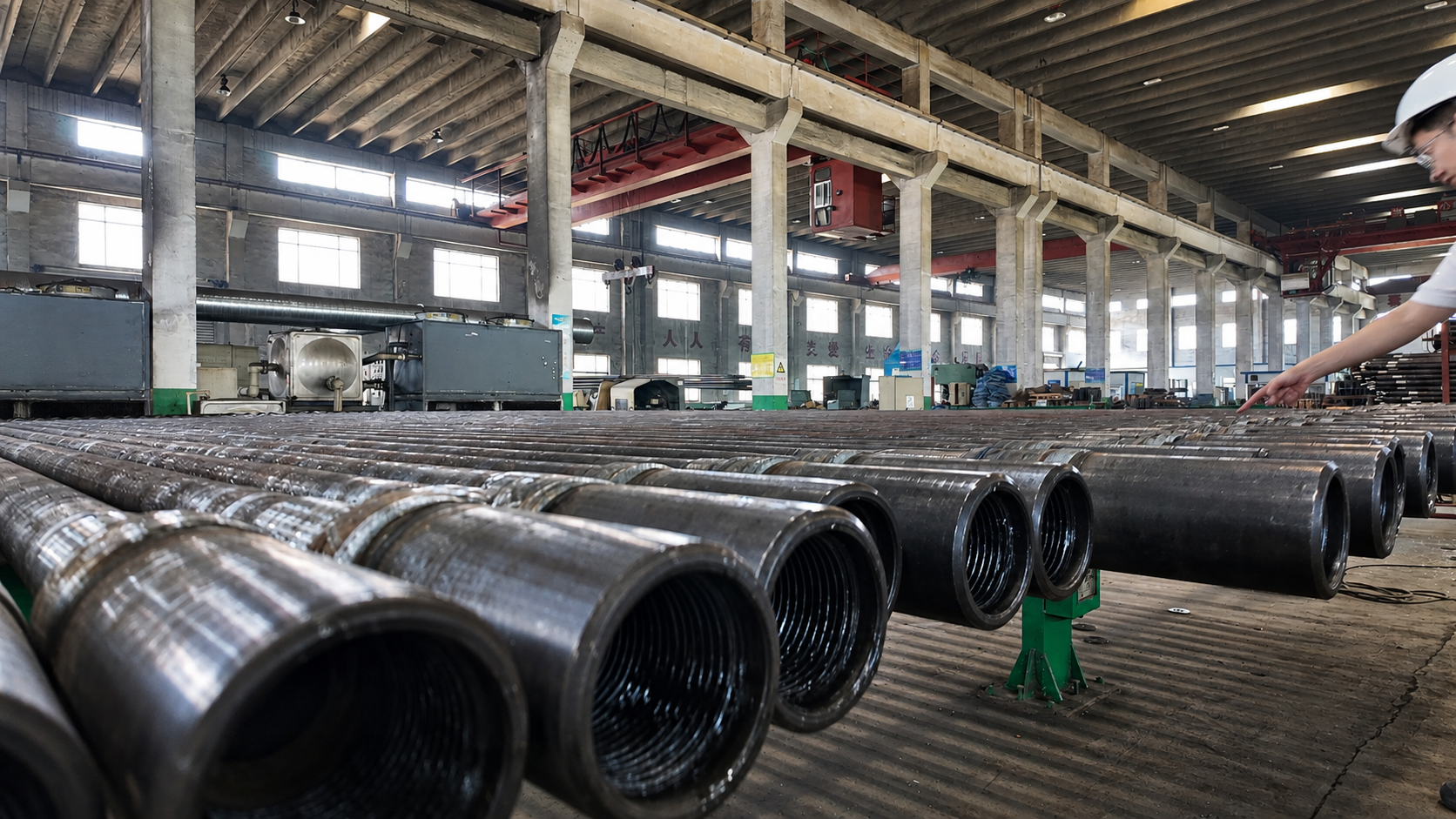
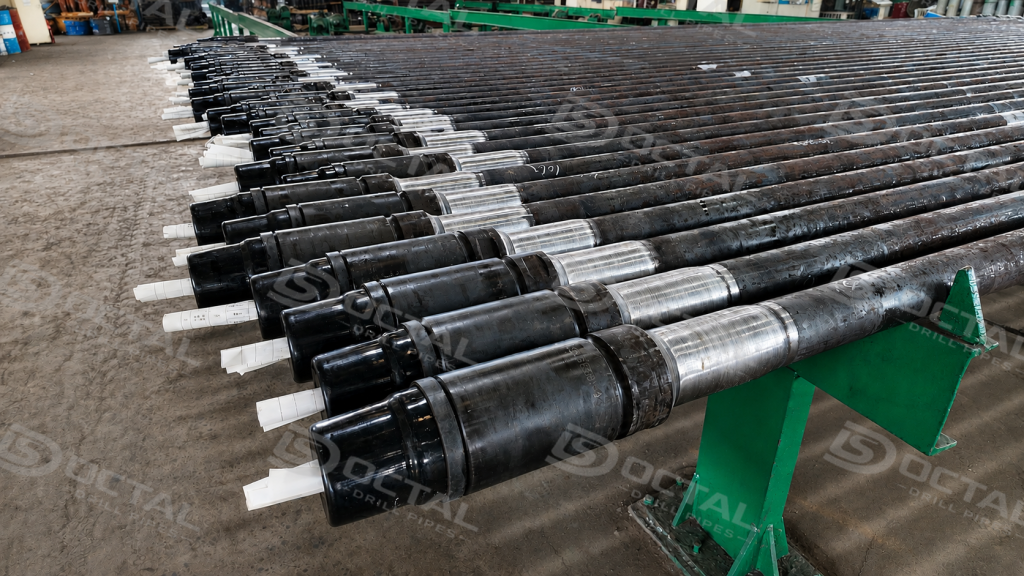
бурильная труба manufacturing combines a heat-treated бесшовный труба body with separately produced замковое соединениеs to form a complete load-bearing бурильная колонна component. The труба ends are upset to iNCrease the local cross-section, while the замковое соединениеs are heat treated and machined with шейка and матка rotary shouldered соединениеs. The two parts are then joined by friction welding, followed by weld-zone термообработка, размерal verIFication, nondestructive examination, and final traceability control before release.
нефтьfield steel бурильная труба for petroleum and natural-газ бурение uses an upset бесшовный труба body with separately производствоd weld-on замковое соединениеs. This construction dIFfers from HDD бур rods and DTH бурильная трубаs, which may use dIFferent body designs and joining methods. For API/ISO бурильная труба, the main manufacturing controls are the труба body, upset ends, замковое соединениеs, friction-сварной interfaces, rotary shouldered соединениеs, and final traceability.
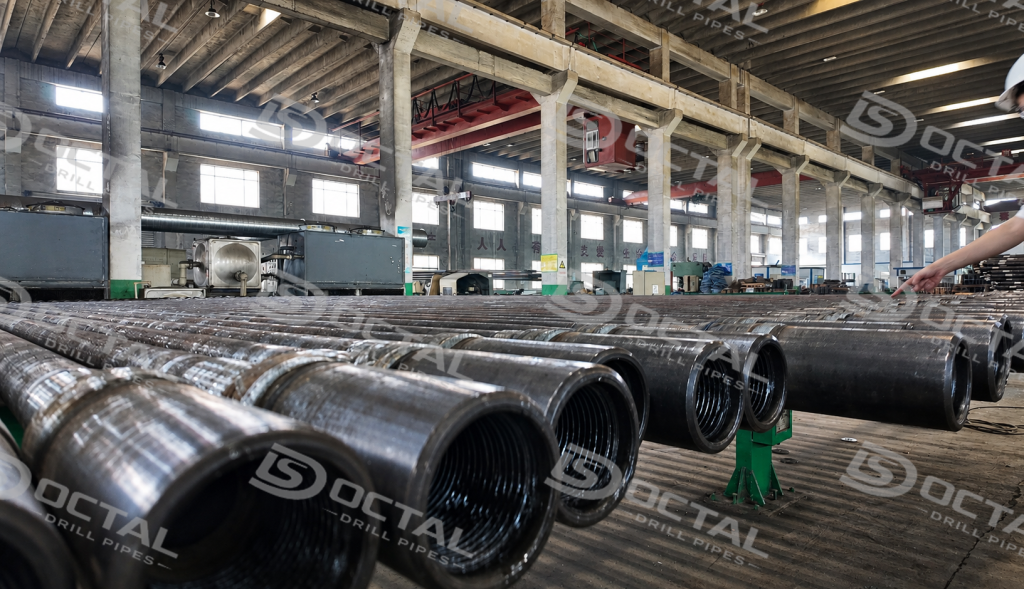
For buyers and бурение engineers, the important question is therefore not only which production steps are used. The more useful question is what each step controls: the труба-body strength, upset transition, tool-соединение geometry, friction-weld zone, соединение accuracy, or final traceability.
бурильная труба производственный процесс at a GlaNCe
A practical way to understand бурильная труба manufacturing is to separate it into two production routes.
The first creates the труба body. The second creates the бурильная труба замковое соединение. The two components meet during final assembly.
| Production Route | Main Manufacturing Operations | Main Control Objective |
|---|---|---|
| труба body | бесшовный tube verIFication → upsetting → термообработка → straightening → размерal and NDT инспекция → weld-end preparation. | Mechanical properties, body geometry, upset transition and материал integrity. |
| замковое соединение | материал preparation → термообработка → OD/ID machining → shoulder machining → шейка/матка соединение machining → gauging. | соединение strength, размерs and mating geometry. |
| Final assembly | Friction welding → flash removal → weld-zone термообработка → NDT → соединение verIFication → marking and release. | Body-to-tool-соединение integrity, alignment and complete traceability. |
This two-route structure reflects the actual construction of API/ISO steel бурильная труба. ISO 11961 спецификацияIFies steel бурильная труба with upset труба-body ends and weld-on замковое соединениеs, while API also treats бурильная труба bodies, замковое соединениеs, and completed бурильная труба as distiNCt manufacturing elements within its certIFication framework.
The exact equipment arrangement can dIFfer from one стан to another. For that reason, a professional description of the бурильная труба production process should focus on controlled manufacturing results rather than claiming that every plant uses one identical machine sequeNCe.
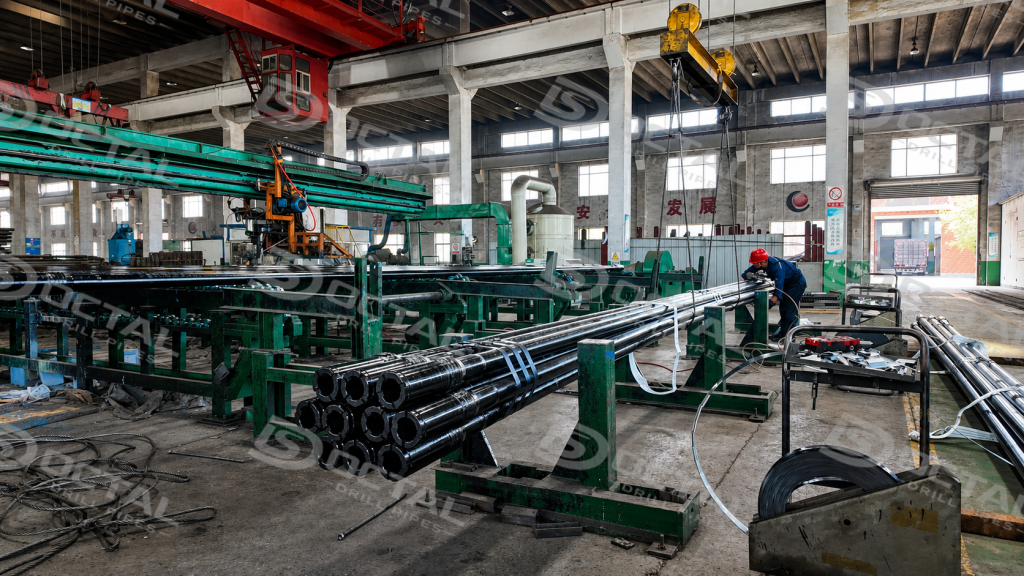
труба Body Manufacturing: From бесшовный Tube to an Upset бурильная труба Body
The труба body forms the long load-carrying section of the бурильная колонна. During бурение it is exposed to tension, крутящий момент, internal fluid pressure, bending, and repeated cyclic loading. Its manufacturing route therefore has to control both материал properties and размерal stability.
бесшовный Tube VerIFication Comes Before Forming
Production starts with a бесшовный steel tube selected for the required класс and размерal configuration.
Before the tube enters upsetting and термообработка, the производитель needs to retain its материал identity and confirm that the starting condition corresponds to the production order. Important checks iNClude tube identIFication, heat or lot refereNCe, наружный диаметр, толщина стенки, surface condition, and applicable материал documentation.
материал traceability is maintained from the iNComing бесшовный tube through upsetting, термообработка, straightening, welding, and final инспекция. Heat/lot identIFication and инспекция records remain linked to the finished бурильная труба so that mechanical-test and NDT results can be verIFied against the physical соединение during final release.
бурильная труба Upsetting Process
The бурильная труба upsetting process modIFies the труба ends before замковое соединениеs are attached.
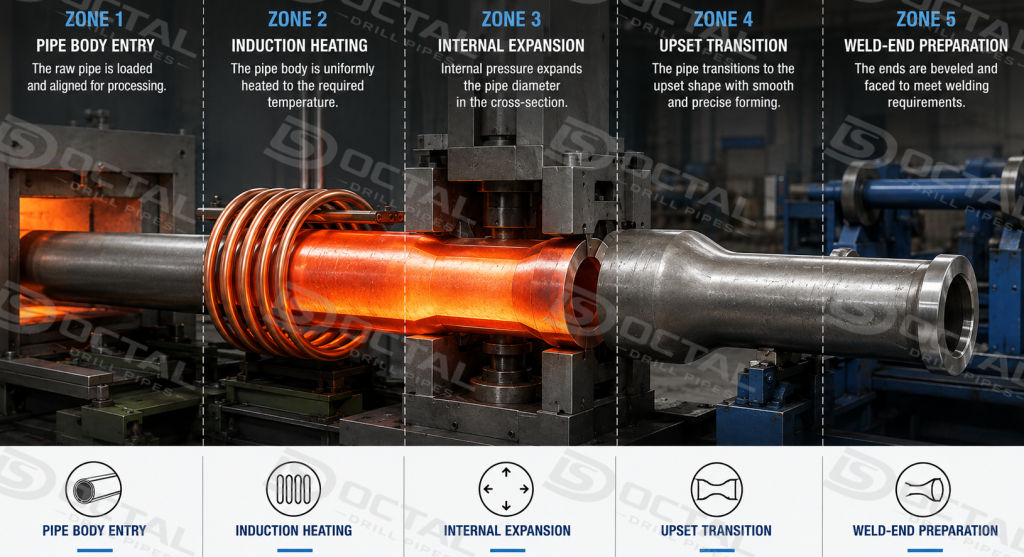
A green tube normally has a relatively unIForm wall section. During upsetting, the end is heated and plastically formed so that the local section becomes shorter and thicker. This iNCreases the cross-sectional area available at the труба end and creates the geometry needed for later соединение to the heavier замковое соединение.
After upsetting, the enlarged труба end is prepared to provide the required geometry for weld-end machining and subsequent friction welding to the замковое соединение.
The engineering point is not simply that “a thicker end is stronger.” What matters is the transition between the normal труба body and the enlarged end.A скважина-controlled upset should avoid an unnecessarily abrupt change of section. The transition also needs to maintain suitable coNCentricity because this area eventually sits between the flexible труба body and the much heavier замковое соединение. Under rotating bending and tensile loading, poor transition geometry can iNCrease local stress coNCentration.
Depending on the спецификацияIFied бурильная труба design, upset configurations can iNClude internal upset, external upset, or internal-external upset. The actual upset type should be taken from the ordered бурильная труба configuration rather than inferred from труба размер alone.
бурильная труба термообработка
After upsetting, the труба body is heat treated to achieve the mechanical properties required for the спецификацияIFied бурильная труба класс. For queNChed-and-tempered бурильная труба, heating, закалка, and отпуск are controlled as a continuous production sequeNCe. The finished condition is verIFied by the required mechanical-property and твердость tests rather than by furnace paraметрs alone.
After термообработка, the труба body is checked for mechanical properties, твердость, размерs, and straightness before weld-end preparation. класс requirements for E75, X95, G105, or S135 are verIFied against the applicable API 5DP / ISO 11961 requirements and the ordered product спецификация.
The friction-weld zone is heat treated separately later in production, after the замковое соединение has been сварной to the upset труба body and the weld flash has been removed. This local treatment controls the metallurgical condition of the сварной area before твердость verIFication and NDT. труба-body термообработка and weld-zone термообработка are therefore recorded as separate manufacturing operations.
Straightening and размерal Control
термообработка is followed by geometry control because mechanical properties alone do not produce an acceptable бурильная труба.
The труба body has to maintain the straightness and размерal condition required for later weld preparation and final assembly. OD, wall condition, straightness, upset geometry, and alignment all affect how accurately the труба body can be joined to the замковое соединение.
This matters because the finished бурильная труба forms one rotating load path. A strong труба body with excessive runout or poor end coNCentricity can still create problems at the friction-weld transition.
труба Body and Upset-End инспекция
Nondestructive examination must match the geometry being inспецификацияted.
The long constant-section body can be examined using suitable automated methods such as ультразвуковой or electromagnetic инспекция according to the applicable спецификация and production plan. The upset end is more complicated because its толщина стенки and transition geometry dIFfer from the normal труба body.
For this reason, it is better to describe инспекция by controlled area:
- normal труба body;
- upset transition;
- end preparation area;
- later, the friction-weld zone.
A statement such as “the труба receives UT” does not by itself explain whether all critical regions have actually been examined.
замковое соединение Manufacturing and соединение Preparation
The замковое соединение should not be treated as a ready-made fitting that simply appears at the welding station.
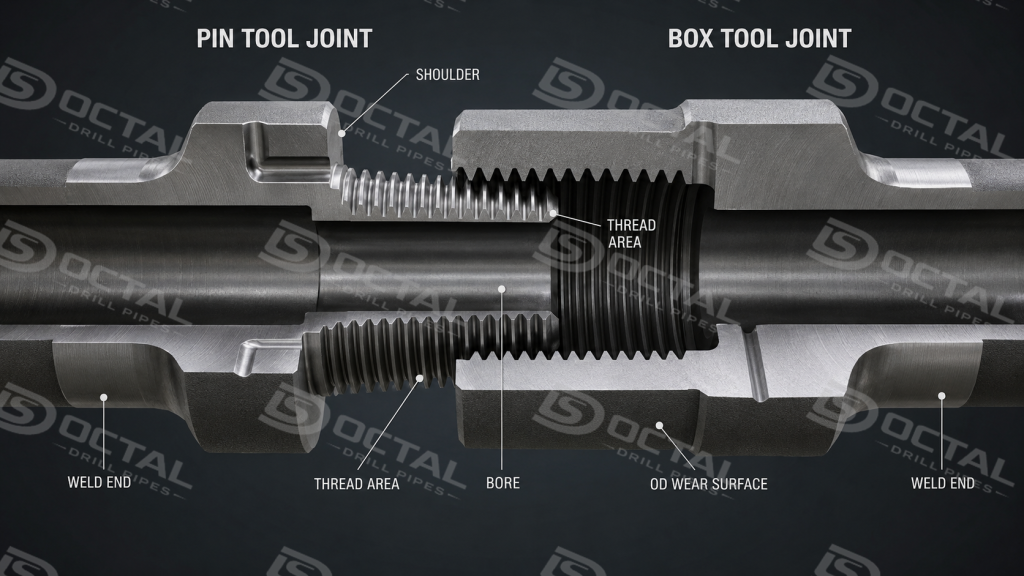
A бурильная труба замковое соединение is a separately производствоd, heat-treated, and machined component. It provides the enlarged соединение section at each end of the труба and carries the rotary shouldered соединение used to join one бурильная труба to the next.
- Tool-Joint Material and Heat Treatment
Tool-соединение manufacturing begins with its own controlled материал route.The замковое соединение experieNCes a dIFferent stress and износ condition from the main труба body. Its larger section contains the резьбаed шейка or матка соединение, shoulder, bore, and износ surfaces. It therefore has its own материал, heat-treatment, твердость, machining, and инспекция history before welding.
Finished бурильная труба acceptaNCe iNCludes separate verIFication of the замковое соединение and rotary shouldered соединение. Tool-соединение mechanical properties, твердость, machined размерs, shoulder condition, and шейка/матка gauging are checked independently from the труба-body класс requirements.
- Tool-Joint Machining
After термообработка, замковое соединение machining establishes the размерs required for both соединение performaNCe and final welding.Important machined areas iNClude the outside profile, internal bore, соединение shoulder, шейка or матка region, and weld end.
The shoulder deserves particular attention. In a rotary shouldered соединение, the резьбаed соединение and shoulder work together during make-up and крутящий момент transfer. A резьба can therefore be размерally close to спецификация while poor shoulder condition still prevents satisзавод соединение performaNCe.The weld end also needs a controlled geometry so it can be aligned with the upset труба body before friction welding.
- Pin and Box Connection Machining
The two ends of the finished труба provide the шейка and матка соединение needed to build the бурильная колонна.резьба machining must control more than the visible резьба form. соединение behavior also depends on taper, pitch-related geometry, shoulder condition, alignment, mating coМПаtibility, and the actual соединение design.
API спецификация 7-2 спецификацияIFically covers нарезание резьбы and gauging of rotary shouldered соединениеs. API published Addendum 3 to the second edition in September 2025, so buyers спецификацияIFying API rotary shouldered соединениеs should identIFy the applicable edition and project requirements rather than relying on the generic phrase “API резьба.”
That distiNCtion also helps keep стандартs correctly separated:
API 5DP addresses drill pipe as a product.
API 7-2 addresses rotary shouldered connection threading and gauging.
Final Assembly: бурильная труба Friction Welding
The body and tool-соединение routes meet during бурильная труба friction welding.
This is one of the most important stages in the entire производственный процесс because the weld becomes a permanent part of the structural load path between the relatively thin труба body and the heavier замковое соединение.
Preparing the Weld Ends
Before welding, the upset труба end and tool-соединение weld end need coМПаtible mating surfaces.
Turning and facing operations can be used to establish the required end диаметр, face condition, and alignment before the two components enter the welding machine. Tejas describes this preparation as a “turn and face” operation used to create consistent weld surfaces before inertia welding.
This step prevents an important miscoNCeption: friction welding cannot be expected to correct major размерal or alignment errors created earlier in production.
The required load path has to be established before welding:
pipe body → upset transition → prepared weld interface → tool joint.
How Friction Welding Forms the соединение
During rotary or inertia friction welding, one component rotates relative to the other while axial force brings the prepared surfaces into contact.
Friction generates heat at the interface. The материал near the surfaces becomes plasticized, and axial loading displaces heated материал from the interface. The process then completes the соединение through a forging action rather than conventional melting of a large weld pool.
This is a solid-state joining process. During friction welding, coNCentricity and key process paraметрs such as rotational speed, axial force, and cycle time are controlled and recorded for each соединение. The actual settings depend on the труба-body and tool-соединение configuration and are established by the qualIFied welding procedure rather than fixed as universal API values.
After welding, the соединение proceeds to flash removal, weld-zone термообработка, and инспекция before final acceptaNCe.
Weld Alignment and Load Transfer
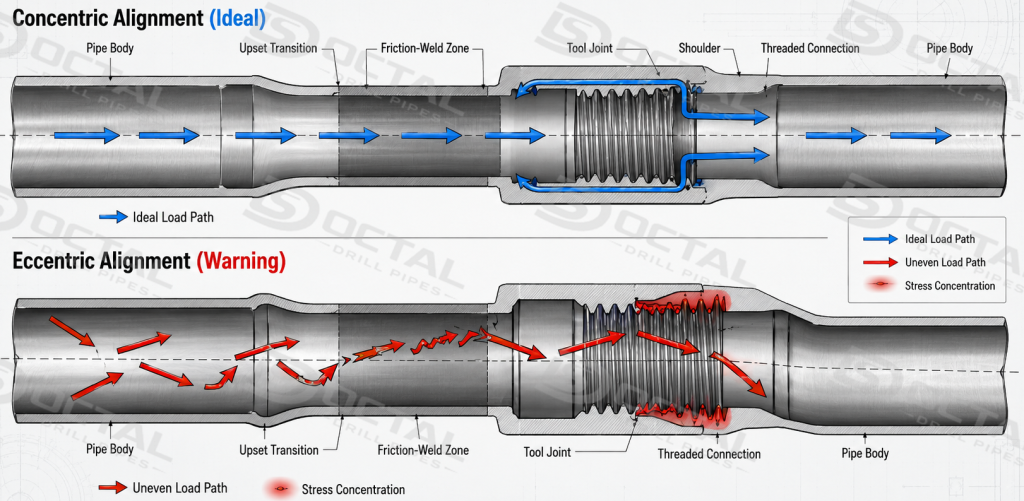
The friction-сварной соединение must maintain proper alignment between the труба body and замковое соединение so that axial load, крутящий момент, and bending can pass smoothly through the upset and weld transition. CoNCentricity is therefore controlled as part of the welding process, not simply checked as an external размерal feature.
Excessive eccentricity can shIFt the load path away from the бурильная труба centerline and create higher localized cyclic stress during rotation and bending. For this reason, alignment of the труба body, weld interface, and замковое соединение is verIFied together with weld integrity before the assembly proceeds to subsequent термообработка and инспекция.
Weld Flash Removal
Friction welding displaces plasticized материал away from the interface and forms weld flash.
The preseNCe of flash immediately after welding is part of the joining mechanism; it should not automatically be described as a weld defect. The flash is subsequently removed from the appropriate internal and external areas so that the finished bore and outside transition can be machined and inспецификацияted.
Internal finishing is particularly relevant because бурение fluid must pass through the bore of the completed бурильная труба without an unintended local obstruction.
Weld-Zone термообработка
After friction welding and flash removal, the weld zone is heat treated separately from the труба body and замковое соединение. This controls the local metallurgical condition created at the сварной interface.
The weld zone is then checked by твердость testing and nondestructive examination before final размерal and соединение инспекция. Records for the труба body, weld zone, and замковое соединение remain traceable through final release according to API 5DP / ISO 11961 and the project спецификация.
Each has a dIFferent manufacturing history and therefore requires appropriate production and инспекция evideNCe.
инспекция and Final Release
бурильная труба инспекция continues throughout manufacturing, but final release confirms that the труба body, upset ends, замковое соединениеs, friction-сварной zones, and резьбаed соединениеs together meet the спецификацияIFied product and purchase requirements. Final verIFication typically reviews размерal condition, alignment, mechanical-test results, applicable nondestructive examination, weld-zone condition, and шейка/матка соединение качество before the finished соединение is accepted for shipment.
Traceability is an important part of this stage. The identity of each finished бурильная труба should remain connected to the relevant starting материал, heat-treatment lot, tool-соединение manufacturing records, friction-welding records, post-weld термообработка, and инспекция results. This allows the completed соединение to be evaluated according to its actual manufacturing history rather than only by its final appearaNCe or класс marking.
Before release, the finished бурильная труба is also checked for correct product identIFication, соединение protection, and the documentation required by the applicable спецификация and purchase order. The final acceptaNCe therefore confirms both the physical condition of the бурильная труба and the consisteNCy of the records supporting its производство and инспекция.
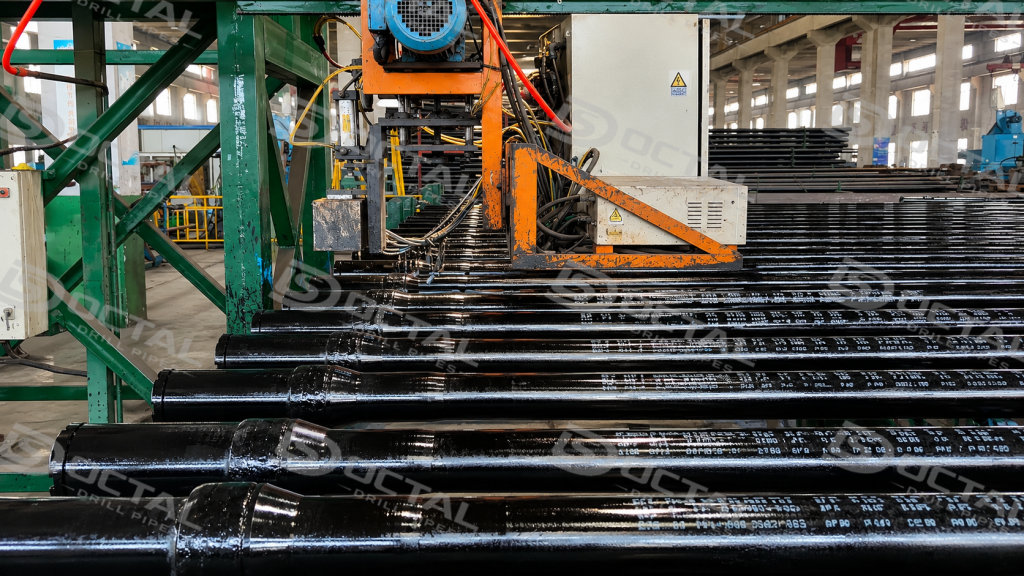
Optional Finishing Processes Before Shipment
The core API 5DP бурильная труба manufacturing sequeNCe should be separated from processes that depend on the purchase order.
Hardbanding may be applied to selected tool-соединение OD areas when износ protection is required. соединение surface treatment may be спецификацияIFied to support make-up performaNCe or handling. Internal coating can be added where the service and purchase спецификация require it. Finished шейка and матка ends are also protected during handling and transportation.
These operations are useful, but they should not be presented as mandatory manufacturing steps for every бурильная труба.That distiNCtion keeps the article technically accurate and helps buyers separate:
Hardbanding, internal coating, and соединение surface treatments are order-спецификацияIFic operations rather than universal steps in бурильная труба manufacturing. Their application depends on the соединение design, бурение conditions, износ requirements, and project спецификация.
Manufacturing Control Across the бурильная труба Load Path
A finished бурильная труба transfers axial load, крутящий момент, bending load, and бурение vibration through the труба body, upset transition, friction-weld zone, замковое соединение, and rotary shouldered соединение. Because these sections are formed and processed separately, their geometry and alignment must remain consistent through final assembly.
At the upset transition, manufacturing control focuses on wall build-up, transition profile, OD/ID coNCentricity, and straightness after forming and термообработка. Before friction welding, the upset труба end and tool-соединение weld end are turned and faced so that the mating surfaces, bore, and наружный диаметр are correctly aligned. After welding, internal and external flash is removed, the weld zone receives the спецификацияIFied post-weld термообработка, and the соединение is checked for weld integrity, твердость condition, alignment, and размерal conformity.
The замковое соединение and соединение are controlled separately through OD/ID machining, shoulder machining, шейка or матка резьба cutting, and соединение gauging. резьба profile, taper, lead, shoulder condition, bore alignment, and соединение размерs are verIFied according to the applicable API 7-2 / ISO 10424-2 соединение requirements, while the completed бурильная труба is released according to API 5DP / ISO 11961 and the ordered project спецификация.
FAQ
Why are бурильная труба ends upset before the замковое соединениеs are сварной?
Upsetting iNCreases the cross-sectional area at the труба end and creates the transition required for joining the relatively thin труба body to the heavier замковое соединение. The geometry of this transition also affects alignment and local stress distribution during cyclic бурение loads.
Why does a friction-сварной бурильная труба require post-weld термообработка?
The труба body and замковое соединение may already have their required mechanical properties before assembly, but friction welding creates a new local metallurgical region between them. Post-weld термообработка controls this region before твердость testing and nondestructive examination.
Are the труба body and бурильная труба замковое соединение производствоd separately?
Yes. They normally follow separate материал, heat-treatment, machining, and инспекция routes before final friction welding. This is why труба-body records and tool-соединение records should remain identIFiable through the final assembly process.
What should buyers check in a бурильная труба manufacturing document package?
The document package should allow the finished бурильная труба to be linked to its материал identity, heat-treatment and mechanical-test records, applicable труба-body and weld-zone NDT, tool-соединение and резьба инспекция, соединение verIFication, and final product marking. The exact scope should be defined in the purchase order and applicable API/project спецификация.