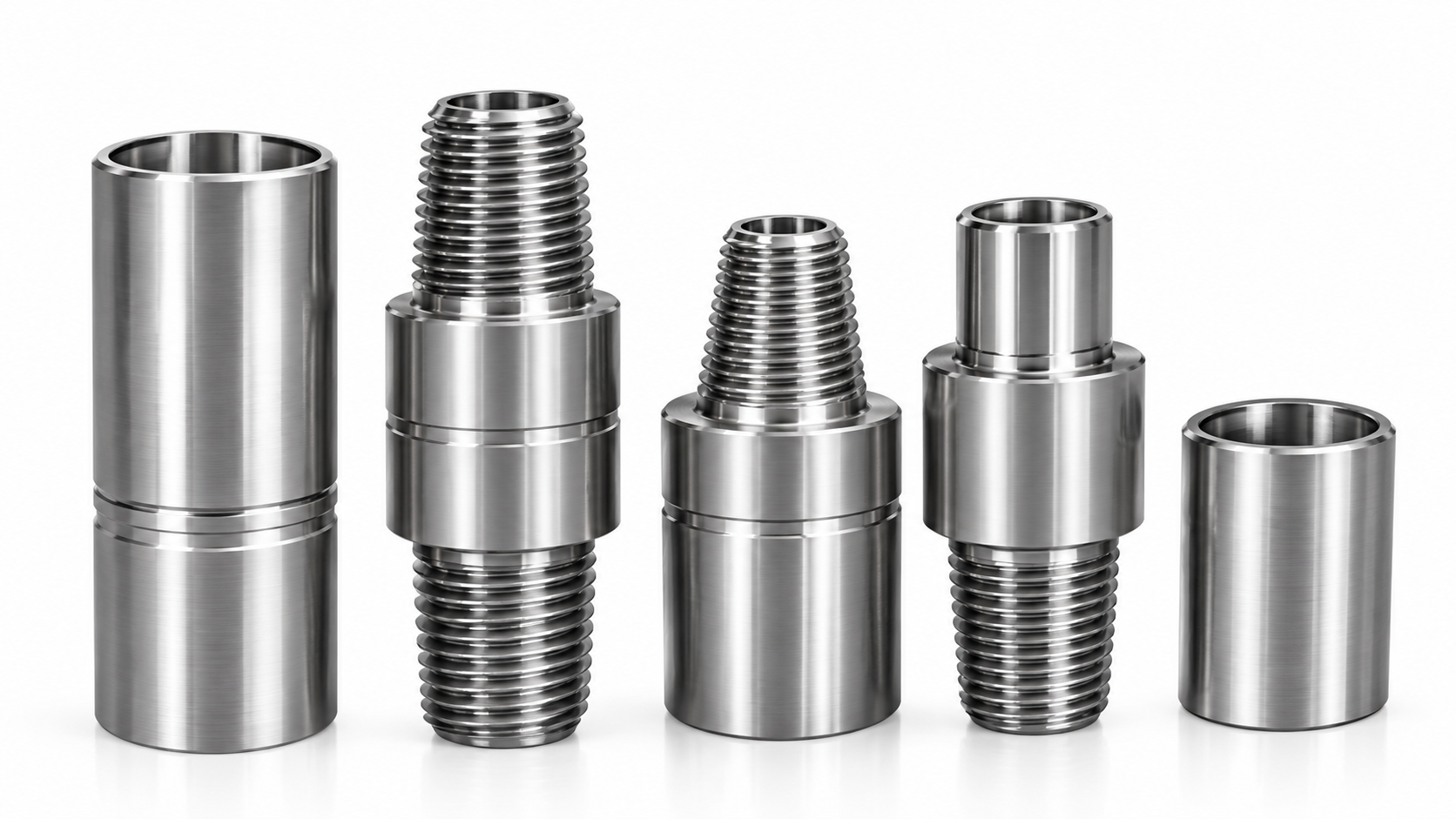
Los accesorios de la sarta de perforación son componentes instalados entre las tuberías de perforación o entre las tuberías de perforación y las tuberías de perforación pesadas para conectar, adaptar y proteger la sarta de perforación.
Common drill pipe accessories and sarta de perforación subs include crossover subs, drill pipe pup joints, bit subs, saver subs, lifting subs, pump-in subs, side entry subs and Kelly valves. Each product performs a different function, so selection starts with three basic questions: where the accessory will be installed, what components it must connect, and what function it must perform.
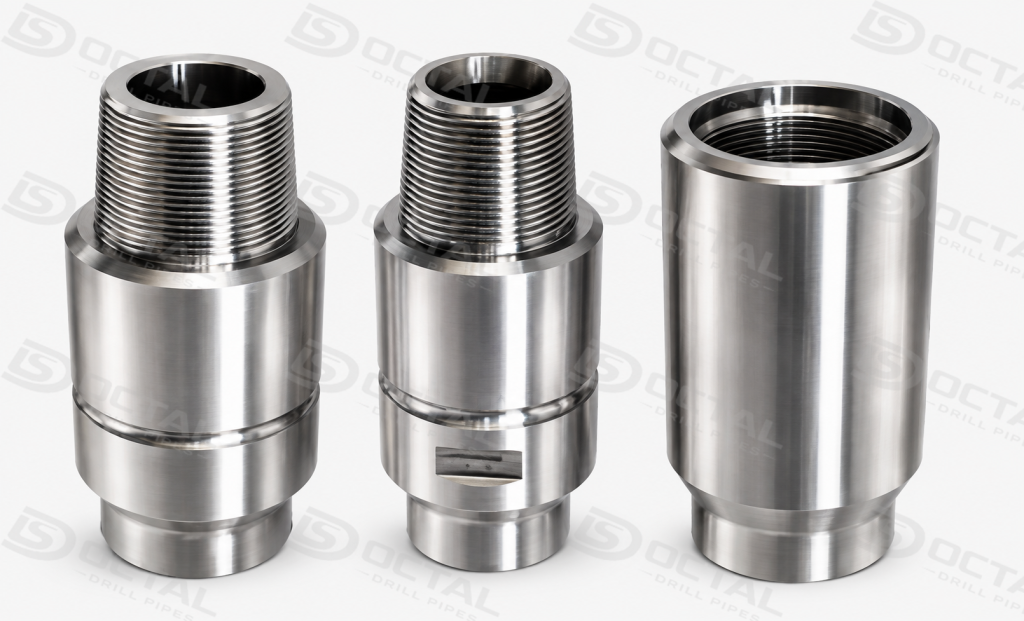
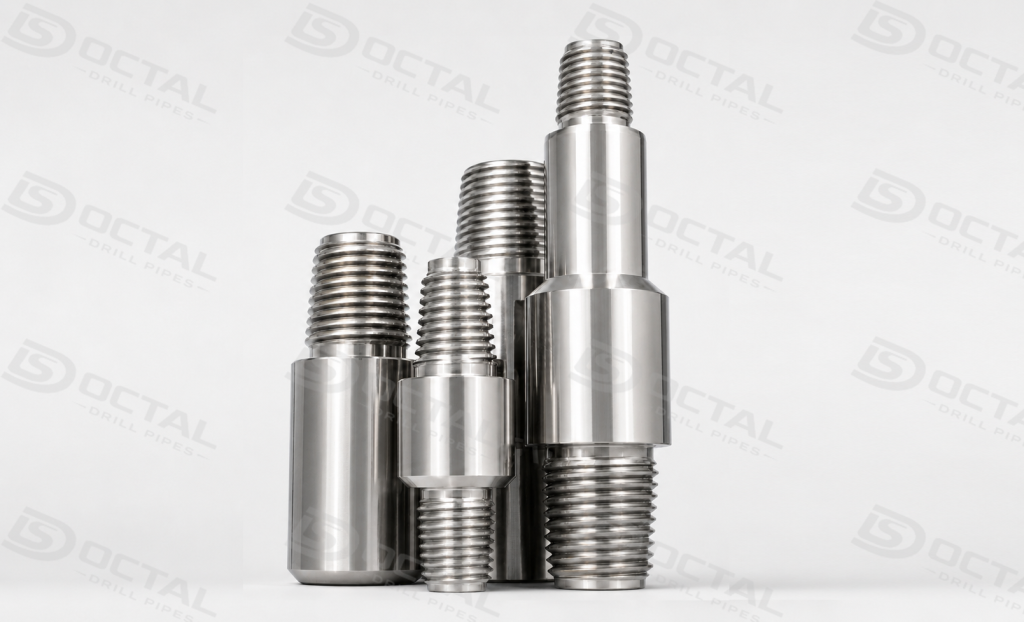
Drill String Accessories and Their Functions
Drill pipe, HWDP and drill collars form the main load-carrying sections of the sarta de perforación, but they cannot cover every connection, spacing, handling and fluid-control requirement encountered during drilling. Sarta de perforación accessories are introduced at specific positions to solve these interface requirements without changing the main tubular configuration. Some accessories adapt one connection to another, some provide a shorter section for string-length adjustment, while others protect frequently used threads, support lifting operations or create a controlled drilling-fluid path. Their function is therefore determined mainly by where they are installed and what problem they solve in the sarta de perforación.
| Accessory | Main Function | Typical Position |
|---|---|---|
| Crossover Sub | Connects two components with different unións | Between tubería de perforación, HWDP, drill collar or BHA tools |
| Drill Pipe Pup Joint | Adds a short section to adjust sarta de perforación length | Within a tubería de perforación or work-string section |
| Bit Sub | Connects the lower BHA or drill collar to the drill bit | Directly above the drill bit |
| Saver Sub | Protects a higher-value unión from repeated wear | Below the top drive or Kelly |
| Lifting Sub / Lift Nubbin | Provides a suitable interface for lifting heavy drill stem components | Drill collars, subs and downhole tools |
| Pump-In Sub | Allows drilling fluid to enter the sarta de perforación through an additional connection | Circulation system |
| Side Entry Sub | Provides a side connection to the sarta de perforación bore | Fluid circulation or intervention configuration |
| Kelly Valve | Opens or closes the perforación-fluid flow path | Kelly and upper sarta de perforación |
These accessories may have similar short, thick-walled bodies, but their functions and selection criteria are different. A crossover sub is selected according to the two connections that must be joined; a pup joint is selected when the string requires a defined shorter length; a saver sub is installed to absorb repeated make-up and break-out wear; and a Kelly valve is used where drilling-fluid flow must be opened or shut off. For this reason, accessory selection should not be based only on outside diameter or general appearance. The required function, installation position, upper and lower connections, internal bore and compatibility with the surrounding sarta de perforación components must be confirmed first.
Types of Drill String Accessories
Sarta de perforación accessories are selected according to the specific problem that must be solved in the string. Connection conversion, string length adjustment, thread protection, bit connection, handling and drilling-fluid control require different components.
Crossover Sub
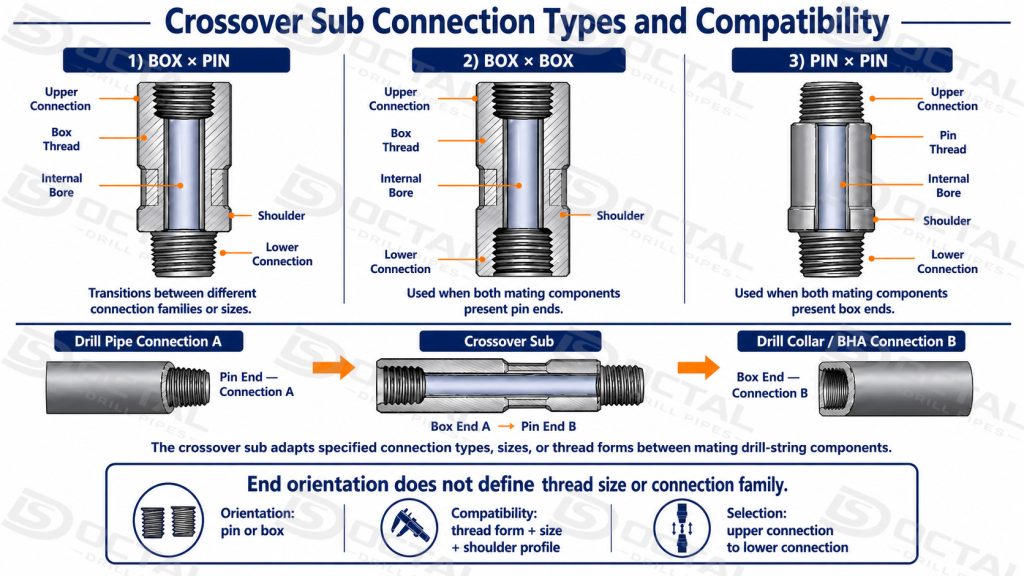
A crossover sub joins sarta de perforación components that cannot connect directly because their thread sizes, connection types or end configurations are different. It is commonly positioned between drill pipe, HWDP, drill collars and BHA tools, allowing each adjoining component to retain its specified connection while the crossover provides the required transition.
Both ends of the sub must therefore be specified independently. Outside diameter alone cannot determine compatibility; the upper and lower connection designations, pin/box orientation, internal bore and adjoining components all need to match the actual sarta de perforación arrangement.
| Configuration | Unión Arrangement | Main Use |
|---|---|---|
| Box × Pin | Box on one end, pin on the other | Connects components requiring opposite end configurations |
| Box × Box | Box unións on both ends | Joins two components presenting pin ends |
| Pin × Pin | Pin unións on both ends | Joins two components presenting box ends |
A Box × Pin, Box × Box or Pin × Pin designation defines only the end orientation and does not identify the actual connection family or thread size. Crossover sub selection therefore requires the exact connection designation at both ends, together with the required OD, internal bore and overall length. These dimensions must match the adjoining drill pipe, HWDP, drill collar or BHA component to maintain sarta de perforación connection compatibility.
Drill Pipe Pup Joint
A drill pipe pup joint provides a shorter drill-string section when a standard drill pipe length does not suit the required spacing or string configuration. It retains the required drill pipe connections while allowing the total string length to be adjusted more precisely.Pup joints are therefore selected as part of the sarta de perforación layout rather than simply by nominal pipe size. The required length must be coordinated with the matching drill pipe, connection dimensions and internal bore.
| Selection Item | Requirement |
|---|---|
| Drill Pipe OD | Match the surrounding tubería de perforación size |
| Unión Type | Match the adjoining tubería de perforación or drill-string component |
| Pin / Box Arrangement | Confirm the required end orientation |
| Internal Bore | Maintain the required fluid passage |
| Overall Length | Meet the planned string spacing |
| Construction | Integral or welded, according to the specified product design |
Pup joint construction may be integral or welded, depending on the required length, connection design and manufacturing route. Integral designs use a continuous forged or machined body, while welded designs combine a pipe body with welded tool-joint ends. The selected construction should remain compatible with the adjoining tubería de perforación in connection geometry, bore and mechanical performance.Overall length is specified together with the connection type and bore so that the pup joint fits the planned drill-string spacing without changing the surrounding tubería de perforación configuration.
Bit Sub
Bit sub connects the lower BHA or drill collar to the drill bit, providing the required connection transition immediately above the bit. Its upper connection matches the BHA component, while the lower connection is machined for the specified bit connection. Selection is mainly based on the upper and lower connections, OD, internal bore and overall length, with the bore maintained for the required drilling-fluid passage through the lower BHA.
Saver Sub
A saver sub is installed between the sarta de perforación and a higher-value connection that is exposed to frequent make-up and break-out. By concentrating repeated connection wear on a replaceable component, it helps protect the threads and shoulders of the top drive or Kelly. The two main configurations are Top Drive Saver Subs and Kelly Saver Subs, selected according to the rig-side connection and the sarta de perforación connection that must be matched.
| Type | Installed Position | Main Function |
|---|---|---|
| Top Drive Saver Sub | Between the top drive and sarta de perforación | Protects the top-drive unión from repeated unión wear |
| Kelly Saver Sub | Between the Kelly and sarta de perforación | Protects the lower Kelly unión during repeated make-up and break-out |
Selection is based first on the connection required at the equipment side and the connection presented by the sarta de perforación, followed by OD, internal bore and overall length to suit the assembly. A saver sub differs from a crossover sub in its primary purpose: the crossover sub adapts incompatible connections, while the saver sub provides a replaceable wear interface for a frequently cycled connection.
Pump-In Sub and Side Entry Sub
Pump-in subs and side entry subs provide an auxiliary fluid connection to the sarta de perforación without interrupting the main threaded connection between the components above and below. A pump-in sub introduces drilling fluid into the internal bore through a dedicated inlet, while a side entry sub provides lateral access to the same flow path. Both are used where the drilling or circulation program requires an additional fluid entry point without changing the basic drill-string arrangement.
Selection is based on the required upper and lower drill-string connections, auxiliary port connection, internal bore, overall length and applicable pressure requirement. The auxiliary connection and bore must be sized for the intended drilling-fluid circulation, while the main end connections remain compatible with the surrounding sarta de perforación. Key specification items include:
- upper and lower drill-string unións;
- pump-in or side-entry port unión;
- internal bore;
- design pressure or working-pressure requirement.
Kelly Valve
A Kelly valve provides a positive means of opening or shutting off fluid flow through the sarta de perforación. It combines rotary drill stem connections with an internal valve mechanism, so its selection involves both connection compatibility and pressure-control requirements.
Upper and lower Kelly valves occupy different positions in the Kelly assembly, but both are used to control the internal drilling-fluid path. The valve should therefore be specified by more than its nominal unión size.
The main information includes:
- upper and lower unións;
- internal bore;
- valve configuration;
- operating and pressure requirements;
- perforación service conditions.
Because a Kelly valve performs a sarta de perforación well-control and flow-control function, pressure-containing parts and operating performance require separate consideration from ordinary solid rotary subs.
Drill String Connection Types and Compatibility
Connection compatibility determines whether a sarta de perforación accessory can be made up correctly with the surrounding components. Matching OD alone is not enough; the upper and lower connection designations, pin/box orientation, thread size, shoulder interface and internal bore must all correspond to the adjoining drill pipe, HWDP, drill collar or BHA tool. These checks are especially important for crossover subs, bit subs, saver subs and pup joints, where a mismatch in connection geometry can prevent proper make-up even when the external dimensions appear suitable.
| Unión Item | What It Controls |
|---|---|
| Upper Unión | Compatibility with the component above |
| Lower Unión | Compatibility with the component below |
| Pin / Box Orientation | Determines how the components make up |
| Unión Type / Size | Defines the actual mating thread |
| Shoulder Interface | Provides correct unión contact after make-up |
| OD | External dimensional compatibility |
| ID / Bore | Internal clearance and perforación-fluid flow |
| Mating Component | Tubería de perforación, HWDP, drill collar, bit or BHA tool |
For accessories using an API or other standardized rotary shouldered connection, the connection designation, thread form, shoulder geometry and applicable gauging requirements must correspond to the mating component. Both ends of crossover subs, bit subs, saver subs and similar rotary subs should therefore be specified independently, because OD and general connection orientation do not define actual interchangeability. Correct compatibility depends on the complete connection data at the upper and lower ends together with the required bore and adjoining sarta de perforación components.
Materials and Heat Treatment for Drill String Accessories
Sarta de perforación subs are commonly manufactured from heat-treated alloy steel to provide the strength and toughness required at threaded connections, shoulders and reduced cross-sections. For crossover subs, saver subs and other integral rotary subs, 4140- and 4145-series alloy steels are commonly used, with the final material condition determined by the connection design, component dimensions and required mechanical properties. Commercial drill-string accessory ranges also commonly specify 4145-modified or 4140 heat-treated steel for crossover and side-entry subs.
The material and manufacturing route should be matched to the accessory construction rather than applied uniformly across the complete product range.
| Accessory Group | Common Construction Approach | Main Material Consideration |
|---|---|---|
| Crossover / Saver / Bit Subs | Integral alloy-steel body with machined unións | Strength and toughness at threads and shoulders |
| Integral Pup Joint | Heat-treated alloy-steel integral body | Mechanical continuity through the complete joint |
| Welded Pup Joint | Pipe body combined with welded end unións | Compatibility with the adjoining tubería de perforación construction |
| Pump-In / Side Entry Sub | Machined alloy-steel body with auxiliary fluid port | Unión load plus pressure-containing section |
| Kelly Valve | Alloy-steel pressure-containing body with internal valve components | Mechanical load, pressure containment and service condition |
For integral tubería de perforación pup joints, 4145H modified steel in a quenched-and-tempered condition is one established manufacturing route, while welded pup joints use a different pipe-body and end-connection construction. Kelly valves likewise require separate material consideration because the body must combine drill-string connection loads with pressure-containing service.
How to Select Drill String Accessories
The easiest way to select a drill string accessory is to start from the job that needs to be performed.
| If You Need To… | Accessory to Consider |
|---|---|
| Connect two different sarta de perforación connections | Crossover Sub |
| Add a short section to adjust sarta de perforación length | Drill Pipe Pup Joint |
| Connect the BHA or drill collar to the bit | Bit Sub |
| Protect the top-drive unión from repeated wear | Top Drive Saver Sub |
| Protect the Kelly unión | Kelly Saver Sub |
| Lift a drill collar or heavy drill stem tool | Lifting Sub / Lift Nubbin |
| Pump fluid into the sarta de perforación | Pump-In Sub |
| Add a side fluid unión | Side Entry Sub |
| Shut off flow inside the sarta de perforación | Kelly Valve |
After identifying the accessory type, the next step is to confirm the unións and dimensions.
A practical selection sequence is:
Function → Installation Position → Upper Unión → Lower Unión → Pin/Box → OD and Bore → Length → Material / Service Requirement
How Drill String Accessories Fit into the Drill String
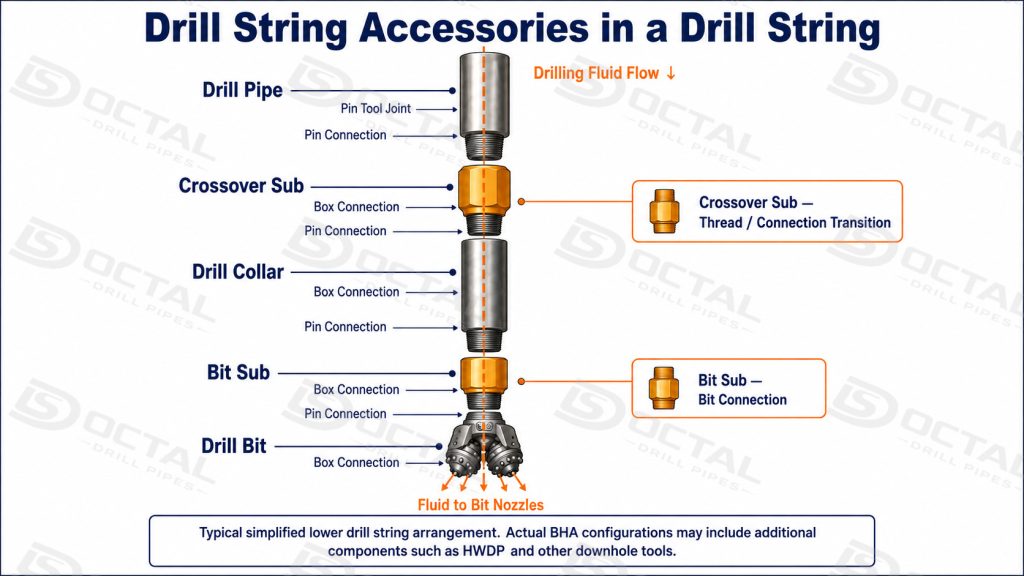
Sarta de perforación accessories work between the main drill stem components rather than replacing them. Drill pipe forms the principal rotating tubular section, heavy weight drill pipe provides the transition toward the stiffer lower string, and drill collars and other BHA components carry the assembly toward the bit. Accessories are added only where the string requires a specific connection change, short-length adjustment, connection protection or fluid-control function.
| Drill String Position | Main Component / Accessory | Function in the Assembly |
|---|---|---|
| Rig-side unión | Top Drive / Kelly + Saver Sub | Transfers rotation into the sarta de perforación while the saver sub protects the frequently cycled connection |
| Main string | Drill Pipe | Transmits rotation, axial load and perforación fluid through the main tubular section |
| Length or unión adjustment | Pup Joint / Crossover Sub | Adjusts string length or connects components with different unións |
| Transition section | Heavy Weight Drill Pipe (HWDP) | Provides a gradual stiffness transition between tubería de perforación and the lower BHA |
| Lower sarta de perforación | Drill Collar / BHA | Adds stiffness and weight near the bit and carries other bottom-hole tools |
| Bit unión | Bit Sub | Connects the lower BHA to the specified drill bit connection |
| Bottom of assembly | Drill Bit | Applies weight and rotary energy to the formation |
The accessory used at each position is determined by the surrounding components and the required function. A crossover sub must match the connections on both sides, a pup joint must fit the planned string length and drill-pipe connection, and a saver sub must match the top-drive or Kelly connection it is intended to protect. In this way, sarta de perforación accessories complete the connection and operating requirements between drill pipe, HWDP and BHA components without changing the basic function of the main sarta de perforación.
Preguntas frecuentes
Q:Can a crossover sub be selected by OD and Box × Pin configuration alone?
A:Can a crossover sub be selected by OD and Box × Pin configuration alone?
A: No. Box × Pin only defines the end orientation. The exact upper and lower connection types, connection sizes, bore and mating drill string components must also be confirmed before the crossover can be specified.
Q:Can a saver sub be used instead of a crossover sub?
A:Not automatically. A crossover sub is primarily used to connect different sarta de perforación connections, while a saver sub provides a replaceable wear connection below a Kelly or top drive. One component should perform both functions only when its connection design is specified for both requirements.
Q: Is an integral tubería de perforación pup joint always better than a welded pup joint?
A: No. Integral and welded pup joints use different construction routes, and the correct choice depends on the specified length, tubería de perforación connection, bore and product design requirements. The construction should match the intended drill-string configuration rather than being selected by one general rule.
Q: Does 4145H material alone define a suitable sarta de perforación sub?
A: No. Material grade is only one part of the specification. A sarta de perforación sub must also match the required connection type, pin/box arrangement, OD, bore, heat-treatment condition and mating components before it can be considered suitable for the intended sarta de perforación.