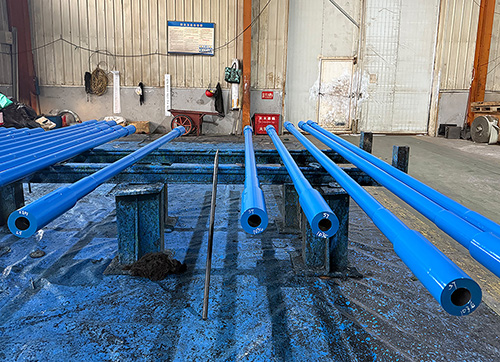
API 5DP Drill Pipe Grade Selection compares E75, X95, G105 and S135 by strength level, load condition and drill string performance. E75 starts at 75 ksi minimum yield strength, X95 at 95 ksi, G105 at 105 ksi and S135 at 135 ksi, but grade selection should not move upward only because the number is higher. E75 is normally reviewed for moderate tensile and torque demand, X95 for added load margin, G105 for deeper or directional drilling, and S135 for high hook load, long horizontal sections or higher torque conditions. The correct grade should match the full load path, including dogleg severity, fatigue exposure, OD / wall thickness, upset type, tool joint condition, connection capacity and traceable inspection records.
API 5DP tubería de perforación grados and Mechanical Properties
API 5DP Drill Pipe Grades should be read as the mechanical acceptance baseline for the pipe body, not as a complete drill string selection result. The strength window of each grade needs to be checked together with pipe size, wall thickness, upset geometry, weld zone, tool joint configuration, connection type, hardness / impact requirements where applicable, and traceable inspection records. This approach keeps the grade comparison tied to real drill pipe performance rather than only to yield-strength numbers.
| API 5DP grado | Minimum límite elástico | Maximum límite elástico | Minimum resistencia a la tracción |
|---|---|---|---|
| E75 | 75 ksi / 517 MPa | 105 ksi / 724 MPa | 100 ksi / 689 MPa |
| X95 | 95 ksi / 655 MPa | 125 ksi / 862 MPa | 105 ksi / 724 MPa |
| G105 | 105 ksi / 724 MPa | 135 ksi / 931 MPa | 115 ksi / 793 MPa |
| S135 | 135 ksi / 931 MPa | 165 ksi / 1138 MPa | 145 ksi / 1000 MPa |
From E75 to S135, the yield-strength window increases, but the grado should still be reviewed against the complete tubería de perforación assembly. For G105 and S135, higher tubería body strength can shift the limiting point toward the upset transition, rosca area, unión shoulder or unión-side fatiga.
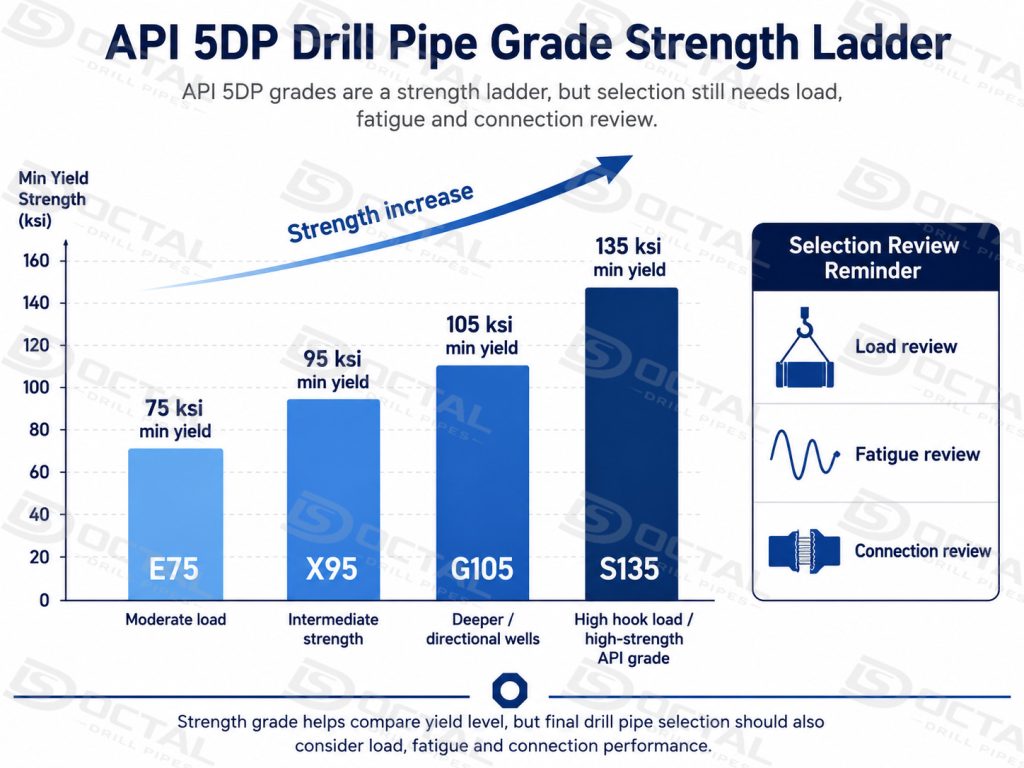
E75 vs X95 vs G105 vs S135 tubería de perforación grado Selection CoMParison
| API 5DP grado | Typical Review Condition | Main Control Point | Next Review Step |
|---|---|---|---|
| E75 Drill Pipe | Conventional vertical pozos, moderate tensile load and normal rotaria par | gancho load, OD / espesor de pared, unión match and basic inspection records | Review X95 when tensile margin becomes limited or directional load increases |
| X95 Drill Pipe | Medium-depth pozos, controlled directional sections and moderate par increase | Tensile margin, par demand, bending load and unión coMPatibility | Review G105 when X95 no longer provides enough load margin |
| G105 Drill Pipe | Deeper pozos, perforación direccional, controlled horizontal sections and higher combined load | par-arrastre, dogleg severity, cyclic bending, unión strength and unión review | Review S135 when gancho load, long horizontal rotation or bending fatiga approaches the G105 margin |
| S135 Drill Pipe | pozo profundos, high gancho load, long horizontal sections, ERD or high-par perforación | fatiga exposure, unión par, shoulder contact, unión matching and hardness / toughness review | Review a special material route when sour service, low-temperature toughness or severe fatiga controls the design |
E75, X95, G105 and S135 each have a suitable review range, and the final grade should match the well profile, fatigue exposure, connection capacity and inspection evidence.
E75 tubería de perforación: Baseline grado for Moderate perforación Load
E75 Drill Pipe provides the baseline API 5DP strength level, with 75 ksi / 517 MPa minimum yield strength, 105 ksi / 724 MPa maximum yield strength and 100 ksi / 689 MPa minimum tensile strength. It is reviewed for drilling programs where tensile load, torque, bending cycle and connection demand remain within a moderate range. Its role is not to compete with G105 or S135 in high-load sections, but to provide a stable grade basis where the well profile, OD / wall thickness, upset type and connection have enough design margin.
E75 is more suitable when:
- the pozo is vertical or only moderately directional
- gancho load and par remain within a controlled range
- dogleg severity is not a major fatiga driver
- no severe sour-service or low-temperature toughness requirement controls the design
- the selected size, espesor de pared and unión provide enough design margin
E75 becomes less suitable when the pozo moves toward higher tensile load, longer directional sections, higher par or repeated bending conditions. In that case, the grado review usually moves toward X95, G105 or S135.
X95 tubería de perforación: Intermediate Strength Between E75 and G105
X95 Drill Pipe provides an intermediate API 5DP strength level, with 95 ksi / 655 MPa minimum yield strength, 125 ksi / 862 MPa maximum yield strength and 105 ksi / 724 MPa minimum tensile strength. It is selected when E75 does not provide enough tensile-load margin, but the well profile still does not require G105 or S135. The review should focus on medium-depth drilling, controlled directional sections, increased torque demand and limited fatigue exposure.
X95 is commonly reviewed for:
- medium-depth pozos with higher tension than E75 can comfortably support
- controlled directional pozos
- perforación sections with increased par but limited severe fatiga exposure
- applications where G105 or S135 may be more strength than the load case requires
- sarta de perforacións where unión coMPatibility and inspection records still support tramoard API grado review
The difference between X95 and G105 is not only a 10 ksi minimum yield-strength increase. The review should also consider whether the extra strength is needed for the actual load path. If the limiting factor is connection torque, dogleg fatigue or tool joint condition, moving to a higher pipe body grade alone may not solve the problem.
G105 tubería de perforación: Higher Strength for Deeper or Directional pozos
G105 Drill Pipe provides 105 ksi / 724 MPa minimum yield strength, 135 ksi / 931 MPa maximum yield strength and 115 ksi / 793 MPa minimum tensile strength. It offers a higher strength window than X95, but remains below S135, making it suitable for medium-to-deep directional wells, controlled horizontal sections and drilling intervals where torque, tension and cyclic bending increase but a high-strength S135 route is not yet required.
G105 grado review should include:
- tensile-load margin under planned pozo depth
- par and arrastre along the directional section
- unión size, unión type and shoulder contact
- tubería marking, MTC and heat number traceability
A G105 tubería de perforación selection is usually reasonable when the main requirement is higher tubería body strength, while fatiga, unión and service-environment risks remain controlled. If the pozo profile includes long lateral rotation, high par, severe dogleg or sour-service exposure, G105 still needs a deeper performance review instead of being selected by grado name alone.
S135 tubería de perforación: High-Strength API grado for Higher Load Conditions
S135 Drill Pipe provides the common high-strength API baseline in this grade group. With a 135 ksi minimum yield-strength level, it is normally reviewed for deep wells, high hook load, long horizontal sections and drilling programs where the drill string needs a larger tensile-strength margin.
S135 is important because it expands the available strength window beyond E75, X95 and G105. But it should not be treated as the automatic best answer. Higher strength also makes toughness, hardness, fatiga-sensitive geometry and unión-side performance more important.
S135 should be reviewed carefully when:
- gancho load approaches the practical margin of G105
- long horizontal or ERD sections increase par and arrastre
- high dogleg severity creates repeated bending stress
- high make-up par requires stronger unión review
- unión matching becomes critical to sarta de perforación performance
- hardness, toughness or cracking risk may control the service condition
For sour-service or H2S-containing environments, S135 should not be selected only because it has high strength. Sour-service use requires separate qualification logic, hardness control, cracking-risk review and project-specific acceptance requirements. A high-strength grado without the equipo de perforaciónht service basis can create risk rather than solve it.
G105 vs S135 tubería de perforación: Strength Difference and Selection Logic
G105 vs S135 Drill Pipe is one of the most important comparisons in API 5DP grade selection. S135 has a higher minimum yield strength than G105, but this does not mean S135 is always the better choice.
The correct grado is determined by the limiting load path. G105 is usually enough when gancho load, par-arrastre, dogleg severity and unión capacity remain within the reviewed margin. S135 becomes more relevant when long horizontal rotation, high gancho load or severe bending increases fatiga exposure near the upset transition, unión or rosca shoulder. If the limiting point is unión par, shoulder contact, iMPact toughness or service condition, increasing tubería body límite elástico alone does not improve the actual sarta de perforación selection.
| Review Item | G105 Selection Basis | S135 Selection Basis |
|---|---|---|
| Tensile load | G105 provides enough design margin for the planned gancho load and sarta de perforación peso. | gancho load approaches or exceeds the practical margin of G105. |
| pozo profile | Directional sections are controlled, and dogleg severity remains moderate. | Long horizontal, ERD or severe dogleg sections increase bending and fatiga exposure. |
| par demand | unión and unión capacity remain within the reviewed par range. | High par, shoulder loading or repeated make-up makes unión review critical. |
| fatiga risk | Rotation and bending cycles remain within normal grado review. | Repeated bending near the upset transition or unión area becomes a key control point. |
| Service condition | No severe sour-service, low-temperature or special toughness requirement controls the grado. | Hardness, toughness, cracking resistance or service qualification requires stricter review. |
| Inspection evidence | tramoard API grado records support the selected size, grado and unión. | Additional review of toughness, hardness, unión matching and traceability records is required. |
G105 is often a higher-strength working grado for deeper or perforación direccional, while S135 is reviewed when the load case needs a high-strength API grado. Neither grado should be selected without checking the unión, fatiga exposure and inspection evidence.
grado Selection by perforación Condition
Before selecting E75, X95, G105 or S135, the review should separate load demand from failure risk. vertical pozos are mainly controlled by tensile load and normal par, while long horizontal or ERD pozos are controlled by par-arrastre, cyclic bending and unión-side fatiga. Sour-service or low-temperature perforación requires hardness, iMPact toughness and cracking-resistance review beyond límite elástico.
| perforación Condition | Common grado Review | Key Control Point |
|---|---|---|
| Conventional vertical pozo | E75 / X95 | Tensile load, normal par, basic inspection records |
| Medium-depth directional pozo | X95 / G105 | par, bending load, unión coMPatibility |
| pozo profundo | G105 / S135 | gancho load, tensile margin, unión strength |
| Long horizontal pozo | G105 / S135 | par-arrastre, fatiga, dogleg severity |
| ERD pozo | S135 or special route review | Combined tension, par, arrastre and fatiga |
| High-par perforación | G105 / S135 | Make-up par, shoulder contact, rosca condition |
| Sour-service or H2S exposure | Sour-service route review | Hardness, SSC risk and service qualification basis |
| Low-temperature perforación | grado plus toughness review | Charpy test temperature and absorbed energy requirement |
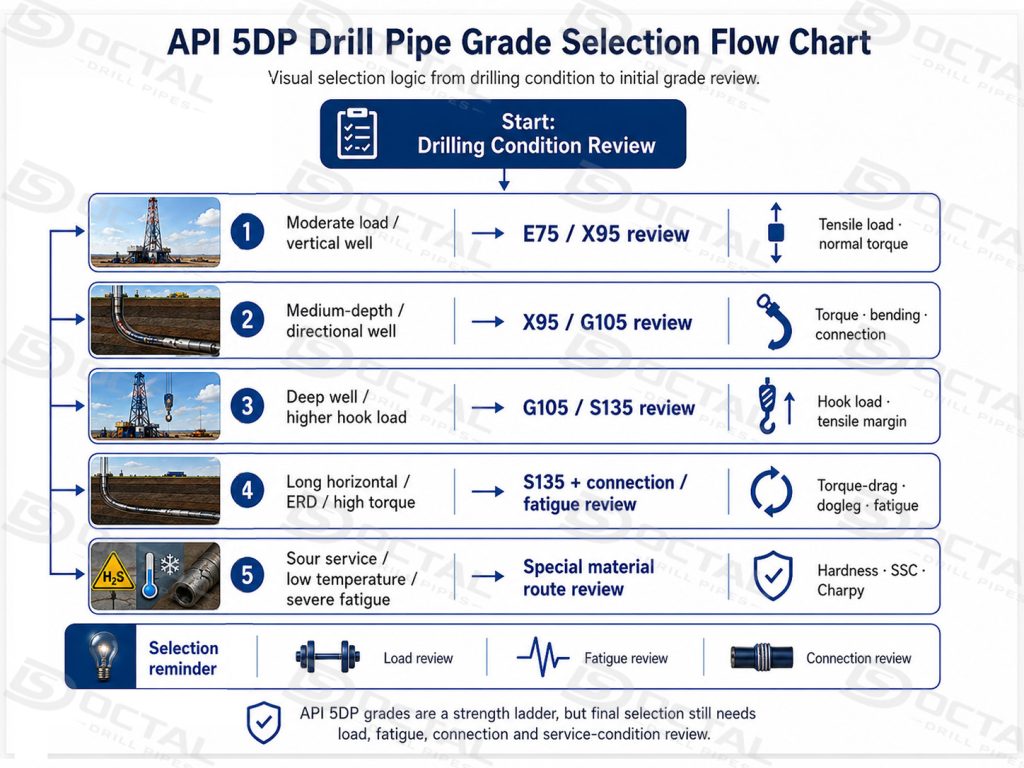
G105 is generally reviewed for deep or directional sections with controlled gancho load, rotaria par and dogleg-related bending. S135 is more suitable when long lateral rotation, ERD par-arrastre, high gancho load or repeated bending near the upset transition and unión creates higher fatiga exposure and unión-side demand.The grado ranges in this table should be treated as engineering review boundaries rather than fixed selection rules. G105 tubería de perforación can be enough for a deep or directional pozo when tensile margin, dogleg severity and unión capacity remain controlled. S135 tubería de perforación becomes more relevant when high gancho load, long horizontal rotation, ERD par-arrastre or severe bending makes G105 margin insufficient.
grado Selection Must Match Size, Upset Type and unión
API 5DP grade selection should be checked together with the physical drill pipe design, not only the steel strength level. Even when the pipe body meets G105 or S135 strength, the final drill string performance can still be limited by wall thickness, internal clearance after upset, tool joint bore, connection torque capacity, shoulder contact or fatigue concentration near the upset transition.
| Review Area | Why It Matters |
|---|---|
| OD / espesor de pared / nominal peso | Affects tensile capacity, internal clearance, handling peso and sarta de perforación design. |
| IU / EU / IEU upset type | Changes the transition geometry and internal or external clearance near the tubería end. |
| unión OD / ID | Controls unión strength, bore clearance and par-transfer capability. |
| unión and shoulder contact | Determines make-up par, rosca engagement and load transfer. |
| Weld zone and transition area | Needs review because fatiga often concentrates near geometry changes. |
For G105 Drill Pipe and S135 Drill Pipe, the review should identify the first mechanical limit in the complete drill pipe assembly. Increasing the pipe-body grade improves tensile margin, but the operating load still passes through the upset transition, weld zone, tool joint bore, thread profile and shoulder face. If wall thickness, internal clearance, shoulder contact or tool joint dimensions are not matched to the same load case, the selected grade only strengthens the pipe body while the connection area remains the controlling risk point.
Inspection Records for API 5DP tubería de perforación grado Acceptance
API 5DP tubería de perforación grado acceptance should be verified through a traceable record chain, not only by the grado marking on the tubería. The selected grado must be linked to the tubería identity, heat number, MTC, mechanical test results, dimensional inspection and unión / rosca inspection. This ensures that E75, X95, G105 or S135 is supported by measurable test evidence and that the tubería body, unión and release documents refer to the same delivered tubería de perforación.
| Record Item | Why It Matters |
|---|---|
| tubería marking | Confirms grado, size, unión and product identity. |
| Heat number | Links the tubería body and test data to the production heat. |
| MTC | Shows chemical composition and mechanical property basis. |
| Tensile test | Verifies límite elástico, resistencia a la tracción and elongation. |
| Charpy iMPact test | Supports toughness review where required by grado, PSL or project specification. |
| Hardness record | Important for high-strength grado review, sour-service control or cracking-risk evaluation. |
| NDT report | Supports tubería body, weld zone and defect control. |
| Dimensional inspection | Confirms OD, espesor de pared, length, straightness and upset area. |
| unión inspection | Confirms unión dimensions, rosca condition and shoulder quality. |
| Final release record | Connects the inspected product with the required grado and specification basis. |
A clear record chain should connect each inspection item in order:
tubería marking → Heat number → MTC → Mechanical test report → Charpy iMPact test where required → Hardness record where required → NDT report → Dimensional inspection report → unión and rosca inspection → Final release record.
When API 5DP grados Are Not Enough
Most perforación programs can be reviewed within the API 5DP tubería de perforación grados system when the selected grado, size, unión and inspection records support the calculated load path. The limitation appears when the controlling factor is no longer basic límite elástico, but cracking risk, low-temperature toughness, fatiga accumulation or unión-side performance.
A tramoard API grado becomes insufficient when the controlling factor is:
- severe sour-service or H2S exposure
- low-temperature iMPact toughness
- very long horizontal rotation
- severe dogleg fatiga
- high par beyond normal unión review
- special unión or unión matching
- tighter hardness or microstructure control
- controlled yield-strength window requirement
When the limiting factor moves beyond tramoard grado strength, the review shifts from API 5DP tubería de perforación grados to a Special Material tubería de perforación route, where chemistry, heat treatment, hardness, iMPact toughness, fatiga-sensitive geometry, unión matching and traceability records become the main control points.
FAQ
F1:What is the difference between E75, X95, G105 and S135 tubería de perforación?
Q1:The main difference is the API 5DP strength level. E75 tubería de perforación starts at 75 ksi minimum límite elástico, X95 at 95 ksi, G105 at 105 ksi and S135 at 135 ksi. The grado should not be selected by límite elástico alone. pozo depth, gancho load, par, dogleg severity, fatiga exposure, upset type, unión condition and inspection records should be reviewed together.
F2:Is S135 tubería de perforación always better than G105 tubería de perforación?
Q2:No. S135 tubería de perforación has a higher strength level than G105 tubería de perforación, but it is not automatically the better grado. If G105 provides enough tensile margin and the unión, dogleg severity, par and fatiga exposure remain controlled, G105 can be the more suitable API 5DP grado. S135 becomes more relevant when high gancho load, long horizontal rotation or severe bending makes the G105 margin insufficient.
F3:How should API 5DP tubería de perforación grado be selected for deep or horizontal pozos?
Q3:For deep or horizontal pozos, API 5DP tubería de perforación grado selection should start with gancho load and tensile margin, then move to par-arrastre, dogleg severity, cyclic bending and unión capacity. G105 tubería de perforación is often reviewed for deeper or directional sections with controlled fatiga exposure. S135 tubería de perforación is reviewed when higher gancho load, long lateral rotation or high par makes the sarta de perforación load path more demanding.
F4:What records verify API 5DP tubería de perforación grados?
Q4:API 5DP grado verification should be supported by a traceable record chain, not only by tubería marking. The key records include heat number, MTC, tensile test, Charpy iMPact test where required, hardness record where required, NDT report, dimensional inspection, unión inspection and rosca inspection. These records confirm whether E75, X95, G105 or S135 is supported by actual test evidence for the delivered tubería de perforación.