What Are API 5DP Drill Pipe Grades?
API 5DP drill pipe grades define the mechanical strength level of the drill pipe body used in rotary drilling operations. The standard applies to steel drill pipe with upset pipe-body ends and weld-on tool joints, and it is organized under PSL-1, PSL-2 and PSL-3 product specification levels. In common oilfield drilling systems, API 5DP drill pipe is classified by grades such as E75, X95, G105 and S135, with typical sizes from 2-3/8″ to 6-5/8″, upset types such as IU, EU and IEU, and rotary shouldered connections such as NC, IF, FH and REG.
The number in each grade represents the specified minimum yield strength in thousands of psi. E75 starts at 75,000 psi, X95 at 95,000 psi, G105 at 105,000 psi, and S135 at 135,000 psi. This strength level affects how the drill pipe handles tensile load, rotary torque, internal pressure, bending stress and repeated fatigue cycles while transmitting drilling fluid and rotation between the rig and the bit.
In field application, the grade is only one part of the drill string performance picture. A vertical well with moderate hook load may use E75 or X95, while deeper wells, directional sections and long horizontal intervals often rely on G105 or S135 after torque demand, dogleg severity, fatigue exposure and connection capacity are evaluated. The strongest grade is not automatically the safest choice; drill pipe reliability also depends on tool joint condition, thread shoulder integrity, weld-zone quality, hardbanding condition, handling marks, corrosion pits and complete inspection records.
API 5DP Drill Pipe Grade Chart
The main mechanical difference between E75, X95, G105 and S135 drill pipe is the yield and tensile strength of the drill pipe body. The following values are based on API 5DP / ISO 11961 tensile requirements for drill-pipe-body grades.
| Drill Pipe Grade | Minimum Yield Strength | Maximum Yield Strength | Minimum Tensile Strength | Practical Meaning |
|---|---|---|---|---|
| E75 | 75,000 psi / 517 MPa | 105,000 psi / 724 MPa | 100,000 psi / 689 MPa | Conventional drilling, moderate load, controlled well profile |
| X95 | 95,000 psi / 655 MPa | 125,000 psi / 862 MPa | 105,000 psi / 724 MPa | Higher load than E75, transition grade for more demanding wells |
| G105 | 105,000 psi / 724 MPa | 135,000 psi / 931 MPa | 115,000 psi / 793 MPa | Deep wells, higher tensile load, directional drilling with fatigue control |
| S135 | 135,000 psi / 931 MPa | 165,000 psi / 1138 MPa | 145,000 psi / 1000 MPa | High-tension, high-torque, extended reach and complex well profiles |
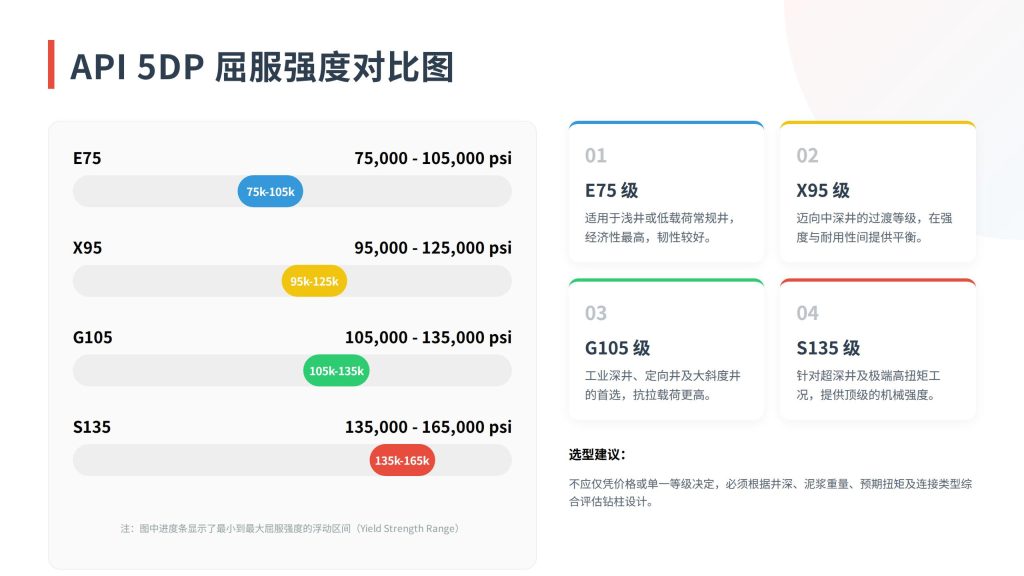
The grade table shows the mechanical strength gap between E75, X95, G105 and S135 drill pipe, but grade comparison should not stop at yield strength. In real drilling conditions, the pipe body works under combined tension, torque, internal pressure and bending load. When the well profile includes high rotary torque, long horizontal displacement, severe dogleg, heavy mud weight or repeated bending cycles, the grade must be evaluated together with connection capacity, tool joint condition, fatigue exposure and inspection scope.
E75 Drill Pipe
E75 drill pipe is the lowest strength level among the common API drill pipe grades, but it is not a low-quality grade. Under API 5DP / ISO 11961 mechanical requirements, E75 has a minimum yield strength of 75,000 psi / 517 MPa, a maximum yield strength of 105,000 psi / 724 MPa, and a minimum tensile strength of 100,000 psi / 689 MPa. This strength window makes it suitable for drilling sections where the drill string is not exposed to extreme tension, high rotary torque, or long-cycle bending fatigue.
E75 is commonly used in controlled drilling conditions such as:
- conventional vertical wells with moderate hook load and limited overpull risk
- shallow to medium-depth sections with a simple well trajectory
- surface or intermediate hole sections where torque and drag remain low
- workover or service operations under controlled rotary and reciprocating loads
- low dogleg severity wells with limited bending fatigue
The practical value of E75 is its balanced mechanical behavior under moderate service loads. Compared with higher-strength grades, it is generally less aggressive in strength design and can be suitable where the well profile does not require the load margin of X95, G105, or S135. However, the grade still has to be checked against combined tension, torque, internal pressure, bending stress, and connection capacity. If long horizontal displacement, severe dogleg, high mud weight, heavy drag, or frequent overpull becomes part of the drilling condition, X95 or G105 may provide a more suitable strength margin.
X95 Drill Pipe
X95 drill pipe is a higher-strength API 5DP grade with a minimum yield strength of 95,000 psi / 655 MPa, a maximum yield strength of 125,000 psi / 862 MPa, and a minimum tensile strength of 105,000 psi / 724 MPa. Compared with E75, X95 provides a wider strength margin for drilling sections where hook load, torque, drag, or well depth begins to exceed conventional service conditions, but where the high-strength range of G105 or S135 is not yet required.
X95 is commonly used in drilling conditions such as:
- deeper vertical wells where E75 may leave limited tensile margin
- intermediate hole sections with higher mud weight and longer drill string length
- moderate directional wells where torque and drag increase beyond straight-hole drilling
- controlled dogleg sections where bending fatigue exists but remains manageable
- intervals that need higher pipe body strength while connection and handling conditions stay stable
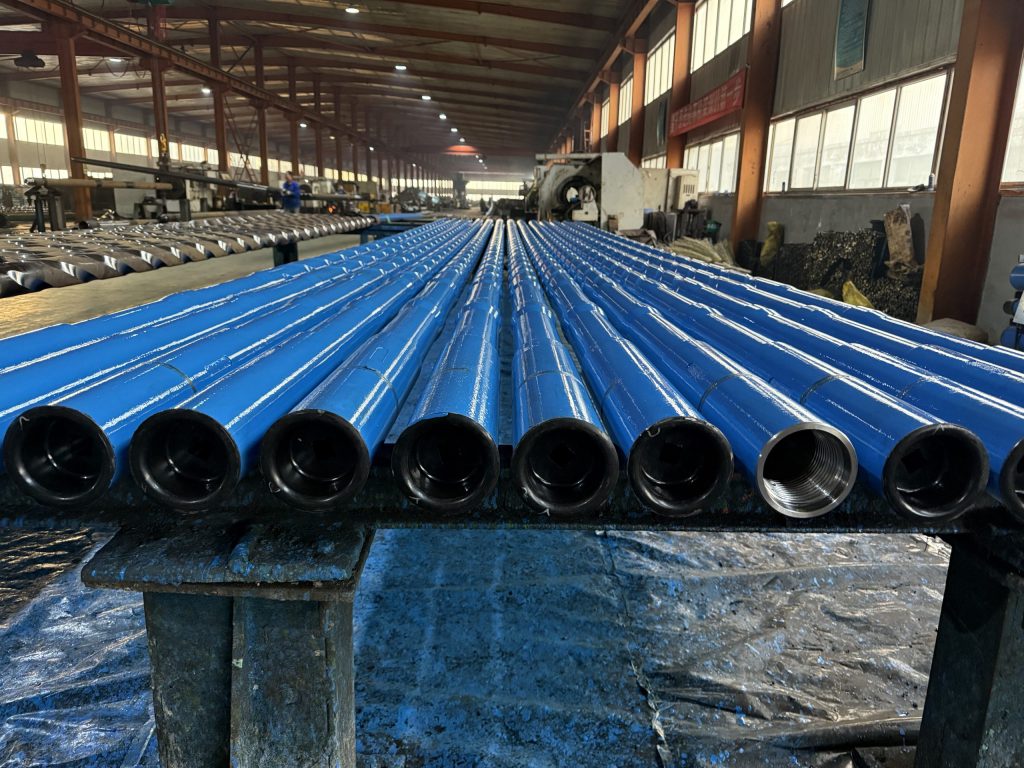
X95 can be understood as a transition grade between conventional and high-strength drill pipe. Its value is not simply that it is stronger than E75, but that it provides additional yield margin without moving directly into the higher strength window of G105 or S135. In field evaluation, X95 should still be checked against combined tension, rotary torque, internal pressure, dogleg severity, connection capacity, and inspection records. If the well includes long horizontal displacement, high overpull, severe cyclic bending, or high-torque rotary drilling, G105 or S135 may provide a more suitable performance margin.
G105 Drill Pipe
G105 drill pipe has a minimum yield strength of 105,000 psi and a minimum tensile strength of 115,000 psi. It is a common high-strength grade for deeper wells, directional drilling and drilling programs with higher working loads.
G105 is often selected when the drill string needs more tensile capacity than X95, but S135 may not be necessary or may create unnecessary cost and handling sensitivity. In real drilling operations, G105 is often valued because it offers a practical balance between strength, fatigue control and service reliability.
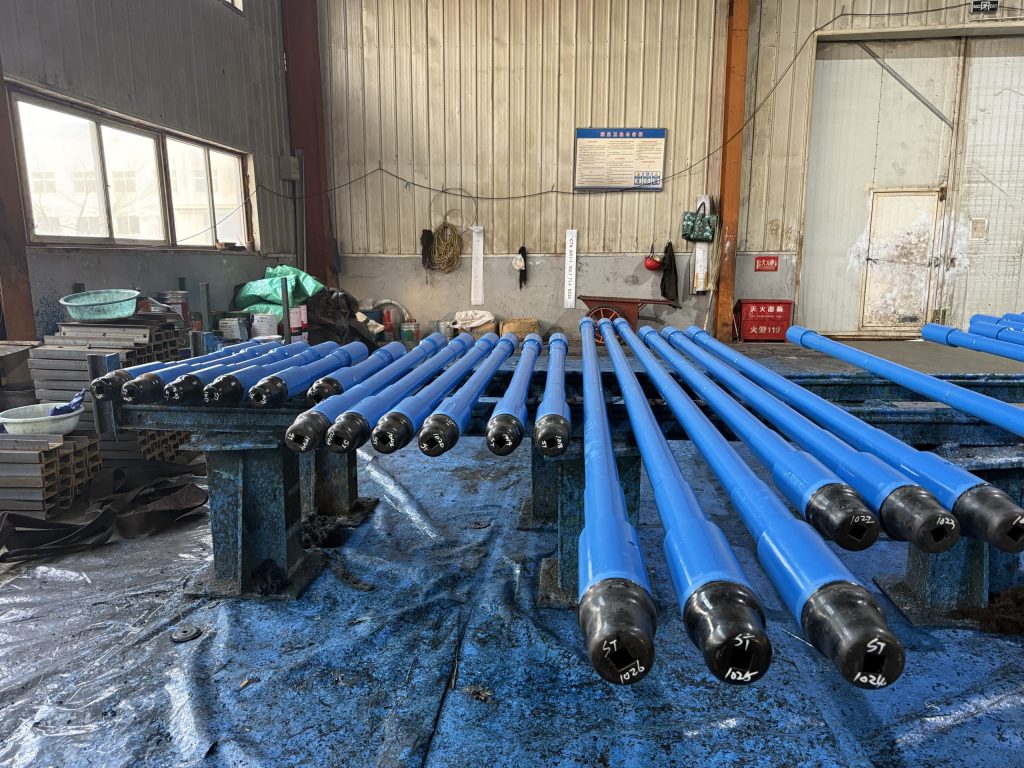
G105 is commonly used in higher-load drilling conditions such as:
- deep vertical wells requiring more tensile margin than E75 or X95
- directional wells where axial tension and bending fatigue occur together
- build-and-hold sections with increased torque and drag
- intermediate or production holes with heavier mud weight and longer drill string length
- intervals where fatigue risk around the upset area, tool joint shoulder, slip area, and hardbanding zone needs closer review
For G105 drill pipe, the main field concern is not only whether the pipe body has enough yield capacity. Fatigue can start from slip marks, thread shoulder damage, corrosion pits, hardbanding defects, or abrupt stress transitions near the upset area, especially in directional wells with repeated bending cycles.
S135 Drill Pipe
S135 drill pipe is the highest-strength grade among the common E75, X95, G105 and S135 group. It has a minimum yield strength of 135,000 psi and a minimum tensile strength of 145,000 psi. It is commonly considered for high-tension, high-torque and complex drilling profiles where the lower grades do not provide enough margin.
S135 is typically reviewed for:
- deep and ultra-deep wells with high suspended string weight
- long horizontal or extended-reach sections with high torque and drag
- drilling under combined tension, torsion, and bending load
- high-hook-load intervals with higher overpull risk
- complex directional wells with severe dogleg or long build-and-hold sections
- wells where fatigue control around the upset area, tool joint shoulder, slip area, and hardbanding zone is critical
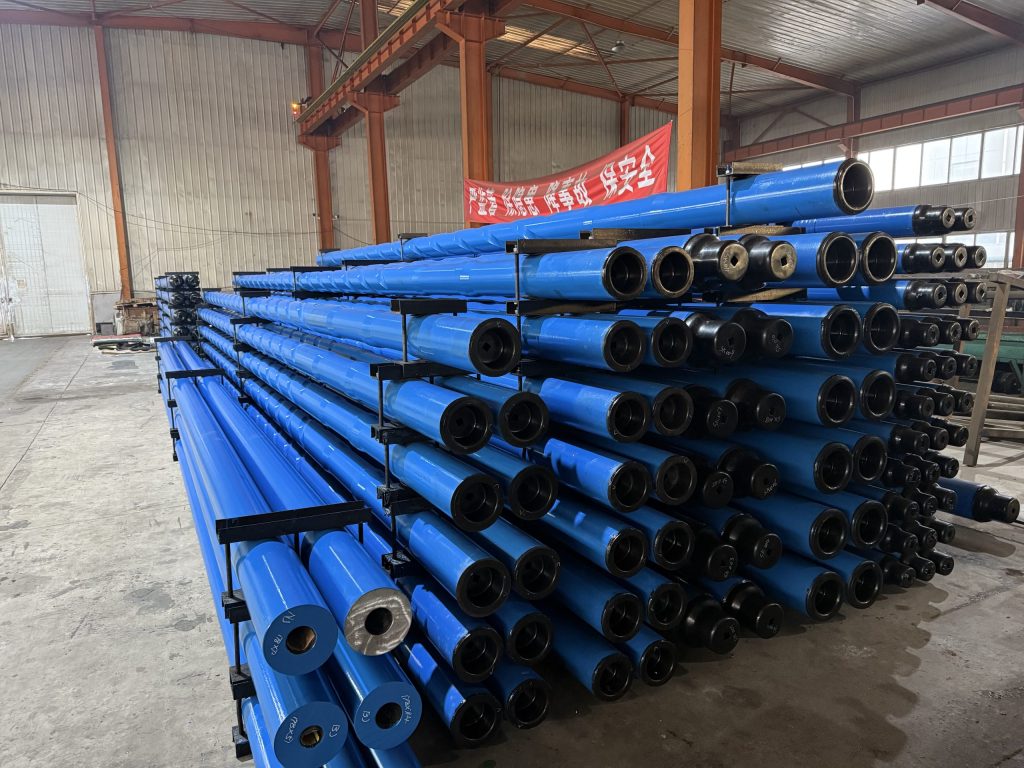
S135 is not automatically better for every drilling program. Higher yield strength helps with tensile load, but drill pipe failure is often controlled by fatigue, connection condition, weld zone quality, handling marks, corrosion damage and dogleg severity. In high-cycle bending zones, a stronger grade still needs careful fatigue management.
For severe environments, S135 selection should also be reviewed against sour service exposure, mud chemistry, CO₂, H₂S, chloride content, temperature and project-specific inspection requirements. The 2025 addendum to API 5DP also highlights hardness control in the weld zone, including a 37 HRC limit for Grades E, X, G and S under the stated weld-zone hardness provisions.
Grade Selection Is Not Only About Yield Strength
The number in E75, X95, G105 or S135 tells the minimum yield strength, but it does not define the full service performance of the drill string. A drill pipe grade selection should consider combined drilling loads, not only one static tensile value.
| Selection Factor | Why It Matters |
|---|---|
| Well depth and hook load | Higher suspended string weight may require X95, G105 or S135 instead of E75. |
| Torque, drag and well profile | Directional, horizontal and extended-reach wells increase torsion, drag and bending fatigue. |
| Dogleg severity | Repeated bending can damage drill pipe even when yield strength is sufficient. |
| Connection and tool joint condition | Connection torque capacity, thread shoulder wear and hardbanding condition affect reliability. |
| Service environment and inspection level | H₂S, CO₂, temperature, hardness, NDT and thread inspection should match the risk level. |
A stronger drill pipe body does not replace connection selection. If the tool joint torque capacity, shoulder condition or thread form is not suitable, the higher pipe body grade will not remove the weak point. API 5DP also notes that changes in tool joint OD and ID can reduce the drill-pipe torsion-strength ratio, which should be checked for the intended application.
A practical selection approach is:
- E75 for conventional or moderate-load drilling
- X95 when E75 margin is not enough but the well is not extremely demanding
- G105 for deeper, higher-load or controlled directional drilling
- S135 for high-tension, high-torque, extended reach or complex well profiles with stricter inspection review
Drill Pipe Body, Upset Ends and Tool Joints
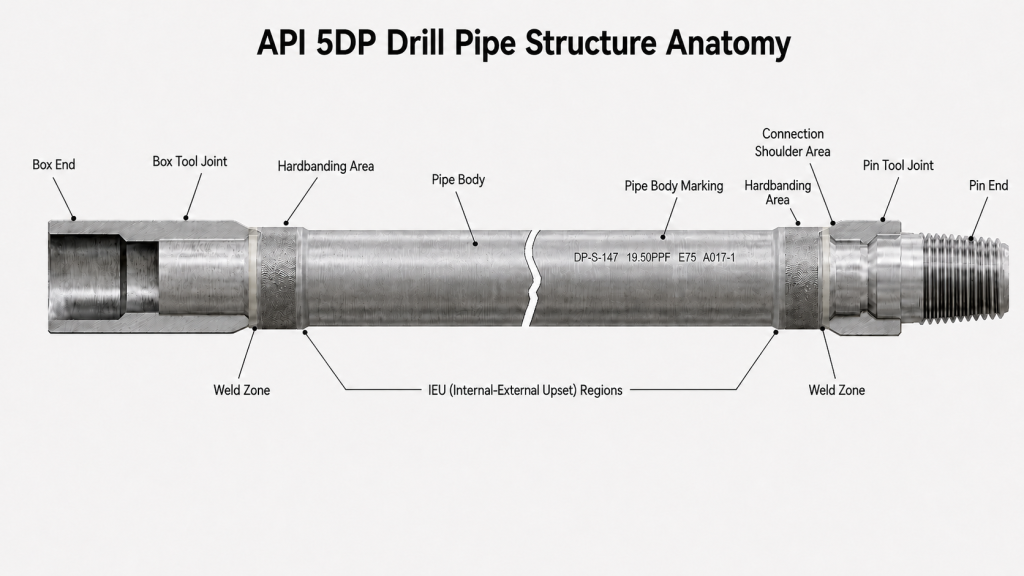
A drill pipe grade does not describe the whole product. API 5DP drill pipe includes the pipe body, upset ends, weld zone and tool joints. The standard defines drill-pipe as a drill-pipe body with weld-on tool joints, and the drill-pipe body as seamless pipe with upset ends.
The main structural areas are:
| Drill Pipe Area | Function | Selection / Inspection Meaning |
|---|---|---|
| Pipe body | Carries tension, torque, internal pressure and bending load | Grade strength and wall condition are critical |
| Upset end | Thickened transition area near pipe ends | Reduces stress concentration and supports welding to tool joint |
| Weld zone | Friction-welded and heat-affected transition area | Requires hardness, NDT and dimensional control |
| Tool joint | Provides rotary shouldered threaded connection | Controls torque capacity and connection durability |
| Pin / box thread | Makes the connection between drill pipe joints | Requires thread gauging, shoulder inspection and compound control |
| Hardbanding area | Wear-resistant area on tool joint, when applied | Helps reduce tool joint wear but must be compatible with casing wear control |
Common upset styles include IU, EU and IEU. Common rotary shouldered connection families include NC, IF, FH and REG, depending on the drill pipe size, rig requirement and project specification. The API 5DP specification also references rotary shouldered connections conforming to ISO 10424-2 or API Spec 7-2.
This is why an API 5DP specification should not only say E75, X95, G105 or S135. The grade must be matched with size, wall thickness, upset style, connection, tool joint dimensions, hardbanding requirement and inspection scope.
Inspection and Documentation for API 5DP Drill Pipe Grades
Inspection is the part that makes a drill pipe grade verifiable. Without MTC, heat number traceability, mechanical test results, NDT records and thread inspection, the grade name alone does not give enough confidence for drilling use.
API 5DP requires heat identity procedures that trace the drill-pipe body to the relevant heat, specified chemical composition, mechanical properties and test results. The standard also describes certificate content including chemical analysis, tensile test data, yield strength, tensile strength and elongation.
| Inspection / Document | What It Confirms |
|---|---|
| MTC / material certificate | Grade, heat number, chemical composition, yield strength, tensile strength and elongation |
| Heat number traceability | Links the drill pipe body to the correct heat, material record and test data |
| Dimensional inspection | Confirms OD, wall thickness, length, straightness, upset area and tool joint dimensions |
| Mechanical test records | Covers tensile test, Charpy impact test when required, and hardness control for high-strength grades |
| NDT inspection | Checks pipe body, surface, weld zone or upset-area defects according to the inspection scope |
| Thread and connection inspection | Verifies thread form, shoulder condition, seal surface, gauging result and tool joint ID clearance |
For API 5DP drill pipe, the grade name is only reliable when it is supported by material records, dimensional results, mechanical tests, NDT evidence, and connection inspection. This is especially important for G105 and S135 drill pipe, where higher strength also makes fatigue control and weld-zone quality more sensitive.
FAQ
F1:Is S135 drill pipe always better than G105?
Q1:No. S135 has higher yield strength, but it is not automatically better. G105 may perform well in deeper or directional wells when torque, dogleg severity, fatigue exposure and connection capacity remain within a controlled range.
F2:Can E75, X95, G105 and S135 be identified by appearance?
Q2:Not reliably. If size, upset type, connection and coating are the same, the grades may look almost identical. Grade should be verified by pipe marking, heat number traceability, mechanical test data and inspection records.
F3:Why should drill pipe grade and connection be checked together?
Q3:The pipe body carries tension and bending load, while the tool joint and connection carry rotary torque and makeup load. A higher pipe body grade cannot compensate for weak connection capacity, thread shoulder damage or poor tool joint condition.
F4:Which API 5DP drill pipe grade is suitable for horizontal wells?
Q4:G105 or S135 is often reviewed for horizontal or extended-reach sections because torque, drag and bending fatigue increase with lateral length. Final selection depends on hook load, dogleg severity, connection capacity and fatigue control, not grade strength alone.