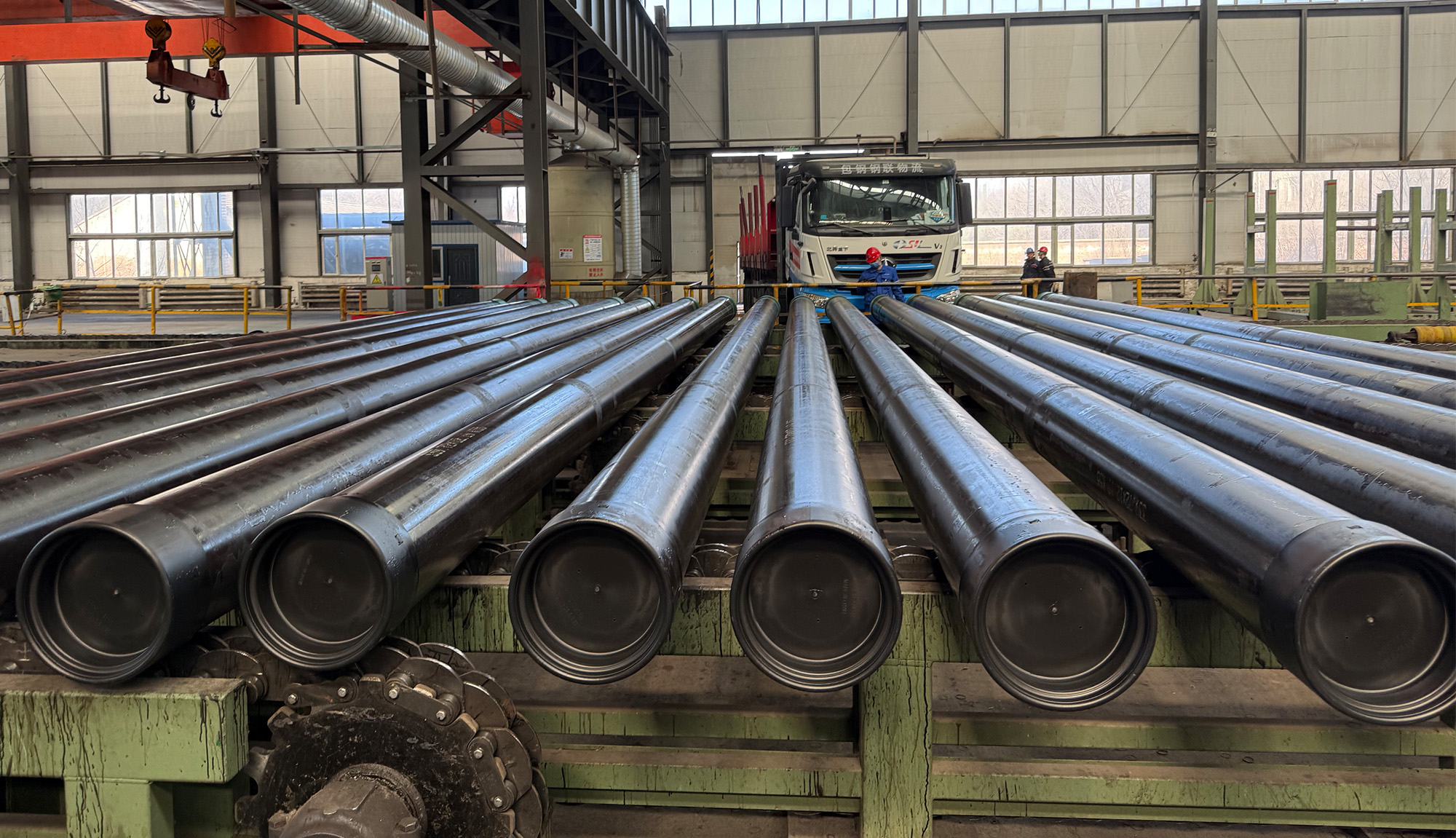
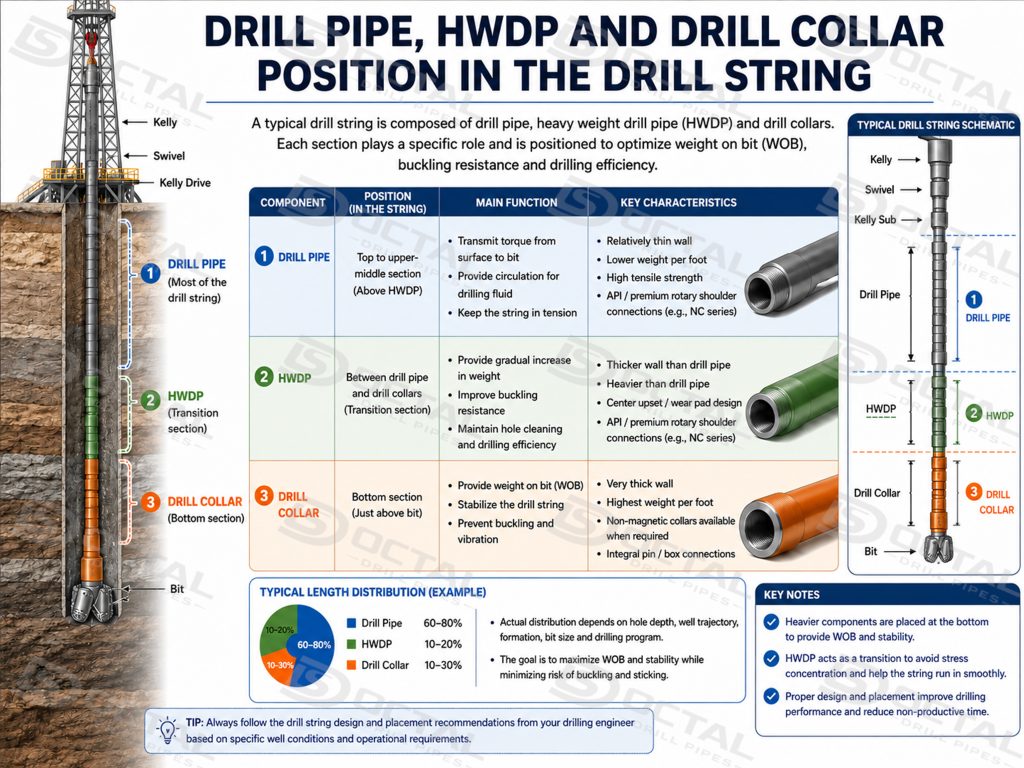
Drill pipe, HWDP and drill collar are all drill string components, but they are not interchangeable. Each one works in a different position, carries a different load pattern and solves a different mechanical problem in the drill string. API 5DP drill pipe forms the main length of the string and carries rotation, drilling fluid and tensile load. Heavy weight drill pipe, or HWDP, works as the stiffness transition between regular drill pipe and drill collars. Drill collar is placed near the bit in the bottom hole assembly, where it provides weight on bit and improves BHA stability.
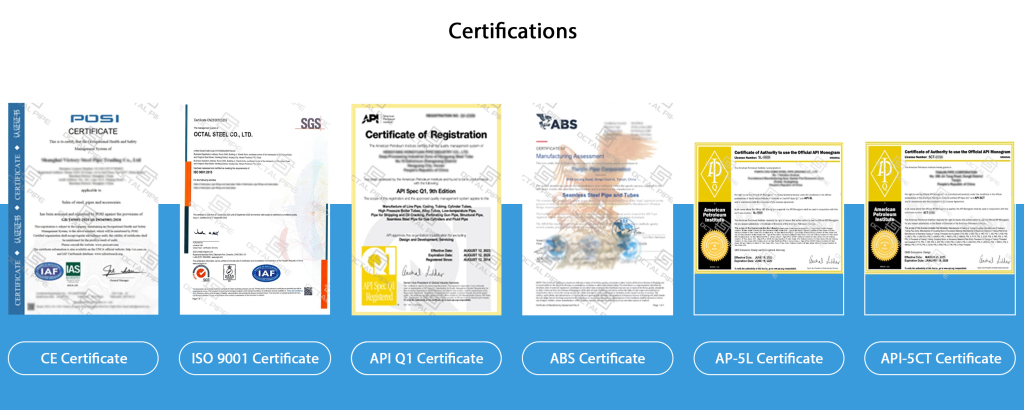
A clear comparison of API 5DP drill pipe vs HWDP vs drill collar should not stop at outside diameter or weight. The real difference is in function: drill pipe manages rotation and circulation through the long drill string, HWDP reduces stiffness jump and drill string fatigue in the transition zone, and drill collar provides concentrated mass and rigidity near the bit. API 5DP specifies technical delivery conditions for steel drill pipe with upset pipe-body ends and welded-on tool joints, while API 7-1 covers rotary drill stem elements such as HWDP and drill collars.
What Are Drill Pipe, HWDP and Drill Collar in a Drill String?
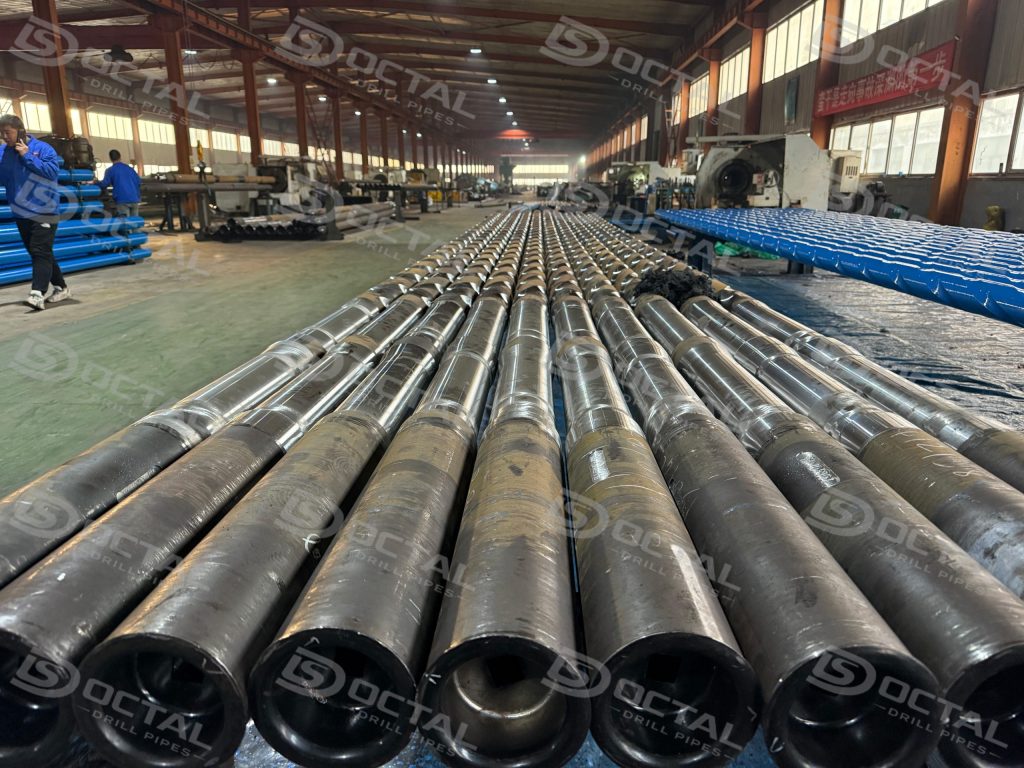
A drill string is not one continuous pipe of the same weight and stiffness. It is a mechanical system assembled from components with different functions. Regular drill pipe normally makes up the long upper section of the string. HWDP is placed in the transition area where the flexible drill pipe meets the much stiffer drill collar section. Drill collars are installed in the lower bottom hole assembly close to the bit.
| Component | Typical Position | Main Function |
|---|---|---|
| API 5DP drill pipe | Main drill string length | Transfers torque, circulates drilling fluid and carries tensile load |
| HWDP | Between drill pipe and drill collars | Adds intermediate weight and smooths stiffness transition |
| Drill collar | BHA near the bit | Provides weight on bit, stiffness and bit stability |
This layout matters because the drill string does not carry only one type of load. In a rotating wellbore, the string sees tension, torsion, bending, compression, vibration and contact with the borehole wall. If the transition from flexible drill pipe to rigid drill collar is too abrupt, stress concentration may increase at the connection or transition zone.
API 5DP Drill Pipe: Torque, Fluid Circulation and Tensile Load
API 5DP drill pipe is a steel drill pipe with upset pipe-body ends and welded-on tool joints. Its hollow pipe body provides the flow path for drilling fluid from the surface pumps to the bit, while the tool joints and rotary shouldered connections transmit torque through the drill string. API 5DP also organizes drill pipe delivery under product specification levels such as PSL-1, PSL-2 and PSL-3.
In service, drill pipe is not selected only by strength grade. It must carry suspended string weight under tension, transfer rotary torque, and keep the internal bore suitable for drilling fluid circulation. The fluid path affects hydraulic cleaning, cuttings transport and bit nozzle flow, while tensile load increases with well depth, overpull risk and long string length.
Common API 5DP grades include E75, X95, G105 and S135, with the grade number reflecting the specified minimum yield strength in thousands of psi. A higher grade may increase tensile margin, but it does not automatically solve cyclic bending, dogleg severity, torque and drag, connection fatigue, tool joint wear, bore restriction or poor transition design.
Key review points for API 5DP drill pipe include:
- Grade and strength level, such as E75, X95, G105 or S135
- OD, wall thickness, length range and upset type
- Internal bore, drift requirement and drilling fluid circulation path
- Tool joint condition and rotary shouldered connection compatibility
- NDT, dimensional inspection and material traceability records
HWDP: The Stiffness Transition Between Drill Pipe and Drill Collar
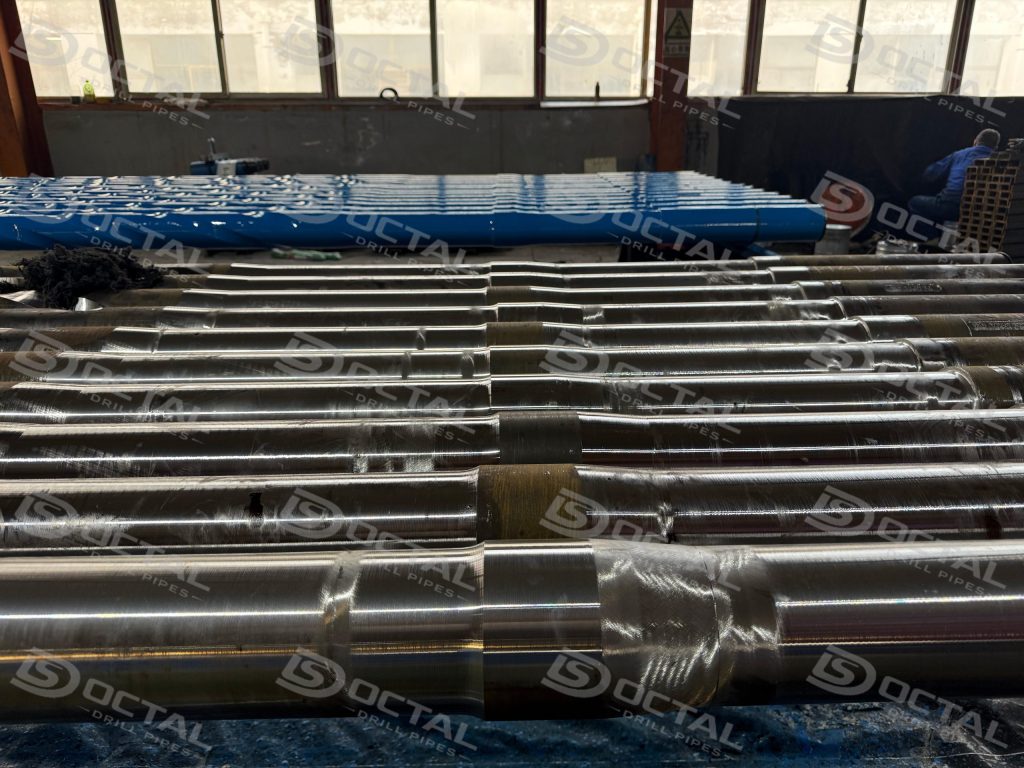
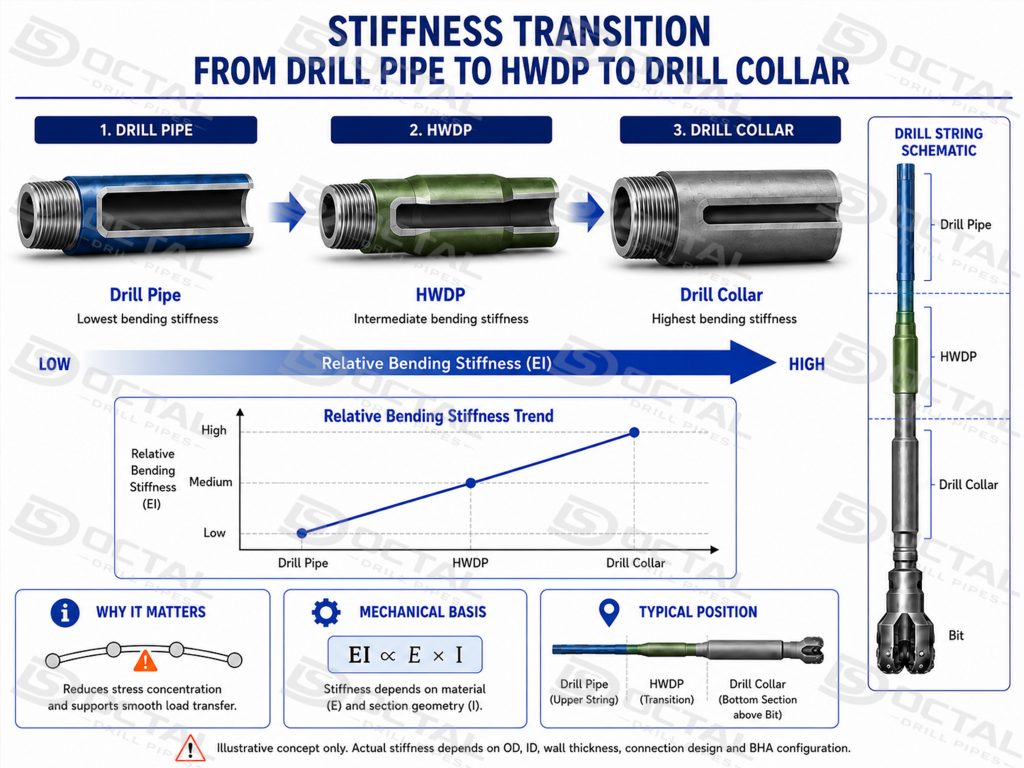
Heavy weight drill pipe is not simply a heavier version of regular drill pipe. Its main value is stiffness transition. HWDP is commonly used between drill pipe and drill collars to reduce the sudden change from a flexible pipe body to a rigid BHA section. NOV describes heavy weight drill pipe as providing a gradual transition between drill pipe and drill collars, which is exactly why it appears in the transition zone.
HWDP normally has a heavier wall section, longer tool joints and wear-resistant features compared with standard drill pipe. It adds weight and stiffness, but still remains more flexible than a drill collar. This intermediate behavior helps reduce stress concentration, drill string fatigue and connection damage in the area above the collars.
| HWDP Function | Engineering Meaning |
|---|---|
| Stiffness transition | Reduces abrupt stiffness change between drill pipe and drill collars |
| Intermediate weight | Adds controlled weight without making the transition too rigid |
| Fatigue reduction | Helps reduce cyclic stress in the transition area |
| Shock and vibration control | Supports smoother load transfer above the BHA |
| Handling compatibility | Often easier to handle than full drill collar sections |
HWDP should be evaluated as a transition and fatigue-control component, not simply as a heavier drill pipe. Its placement above the drill collar section helps distribute bending stress, reduce abrupt stiffness change, and protect the connection area from repeated load concentration. In directional or high-deviation wells, this transition role becomes more important because torque, drag, side force and cyclic bending are all acting on the drill string at the same time.
Drill Collar: Weight on Bit and BHA Stability
A drill collar is a heavy, stiff drill stem component used in the lower bottom hole assembly. Its main function is to provide weight on bit, maintain bit stability and keep the lower assembly more rigid. Compared with drill pipe and HWDP, a drill collar is heavier, less flexible and more focused on compression and BHA control.
In the comparison of HWDP vs drill collar, the drill collar provides more concentrated weight and stiffness, while HWDP provides a smoother transition above it. In vertical and hard-formation drilling, drill collars help transfer the required WOB to the bit. In directional, high-deviation or horizontal wells, too much collar stiffness may increase torque and drag, sticking risk or trajectory-control difficulty.
Drill collars are commonly supplied in several structural types according to BHA design and measurement requirements:
- Slick drill collar for standard BHA weight and stiffness control
- Spiral drill collar to reduce contact area and help lower differential sticking risk
- Non-magnetic drill collar for MWD / LWD environments where magnetic interference must be controlled
- Square drill collar for selected anti-deviation applications where higher wall contact and directional control are required
API 7-1 covers drill collars as rotary drill stem elements, including slick drill collars, spiral drill collars and non-magnetic drill collars. For drill collar inspection, the key review points usually include OD, ID, overall length, straightness, connection shoulder condition, thread gauging, bore/drift clearance, surface defects, hardness, impact properties when required, and material traceability. In BHA service, these checks matter because drill collars carry concentrated compressive load near the bit and any connection damage, bore restriction or surface cracking may affect WOB transfer, tool joint reliability and downhole stability.
Drill Pipe vs HWDP vs Drill Collar Comparison Table
Drill pipe, HWDP and drill collar should be compared by load position, not by weight alone. Drill pipe carries most of the tensile and rotary load, HWDP controls the stiffness transition above the collar section, and drill collar concentrates compressive weight near the bit. This difference becomes more important in directional and horizontal wells, where torque, drag, dogleg severity and fatigue exposure act together.
| Item | API 5DP Drill Pipe | HWDP | Drill Collar |
|---|---|---|---|
| Main function | Transfers torque, circulates drilling fluid and carries long-string tensile load | Controls stiffness transition and adds intermediate weight above collars | Provides weight on bit, stiffness and BHA stability near the bit |
| Typical position | Main drill string above the BHA | Transition zone between drill pipe and drill collars | Lower BHA, close to the bit |
| Load behavior | Tension, torsion, internal pressure and cyclic bending | Mixed tension / compression transition, shock load and fatigue control | Compression-dominant loading, bit weight and stabilizing force |
| Weight and flexibility | Lightest and most flexible of the three | Heavier than drill pipe, more flexible than drill collar | Heaviest and stiffest component |
| Main selection risk | Grade strength alone cannot solve connection fatigue or bore restriction | Poor placement may leave stiffness jump and transition fatigue unresolved | Excessive collar stiffness may increase drag and sticking risk in high-angle wells |
These components cannot be substituted only by increasing wall thickness or weight. A high-grade drill pipe may improve tensile margin, but it cannot provide the same WOB as a drill collar. A drill collar can stabilize the bit, but too much collar stiffness may increase drag and sticking risk. HWDP fills the transition zone, where stiffness control and fatigue reduction are more important than maximum weight.
Why HWDP Is Not Just a Heavier Drill Pipe
HWDP should not be understood only as a heavier version of regular drill pipe. Its main function is to control the stiffness change between the flexible drill pipe section and the much more rigid drill collar section. This transition is important because bending stress, torque, drag and side force often concentrate where the load path changes suddenly.
If regular drill pipe is connected directly to a long drill collar section, the stiffness jump may increase fatigue risk near the transition zone, especially in dogleg sections, high-deviation wells and long intervals where the string rotates under side load. HWDP helps distribute this load more gradually, reducing stress concentration above the collar section.
In practical BHA review, HWDP is checked for:
- Tube body and center upset condition
- Tool joint and connection condition
- Wear pad or hardbanding area
- Drift / ID clearance
- OD and bore consistency
- NDT and dimensional inspection records
- Placement in relation to drill collars and stabilizers
This is why HWDP is normally treated as a transition and fatigue-control component, not just a weight-adding pipe. Drill pipe carries most of the long-string tension and circulation path, drill collar concentrates WOB near the bit, and HWDP manages the stiffness change between them.
When to Use Drill Pipe, HWDP or Drill Collar
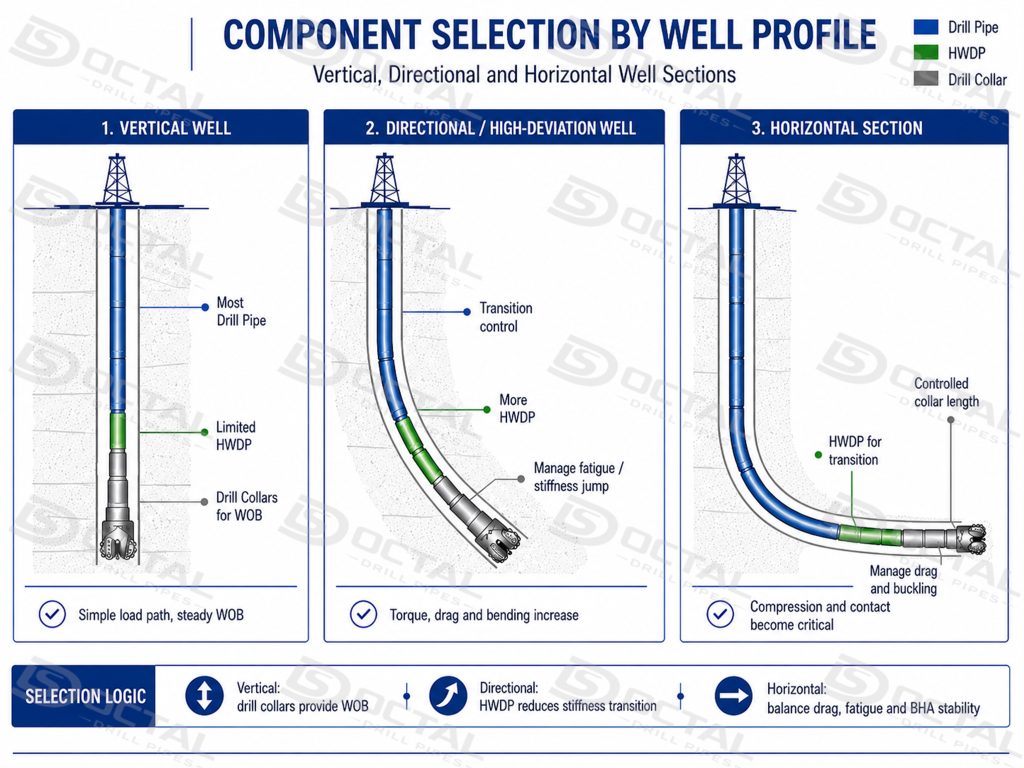
Selection depends on the well profile, WOB requirement, BHA design and fatigue exposure. The right component is chosen by working position, not by weight alone.
Vertical wells with moderate load
Regular API 5DP drill pipe forms most of the drill string. Drill collars provide the required weight on bit near the bottom. HWDP may be used in limited quantities as a transition section, especially if vibration, shock load or fatigue risk is expected.
Directional or high-deviation wells
Torque and drag increase as inclination builds. HWDP becomes more important because it helps reduce stiffness jump and transition-zone fatigue. Excessive drill collar length may increase side force and sticking risk, so collar placement and HWDP quantity should be reviewed together.
Long horizontal sections
In horizontal wells, the string may experience high drag, compression, bending and rotation under contact with the wellbore. Drill pipe grade, connection capacity and fatigue exposure are critical. HWDP may help manage the transition and compression load, but its placement should be checked against buckling risk and BHA design.
Hard formation drilling
Drill collars are important when the bit needs steady WOB and stability. HWDP can support the transition above the collars and reduce shock transfer into the drill pipe. The drill pipe section should still be checked for torque, tensile load and connection fatigue.
Standards and Inspection Points: API 5DP, API 7-1 and API 7-2
A common mistake is to mix all drill string components under one standard name. The standard boundary should be kept clear because drill pipe, HWDP and drill collar are not controlled in the same way.
| Standard / Reference | Where It Fits |
|---|---|
| API 5DP | Drill pipe technical delivery conditions, grades, upset type and welded-on tool joints |
| API 7-1 | HWDP, drill collars and other rotary drill stem elements |
| API 7-2 | Rotary shouldered connection threading and gauging |
| API RP 7G-2 | Used drill stem inspection and classification reference |
| Project ITP | Actual inspection scope, NDT, hardness, marking and document review |
For API 5DP drill pipe, inspection often focuses on pipe body condition, upset area, tool joint weld zone, connection identity, grade marking, NDT and material records. For HWDP and drill collars, inspection also needs to consider bore condition, connection shoulder, hardbanding or wear area, straightness, drift and BHA-related dimensional requirements. API 7-1 is the closer reference for HWDP and drill collar scope, while API 5DP remains specific to drill pipe delivery conditions.
Common Selection Mistakes in Drill String Components
Drill pipe, HWDP and drill collar should not be selected only by weight or strength grade. Most selection problems appear when the load path, stiffness transition, well profile and connection capacity are not reviewed together.
| Selection Mistake | What Can Go Wrong | Better Review Point |
|---|---|---|
| Treating HWDP as normal drill pipe | Transition fatigue risk may be missed | Review stiffness change, BHA placement and fatigue exposure |
| Using too many drill collars in high-angle wells | Torque, drag and sticking risk may increase | Balance WOB with trajectory control and hole condition |
| Selecting drill pipe only by grade strength | Connection fatigue or tool joint limits may be ignored | Check torque, dogleg severity and connection capacity |
| Mixing API 5DP, API 7-1 and API 7-2 scope | Inspection and marking basis may become unclear | Separate drill pipe, drill stem element and connection requirements |
In directional and horizontal drilling, the strongest or heaviest component is not always the safest choice. The correct selection depends on where the component works in the drill string and what load it needs to control.
FAQ
F1:What is the main difference between API 5DP drill pipe, HWDP and drill collar?
Q1:API 5DP drill pipe forms the main drill string and carries torque, drilling fluid and tensile load. HWDP works as the stiffness transition above the drill collars, while drill collar provides concentrated weight on bit and BHA stability near the bit.
F2:Why is HWDP placed between drill pipe and drill collar?
Q2:HWDP reduces the sudden stiffness change between flexible drill pipe and rigid drill collars. This helps lower stress concentration, connection fatigue and bending damage in the transition zone, especially in directional or high-deviation wells.
F3:Can HWDP replace drill collars in a BHA?
Q3:HWDP can reduce stiffness jump and add intermediate weight, but it does not fully replace drill collars when high WOB and bit stability are required. Drill collar selection still depends on hole size, formation hardness, trajectory, torque and drag, and BHA design.
F4:Is API 5DP used for HWDP and drill collars?
Q4:API 5DP mainly covers steel drill pipe with upset pipe-body ends and welded-on tool joints. HWDP and drill collars are generally closer to API 7-1 rotary drill stem element scope, while API 7-2 is relevant for rotary shouldered connection threading and gauging.