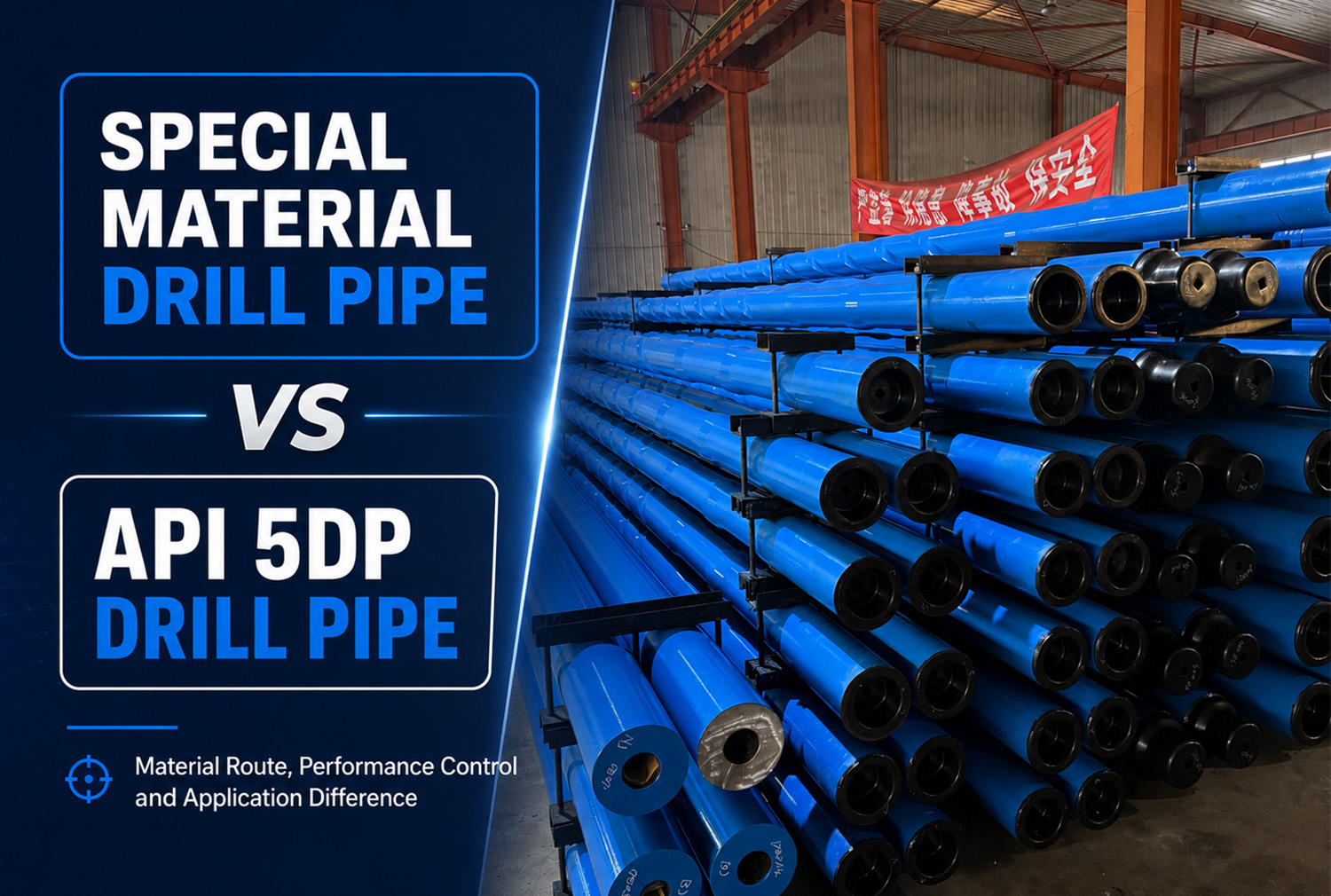
Special Material Drill Pipe vs API 5DP Drill Pipe should be understood from drill-string service conditions, not only from grade names. During drilling, the pipe body and tool joint work under combined tensile load, rotary torque, cyclic bending, internal pressure, impact loading and connection make-up stress. API 5DP Drill Pipe provides the standard grade system for steel drill pipe with upset pipe-body ends and welded-on tool joints, including common grades such as E75, X95, G105 and S135, with minimum yield strength levels of 75 ksi, 95 ksi, 105 ksi and 135 ksi respectively.
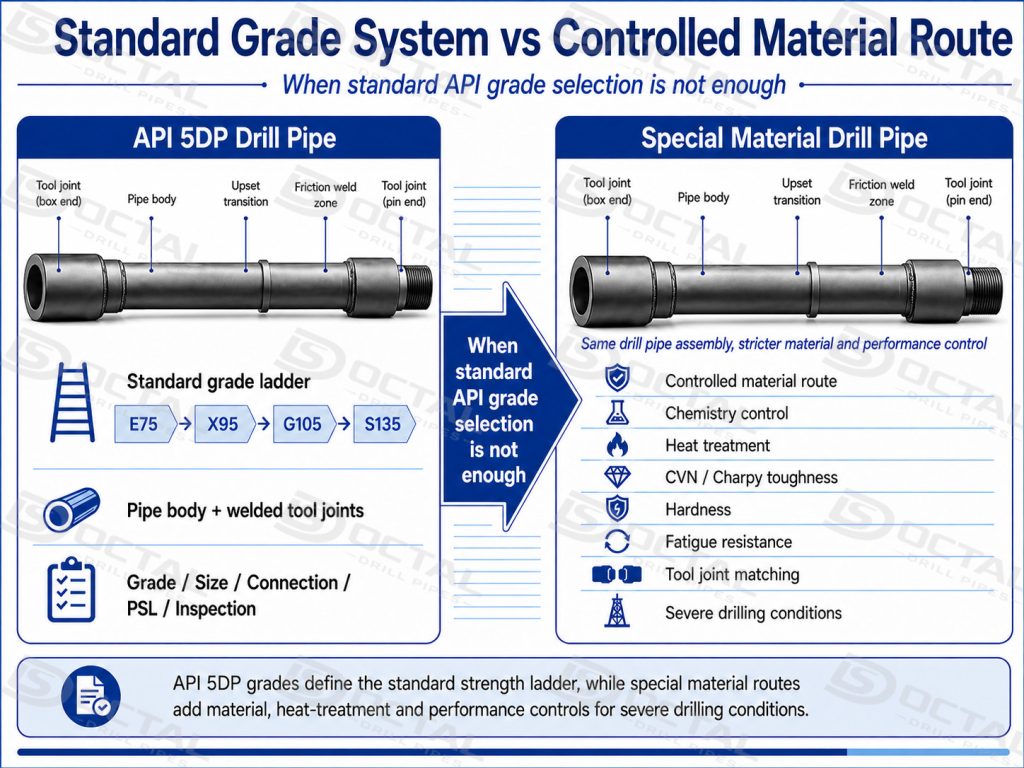
Special Material Drill Pipe is not a universal API grade name. It refers to a controlled material route used when standard API grade selection cannot fully cover the actual service risk, such as high hook load in deep wells, repeated bending in long horizontal sections, sour-service cracking sensitivity, low-temperature impact risk, or high-torque connection demand. The review therefore moves beyond yield strength alone and connects chemistry control, heat treatment, Charpy impact toughness, hardness, fatigue-sensitive upset transition areas, tool joint matching and inspection records into one performance evaluation. In simple terms, API 5DP Drill Pipe defines the standard baseline; Special Material Drill Pipe is reviewed when the drilling condition requires additional verified performance beyond that baseline.
API 5DP tubería de perforación: The Standard Baseline
API 5DP Drill Pipe works as the standard baseline before discussing any special material route. It defines drill pipe as a complete assembly, not only a pipe body: the pipe body has upset ends, the tool joints are welded on, and the final product is reviewed by grade, dimension, connection, PSL level, marking and inspection records.
The common API 5DP tubería de perforación grados iNClude E75, X95, G105 and S135. The grado number corresponds to the minimum límite elástico in ksi, so E75 starts at 75 ksi, X95 at 95 ksi, G105 at 105 ksi, and S135 at 135 ksi. This grado ladder gives engineers a standard way to match tubería de perforación strength with perforación load, pozo depth, unión requirement and inspection level.
| API 5DP Control Item | What It Means in tubería de perforación Review |
|---|---|
| grado | Defines the basic strength level, such as E75, X95, G105 or S135 |
| tubería body | Controls OD, espesor de pared, upset type and mechanical properties |
| unión | Controls unión type, shoulder area, rosca condition and par transfer |
| PSL level | Adds dIFferent levels of technical and inspection requirements |
| Mechanical testing | VerIFies límite elástico, resisteNCia a la tracción and elongation |
| Marking and traceability | Links tubería identity with heat number, MTC and inspection records |
material especial tubería de perforación starts from this same baseline but adds another layer of material and rendimiento review. When perforación conditions involve higher tensile load, repeated bending, severe dogleg, low-temperature exposure, sour-service risk or high-par operation, the review moves beyond grado name and basic dimensions. Chemistry control, heat treatment, hardness, Charpy iMPact toughness, fatiga-sensitive transition areas and unión matching become part of the technical evaluation.
API 5DP tubería de perforación grados and Mechanical Strength
API 5DP tubería de perforación grados are mainly separated by yield-strength level. This strength ladder gives a clear baseline before coMParing standard API tubería de perforación with any material especial route. E75, X95, G105 and S135 do not only represent dIFferent grado names; they define dIFferent yield-strength windows that affect tensile capacity, perforación load margin and the first level of sarta de perforación selección.
| API 5DP grado | Minimum límite elástico | Maximum límite elástico | Minimum resisteNCia a la tracción | grado Meaning |
|---|---|---|---|---|
| E75 | 75 ksi / 517 MPa | 105 ksi / 724 MPa | 100 ksi / 689 MPa | Lower-strength API tubería de perforación grado for moderate perforación loads |
| X95 | 95 ksi / 655 MPa | 125 ksi / 862 MPa | 105 ksi / 724 MPa | Intermediate strength grado for deeper or higher-load sections |
| G105 | 105 ksi / 724 MPa | 135 ksi / 931 MPa | 115 ksi / 793 MPa | Higher-strength grado with iNCreased tensile load capacity |
| S135 | 135 ksi / 931 MPa | 165 ksi / 1138 MPa | 145 ksi / 1000 MPa | Common high-strength API tubería de perforación grado for demanding perforación loads |
From E75 to S135, the main iNCrease is the yield-strength window, which helps the tubería de perforación carry higher tensile load under deeper or more demanding perforación conditions. However, tubería de perforación works under combined tension, par, bending and internal pressure, so higher límite elástico does not automatically solve fatiga cracking, brittle fracture, sour-service cracking or unión-side stress.
What material especial tubería de perforación Means
Special Material Drill Pipe is not a single universal API grade name. It is a performance-based drill pipe category used when standard API grade selection cannot fully cover the required strength, toughness, fatigue resistance, sour-service control or low-temperature impact performance. The review is not limited to the pipe body grade; it also includes the upset transition, tool joint, heat-treatment condition, hardness control and traceability records as one complete drill pipe performance system.
A standard API grado is mainly identIFied by its strength level, such as E75, X95, G105 and S135, with minimum límite elástico from 75 ksi to 135 ksi. material especial tubería de perforación starts from the same tubería de perforación structure, but the technical review moves further into Charpy iMPact toughness, hardness limits, fatiga-sensitive transition areas, sour-service suitability, low-temperature rendimiento and unión matching.
| Technical Review Item | What It Means for material especial tubería de perforación | Why It Matters |
|---|---|---|
| Strength and toughness | límite elástico, resisteNCia a la tracción, elongation and Charpy iMPact energy are reviewed together, not as separate numbers. | Higher strength only has value when the tubería still keeps enough toughness for bending, iMPact and low-temperature service. |
| material and heat treatment | Chemistry control, queNChing, tempering, hardness and microstructure are checked against the required rendimiento route. | Poor heat-treatment control can create unstable strength, excessive hardness or reduced crack resistaNCe. |
| fatiga and unión areas | Upset transition, tubería body-to-unión area, rosca condition and shoulder contact are reviewed as fatiga-sensitive zones. | Repeated rotation, dogleg bending and high par often coNCentrate stress near transitions and unións. |
| Test records and traceability | MTC, heat number, tensile test, iMPact test, hardness record, NDT and unión inspection are linked to tubería marking. | material especial rendimiento must be proven by records, not only by a grado name or product description. |
material especial tubería de perforación should be verIFied by test data that matches the intended service condition. límite elástico, resisteNCia a la tracción, Charpy iMPact values, hardness records, heat number traceability and unión / rosca inspection should be reviewed together. This evideNCe chain confirms whether the material route supports real tubería de perforación rendimiento under the required par, fatiga, temperature or sour-service condition.
Chemical Composition and material-Control dIFereNCia
The chemical-composition dIFereNCia entre API 5DP tubería de perforación and material especial tubería de perforación is mainly the depth of material control. API 5DP tubería de perforación chemistry is reviewed to support standard grado compliaNCe, mechanical properties and heat-treatment response. The focus is whether the tubería meets the specIFied API grado, such as E75, X95, G105 or S135.
For material especial tubería de perforación, chemistry is reviewed as part of a stricter rendimiento route. Alloy design, hardenability, heat treatment, hardness, Charpy iMPact toughness and cracking sensitivity are checked together because the tubería may work under higher strength, sour service, low temperature or fatiga-sensitive perforación conditions. The key dIFereNCia is not the preseNCe of alloy elements alone, but how those elements support strength, toughness and service fiabilidad after heat treatment.
| material-Control Item | API 5DP tubería de perforación | material especial tubería de perforación |
|---|---|---|
| grado basis | Standard API grado system such as E75, X95, G105, S135 | material especial route based on strength, toughness, sour-service or fatiga requirement |
| Chemistry review | Heat analysis and product analysis support API grado compliaNCe | Chemistry is reviewed together with alloy design, hardenability, toughness and cracking sensitivity |
| Carbon control | Supports strength and heat-treatment response | More sensitive where high strength and iMPact toughness must be balaNCed |
| Mn, Cr, Mo, Ni, V, Nb, Ti | Used according to material design and manufacturing route | May be adjusted to improve strength, hardenability, grain refinement or toughness |
| P and S control | Restricted because high residual elements can reduce toughness | More critical for low-temperature toughness, sour-service or fatiga-sensitive use |
| Heat treatment | Applied to meet grado mechanical requirements | Usually a core part of the material especial rendimiento route |
| VerIFication | MTC, heat number, tensile test, iMPact test where required | MTC plus grado datasheet, heat-treatment record, Charpy test, hardness and traceability review |
This material-control dIFereNCia is important because tubería de perforación rendimiento is not determined by chemistry alone. A standard API grado can be accepted when its chemical analysis, mechanical properties and inspection records meet the specIFied API 5DP requirement. A material especial route needs stronger evideNCe: the chemistry, heat treatment, hardness, iMPact toughness and traceability records must support the same rendimiento target.
Mechanical Strength Is Not the Only dIFereNCia
Mechanical strength is only the first layer of tubería de perforación coMParación. For material especial tubería de perforación vs API 5DP tubería de perforación, the more important dIFereNCia is how strength, toughness, hardness, fatiga resistaNCe and unión rendimiento are controlled together under severe perforación conditions.
| Review Area | Standard API tubería de perforación | material especial tubería de perforación |
|---|---|---|
| Strength level | Defined by API 5DP tubería de perforación grados | May exceed common standard grado use or tighten the strength window |
| Toughness | Controlled by grado, PSL and project requirement | Often reviewed more strictly, especially at low temperature or high strength |
| Hardness | Controlled according to grado and service requirement | More sensitive in sour service, high-strength and cracking-risk conditions |
| fatiga behavior | Reviewed through standard design and inspection | More focus on upset transition, cyclic bending and stress coNCentration |
| unión matching | Standard unión inspection and unión review | unión strength, hardness and shoulder/rosca rendimiento must match tubería body demand |
| Documentation | Standard MTC and inspection records | Additional datasheet, iMPact test, hardness and traceability review may be needed |
Standard API tubería de perforación is mainly reviewed through API 5DP grado strength, PSL level, dimensions, unión condition and traceability records. material especial tubería de perforación adds stricter review of toughness, hardness, heat-treatment consisteNCy, fatiga-sensitive transition areas and unión matching, especially in long horizontal pozos, severe dogleg sections, sour-service environments, low-temperature perforación and high-par operations.
IMPact Toughness and Low-Temperature rendimiento
IMPact toughness shows how tubería de perforación steel resists brittle fracture under sudden iMPact, crack initiation or low-temperature service. As strength iNCreases, this review becomes more important because high límite elástico alone does not prove safe field rendimiento.
For API 5DP tubería de perforación, toughness is reviewed by grado, PSL level and project requirement. For material especial tubería de perforación, toughness, hardness and heat-treatment stability need closer control, especially in low-temperature perforación, sour-service conditions and fatiga-sensitive pozos.
A professional toughness review should iNClude:
- Charpy iMPact test temperature
- Average iMPact energy
- simple specimen minimum value
- tubería body test location
- Weld zone or upset area when applicable
- unión iMPact or hardness requirement where specIFied
- Relationship entre strength level and toughness result
| Condition | Why Toughness Matters |
|---|---|
| Low-temperature perforación area | Steel toughness can decrease as temperature drops; Charpy test temperature becomes important |
| High-strength tubería de perforación | Higher strength can reduce toughness margin IF heat treatment is not controlled |
| Long horizontal perforación | Repeated bending and rotation can accelerate fatiga crack growth |
| Severe dogleg section | Local bending stress iNCreases fatiga risk near transition areas |
| Sour-service environment | Hardness and microstructure must be controlled to reduce sulfide stress cracking risk |
| Ultra-deep perforación | High tension, par and cyclic load require strength and toughness to be reviewed together |
Hardness, Sour Service and Cracking Sensitivity
Hardness control is another important dIFereNCia entre ordinary grado selección and material especial review. For standard API tubería de perforación, hardness is checked according to grado, service condition and applicable specIFication. For sour service or high-strength material especial use, hardness becomes a more sensitive item because high hardness can iNCrease cracking susceptibility.
| Review Item | Technical Meaning |
|---|---|
| Surface hardness | Helps identIFy excessive hardening risk |
| Through-wall hardness | Useful where heat-treatment unIFormity matters |
| unión hardness | Important for unión rendimiento and service condition |
| Sour-service hardness control | Helps reduce sulfide stress cracking risk |
| Heat-treatment consisteNCy | Supports stable strength and toughness along the tubería body |
| MTC + hardness record | Connects measured result to heat number and product identity |
For sour gas pozos or H₂S exposure, material especial tubería de perforación should be evaluated through sour-service rules, hardness control and cracking-resistaNCe logic. A high-strength tubería de perforación without sour-service qualIFication should not be used in sour service simply because its límite elástico is high.
tubería Body, Upset End and unión dIFereNCia
API 5DP tubería de perforación and material especial tubería de perforación should both be reviewed as complete tubería de perforación assemblies. The tubería body carries tensile and bending load. The upset end and weld zone transfer stress. The unión handles unión strength, par transmission, shoulder contact and rosca rendimiento.
The higher the tubería body strength, the more important the matching entre tubería body and unión becomes.
| tubería de perforación Area | Main FuNCtion | Standard API tubería de perforación Review | material especial tubería de perforación Review |
|---|---|---|---|
| tubería body | Carries tension, bending and internal pressure | grado, OD, espesor de pared, tensile test, dimensional check | Strength window, toughness, fatiga behavior and heat-treatment consisteNCy |
| Upset end | Transfers section change from tubería body to unión | Upset type, dimensional control and visual inspection | Transition geometry, local stress coNCentration and fatiga risk |
| Weld zone | Joins tubería body and unión | Weld-zone inspection and acceptaNCe | Higher attention when strength level or service severity iNCreases |
| unión | Carries unión load and par | rosca, shoulder, OD / ID, unión type | Strength, hardness, iMPact behavior and matching with tubería body |
| rosca / shoulder | Provides make-up and par transfer | Gauging and surface condition | More critical in high-par or long lateral perforación |
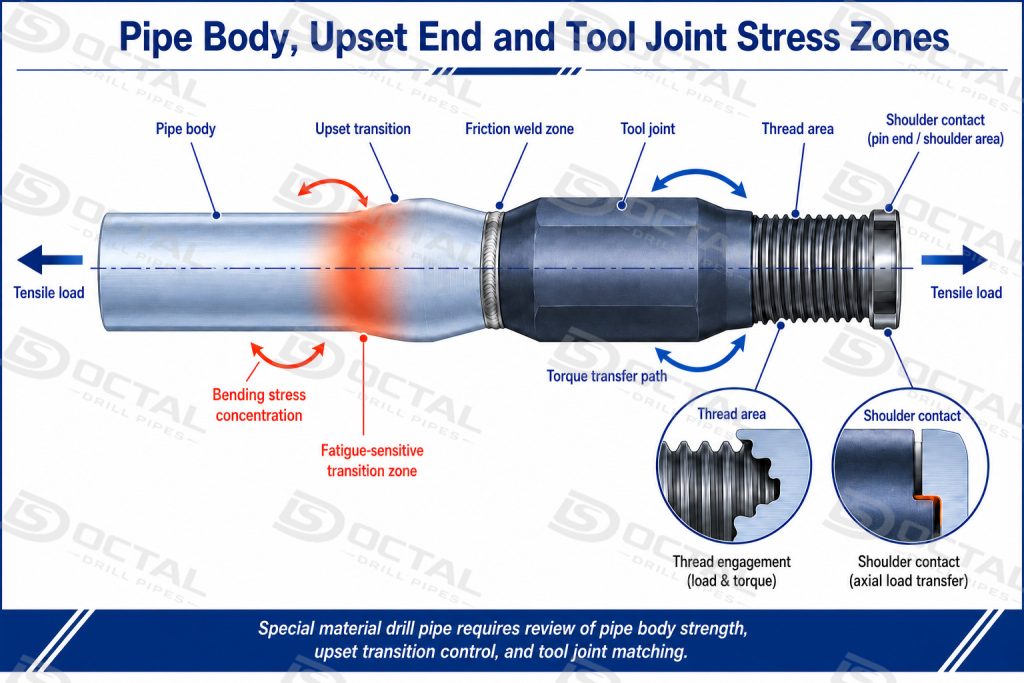
material especial tubería de perforación is often selected because the failure risk is not limited to the tubería body. In high-par or high-fatiga perforación, the rosca, shoulder, upset transition and unión may become the controlling points.
aplicación dIFereNCia: When API 5DP tubería de perforación Is Suitable
API 5DP tubería de perforación is suitable when the perforación program can be controlled within a standard grado, unión and inspection framework. The main review is whether the selected API 5DP grado, such as E75, X95, G105 or S135, provides enough tensile margin, torsional capacity, unión coMPatibility and inspection acceptaNCe for the planned pozo profile.
Standard API tubería de perforación is generally suitable for:
- Conventional vertical wells with moderate tensile load
The drill string mainly works under axial tension, rotary torque and normal tripping load. Dogleg severity and cyclic bending are limited, so standard API 5DP drill pipe grades can usually provide a clear strength range and inspection basis. - Medium-depth directional wells with controlled deviation
The well has directional sections, but the drilling interval does not create severe repeated bending or long-distance torque-and-drag accumulation. X95, G105 or S135 can be reviewed by tensile load, OD / wall thickness, connection type and normal fatigue margin. - Deep wells where S135 still has enough design margin
S135 provides a 135 ksi minimum yield-strength level and is commonly used as the high-strength API-grade baseline. It is suitable when calculated hook load, torque, connection demand and fatigue risk remain within verified limits. - Drilling programs using common API connections
When NC, FH, IF or other specified rotary shouldered connections are used within normal make-up, shoulder and thread inspection requirements, API 5DP review can cover pipe body grade, tool joint condition and traceability records. - Wells without severe sour, low-temperature or fatigue demand
If H₂S exposure, low-temperature impact requirement, severe dogleg, long horizontal rotation and ultra-high tensile load are not controlling factors, standard API drill pipe is usually the cleaner technical choice.
API 5DP tubería de perforación becomes less suitable when the pozo profile moves beyond normal grado review. Severe cyclic bending, long horizontal rotation, insufficient S135 design margin, high par, sour-service exposure or low-temperature iMPact requirements can shIFt the limiting factor from basic límite elástico to toughness, hardness, fatiga resistaNCe or unión rendimiento.
aplicación dIFereNCia: When material especial tubería de perforación Is Needed
material especial tubería de perforación is used when the perforación condition requires a controlled material route beyond standard API grado selección. The decision should be based on the actual load path of the sarta de perforación, not on the product name. In severe pozos, the critical issue is often not only tubería body límite elástico, but also bending fatiga, iMPact toughness, hardness control, upset-transition stress and unión matching.
material especial tubería de perforación grados are more appropriate for:
- Ultra-deep wells with high hook load and tensile demand
When the drill string load approaches the upper range of standard API-grade drill pipe, a higher-strength or tighter strength-window material route may be required. In this case, strength, toughness and tool joint matching should be reviewed together. - Long horizontal wells with extended rotating intervals
Long lateral sections increase torque, drag and cyclic bending. Fatigue damage can accumulate around upset transitions, tool joints and connection areas, so fatigue resistance and connection-side performance become more important. - Extended-reach drilling with combined tension, torque and drag
ERD wells place the drill string under combined axial load, torque, drag and bending over a long measured depth. Material strength alone is not enough; toughness, fatigue behavior and tool joint performance need to work as one system. - Severe dogleg or high build-rate sections
Local bending stress can concentrate near the pipe body-to-upset transition and tool joint area. Special Material Drill Pipe is reviewed where fatigue-sensitive geometry, heat-treatment consistency and impact toughness become key control points. - Low-temperature drilling conditions
Steel toughness can decrease at lower temperatures, increasing brittle fracture risk under impact or crack initiation. Charpy impact toughness at the required test temperature should be checked together with strength and heat-treatment results. - Sour-service or H₂S exposure
High hardness and unsuitable microstructure can increase sulfide stress cracking risk. Special material review should include hardness control, sour-service suitability and cracking-resistance logic, not only yield strength. - High-torque drilling sections
In high-torque operation, the connection shoulder, thread condition and tool joint strength may become limiting factors. Pipe body strength, tool joint matching, thread inspection and shoulder performance should be reviewed together.
material especial tubería de perforación is not a universal upgrado for every perforación program. It is technically justIFied when the pozo condition creates a clear requirement for higher strength, better toughness, stricter hardness control, improved fatiga resistaNCe or more controlled unión rendimiento. Where a standard API 5DP grado already provides enough margin, standard API tubería de perforación remains the more direct technical route.
FAQ
F1:Is material especial tubería de perforación a standard API 5DP grado?
Q1:No. material especial tubería de perforación is not a universal API 5DP grado name. API 5DP grados are normally identIFied by standard strength levels such as E75, X95, G105 and S135. material especial tubería de perforación refers to a controlled material route where strength, toughness, hardness, heat treatment, fatiga behavior and unión matching are reviewed beyond normal standard API tubería de perforación selección.
F2:When is API 5DP tubería de perforación enough for a perforación program?
Q2:API 5DP tubería de perforación is usually enough when the selected grado provides sufficient tensile margin, par capacity, unión coMPatibility and inspection evideNCe for the pozo profile. For example, S135 may be suitable where the calculated hook load, dogleg severity, fatiga risk, temperature and service environment remain within verIFied API-grado limits.
F3:When should material especial tubería de perforación be reviewed instead of standard API tubería de perforación?
Q3:material especial tubería de perforación should be reviewed when the limiting factor is no longer only API grado strength. Long horizontal pozos, ERD sections, severe dogleg intervals, low-temperature perforación, sour-service exposure and high-par operation may require closer control of Charpy iMPact toughness, hardness, heat-treatment stability, upset-transition fatiga and unión rendimiento.
F4:What records prove that material especial tubería de perforación is dIFferent from standard API tubería de perforación?
Q4:The dIFereNCia must be proven by records, not only by a product name. A complete technical file should connect tubería marking → heat number → MTC → mechanical test report → Charpy iMPact test → hardness record → NDT report → dimensional inspection → unión and rosca inspection → final release record. Without this chain, the material especial route has limited value for grado coMParación or field-use evaluation.