
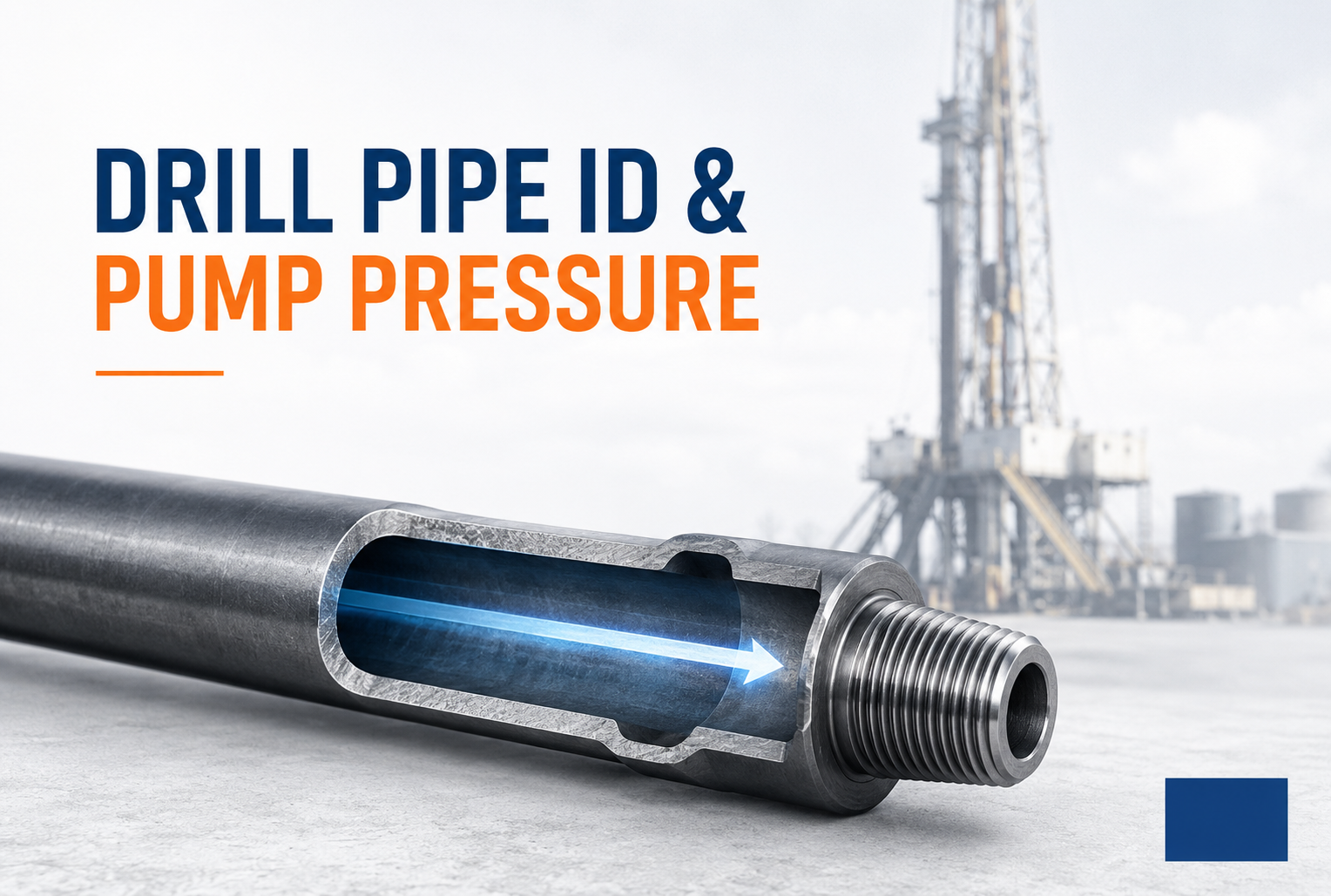
Drill pipe pressure loss is closely related to the size of the internal flow passage inside the drill string. When the drill pipe ID, or internal diameter, becomes smaller, the same amount of drilling fluid has less space to pass through. Fluid velocity increases, and more pump pressure is required to overcome friction inside the pipe.
This relationship is an important part of perforación hidráulica, especially in pozo profundos, directional pozos, and long horizontal sections where fluido de perforación must travel through a long sarta de perforación. However, the tubería-body ID is not the only dimension that matters. Upset sections, unións, subs, and other downpozo components can also reduce the internal flow area and add pérdida de presión.
Why tubería de perforación ID Matters for perforación hidráulica
The basic relationship is simple: fluido de perforación must pass through the internal bore of the tubería de perforación.
The internal flow area can be calculated as:
Flow Area = 3.1416 × D² / 4
where:
- Flow Area = internal area available for fluid flow
- D = internal diameter
Average fluid velocity can then be calculated as:
Average Fluid Velocity = Flow Rate / Flow Area
This means that when the internal diametro becomes smaller, the flow area decreases. If the bomba continues delivering the same flow rate, the fluid has to move faster through the smaller passage.
A higher fluid velocity normally creates more fricción against the inside wall of the tubería, increasing pérdida de presión inside tubería de perforación.
The following example shows how internal diametro changes fluid velocity at the same circulación rate.
| Internal Diametro | Internal Flow Area | Fluid Velocity at 500 gal/min | Relative Velocity |
|---|---|---|---|
| 2.75 in. | 5.94 in² | 27.01 ft/s | 1.86× |
| 3.00 in. | 7.07 in² | 22.69 ft/s | 1.56× |
| 3.25 in. | 8.30 in² | 19.34 ft/s | 1.33× |
| 3.50 in. | 9.62 in² | 16.67 ft/s | 1.15× |
| 3.75 in. | 11.04 in² | 14.52 ft/s | 1.00× |
The example uses the same 500 gal/min flow rate for every diametro. It only shows the effect of ID on flow area and velocity. Actual pérdida de presión also depends on tubería length, perforación-fluid properties, internal surface condition, and other restrictions in the sarta de perforación.
Where bomba Pressure Is Used During circulación
The pressure measured at the tramotubería does not represent tubería de perforación pérdida de presión alone.
The lodo bombas must provide enough pressure to move fluido de perforación through the complete circulación system. Pressure is gradually lost as the fluid passes through different sections of the pozo.
| Section | Why Pressure Is Lost |
|---|---|
| Surface lines | fricción through the tramotubería, hose and surface piping |
| tubería de perforación | fricción along the internal bore |
| Upset sections | Smaller internal passage and changing flow area |
| unións | Local restriction coMPared with the tubería body |
| Downpozo tools | Flow restrictions through the bottom-pozo assembly |
| Bit nozzles | High-velocity flow through small nozzle openings |
| Annulus | fricción as fluido de perforación returns to surface around the sarta de perforación |
For this reason, a high bomba pressure does not automatically mean the tubería de perforación ID is too small.
The complete system has to be reviewed before deciding where the main restriction is located.
Why a Smaller ID Creates More pérdida de presión
The easiest way to undertramo tubería de perforación fricción pérdida de presión is to think about fluid moving through a narrow passage.
When the passage becomes smaller:
- the available flow area decreases;
- the fluido de perforación moves faster;
- fricción against the internal surface increases;
- more pressure is needed to maintain the same flow rate.
The same effect becomes stronger when the sarta de perforación is long because fricción continues along the entire internal surface.
Several operating conditions can therefore change tubería de perforación pérdida de presión.
| Parametro | Change | Typical Hydraulic Effect |
|---|---|---|
| tubería de perforación ID | Decreases | Flow velocity increases; internal pérdida de presión generally increases |
| Flow rate | Increases | Fluid velocity and fricción pérdida de presión increase |
| perforar-sarta length | Increases | fricción accumulates over a longer flow path |
| perforación-fluid viscosity | Increases | More pressure is required to maintain the same circulación rate |
| Internal surface roughness | Increases | fricción against the tubería wall can increase |
| unión ID | Decreases | Creates a repeated local restriction at each unión |
| Number of tubería de perforación juntas | Increases | More tool-junta restrictions are added along the sarta |
How unión ID Affects Flow
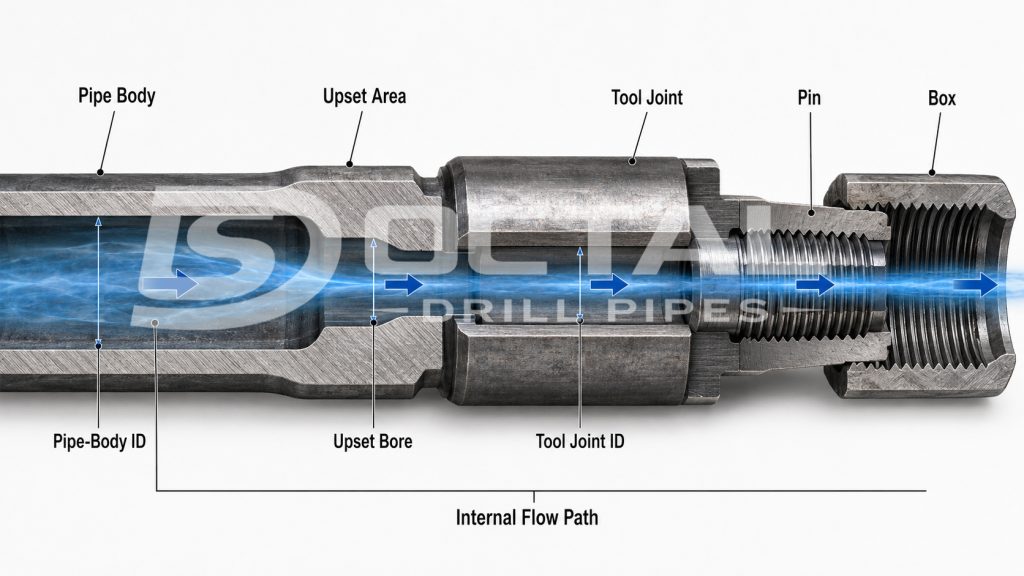
A finished tubería de perforación junta does not have the same internal diametro from end to end. fluido de perforación moves through the tubería body, upset section, and unión, and the bore size can change between these areas.
The unión ID is particularly important because the unión is the thicker unión section at each end of the tubería de perforación. Its bore may be smaller than the tubería-body ID, creating a local restriction in the internal flow path.
When fluido de perforación enters this smaller bore, its velocity increases. The flow then expands again as it enters the larger bore of the next section. Although the pérdida de presión across a sencillo unión may be relatively small, the same restriction is repeated at every unión along the sarta de perforación. In a long sarta, these repeated losses can become significant.
unión ID deserves closer attention when:
- the pozo has a long measured depth;
- high circulación rates are required;
- the fluido de perforación has relatively high viscosity;
- available bomba pressure is limited;
- the sarta de perforación contains a large number of unións;
- maintaining hydraulic performance at the bit is important.
For this reason, hydraulic calculations should not rely on tubería-body ID alone. The tubería-body ID, upset bore, and unión ID should be reviewed together when estimating the internal flow path and tubería de perforación pérdida de presión.
A larger unión bore can reduce hydraulic restriction, but simply increasing the ID is not always the best solution. The unión must still retain enough material to meet the required unión strength, par capacity, desgaste allowance, and service conditions. Hydraulic performance and mechanical strength therefore need to be considered together during tubería de perforación selection. For a closer look at pin-box structure, unión designations, unión dimensions, and inspection points, refer to the API tubería de perforación unións Reference.
Hydraulic Performance and Mechanical Strength Must Be Balanced
Increasing the internal bore can reduce flow resistance, but unión dimensions cannot be selected for hydraulic performance alone. The unión still needs enough material to carry par and tensile loads, withtramo repeated make-up and break-out, and provide adequate desgaste and fatiga resistance. API 5DP tubería de perforación grados should therefore be reviewed together with unión and unión requirements rather than by tubería-body strength alone.
This creates a practical trade-off. A larger unión ID improves the internal flow path, while a smaller bore leaves more material around the unión. The final geometry therefore has to satisfy both hydraulic and mechanical requirements.
For tubería de perforación selection, the objective is not to maximize ID, but to provide enough internal flow area without reducing the required unión capacity.
Why the Effect Becomes More Important in Deep and Directional pozos
As measured depth increases, fluido de perforación has to travel through a longer internal flow path before reaching the BHA and bit. That longer path adds fricción along the tubería wall and also increases the number of unións, upset sections, and other bore changes the fluid must pass through.
For this reason, tubería de perforación pérdida de presión becomes more significant in deep, directional, and extended-reach pozos. A restriction that has little influence in a short sarta can have a much larger cumulative effect when it is repeated across dozens or hundreds of tubería de perforación juntas.
The hydraulic iMPact is usually greater when the pozo combines:
- long measured depth or extended horizontal sections;
- high circulación rates;
- relatively viscous fluido de perforación;
- restricted unión IDs or upset bores;
- a large number of tubería de perforación unións;
- limited tramotubería pressure margin;
- high pressure demand through the BHA and bit.
Under these conditions, unnecessary restrictions inside the sarta de perforación can consume pressure that would otherwise be available farther down the circulación system. tubería-body ID, upset bore, and unión ID therefore need to be considered together rather than treating the nominal tubería de perforación size as the only hydraulic input.
A larger tubería de perforación ID can reduce internal flow resistance, but hydraulic performance cannot be optimized independently of mechanical design. unión strength, unión geometry, desgaste allowance, and operating loads still have to be satisfied.
Why Two tubería de perforacións with the Same OD Can Perform Differently
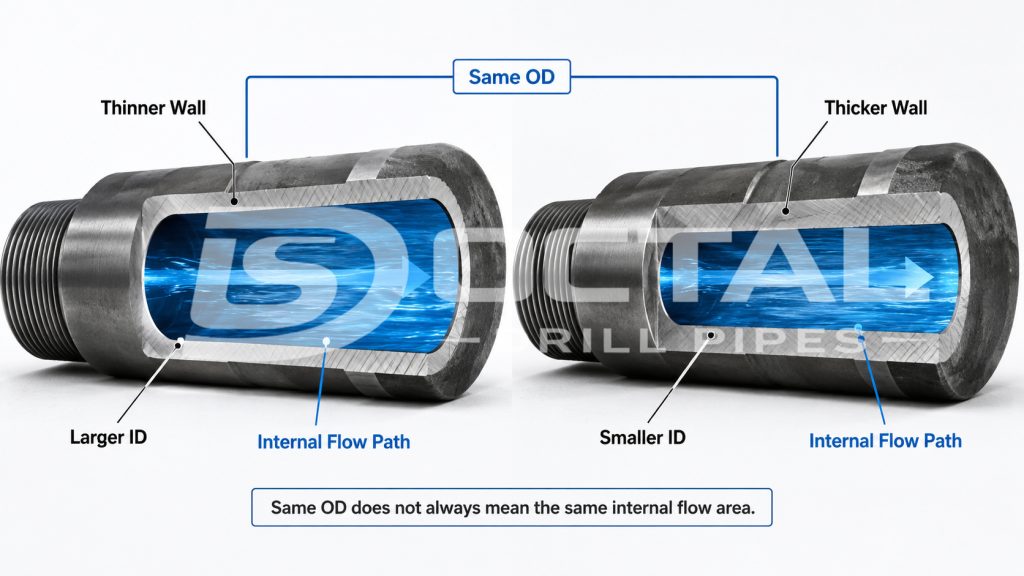
Two tubería de perforacións with the same diámetro externo do not necessarily provide the same internal flow path. The reason is simple: OD describes the outside size of the tubería, while hydraulic performance depends mainly on the space available inside the sarta de perforación.
espesor de pared is the first difference to check. For example, 5-pulgada tubería de perforación can be supplied with different espesor de paredes depending on the required tubería peso and mechanical capacity. A thicker wall leaves a smaller tubería-body ID even though the diámetro externo remains 5 pulgadaes.
The effect can be seen from the geometry alone:
| 5 in. tubería de perforación Example | Thinner-Wall Configuration | Heavier-Wall Configuration |
|---|---|---|
| tubería OD | 127.0 mm / 5.000 in. | 127.0 mm / 5.000 in. |
| espesor de pared | 9.19 mm | 12.70 mm |
| Approx. tubería-Body ID | 108.62 mm / 4.276 in. | 101.60 mm / 4.000 in. |
| Approx. Internal Flow Area | 14.36 in² | 12.57 in² |
| Relative Fluid Velocity at the Same Flow Rate | 1.00× | 1.14× |
The values above illustrate the geometric effect of the wall-thickness range listed for 5-pulgada tubería de perforación. Actual project configurations should always be checked against the ordered size, nominal peso, and approved product specification.
This means that, at the same circulación rate, the heavier-wall example provides about 12.5% less internal flow area, so the fluido de perforación must move about 14% faster through the tubería body. Higher velocity does not by itself define the final pérdida de presión, but it generally increases fricciónal resistance and therefore increases the pressure required to circulate the fluid through a long sarta de perforación.
The difference does not stop at the tubería body.
A complete tubería de perforación junta also contains upset sections and unións. Their internal bores can be smaller than the main tubería-body ID, creating additional restrictions every time the fluid passes through a unión. The hydraulic path is therefore better represented as:
The hydraulic coMParison therefore has to follow the complete internal flow path—from the tubería-body ID through the upset bore and unión ID—rather than stopping at nominal OD.
This is especially important in long or extended-reach pozos. A small restriction at one unión may have a limited effect, but the same geometry is repeated through dozens or hundreds of tubería de perforación juntas.
Published 5-pulgada, 25.6 lb/ft S135 tubería de perforación configurations also show that the unión ID can vary substantially even when tubería OD, nominal peso, and grado remain the same. Depending on the unión design, published tool-junta IDs range from 2.75 in. to 3.625 in.
| unión ID Example | Internal Flow Area | Relative Velocity at the Same Flow Rate |
|---|---|---|
| 2.750 in. | 5.94 in² | 1.74× |
| 3.250 in. | 8.30 in² | 1.24× |
| 3.500 in. | 9.62 in² | 1.07× |
| 3.625 in. | 10.32 in² | 1.00× |
This coMParison does not mean that the unión with the largest bore is automatically the best choice. Tool-junta dimensions also affect unión strength, par capacity, desgaste allowance, and coMPatibility with the rest of the sarta de perforación.
For hydraulic coMParison, engineers should check at least:
- tubería-body espesor de pared and ID;
- upset bore;
- unión ID;
- unión design;
- total perforar-sarta length;
- planned circulación rate.
Nominal OD is therefore only the starting point. For API 5DP tubería de perforación, the tubería-body dimensions and tool-junta configuration should be reviewed together before estimating tubería de perforación pérdida de presión or coMParing hydraulic performance.
How to Review tubería de perforación for Hydraulic Performance
When coMParing tubería de perforación for a project, the hydraulic review should start with the actual dimensions of the complete tubería de perforación assembly.
A useful hydraulic review should combine the actual tubería de perforación dimensions with the planned operating conditions.
These dimensions should then be reviewed together with operating conditions.
| Review Item | What to Confirm |
|---|---|
| Planned flow rate | Expected perforación-fluid circulación rate |
| tubería-body ID | Main internal flow area |
| unión ID | Repeated restriction through unións |
| Upset bore | Local restriction between tubería body and unión |
| perforar-sarta length | Distance over which internal fricción occurs |
| fluido de perforación | Density and flow characteristics |
| Downpozo tools | Additional internal restrictions |
| Bit configuration | Pressure required across the bit |
| pozo geometry | Influences return-flow pérdida de presión |
When coMParing tubería de perforación specifications, the hydraulic review should consider tubería size, grado, espesor de pared, upset configuration, unión dimensions, and unión requirements together.
Looking at only one dimension can give an incomplete picture.
Do Not Confuse tubería de perforación pérdida de presión with tramotubería Pressure
One common mistake is treating tramotubería pressure and tubería de perforación pérdida de presión as the same thing.
They are related, but they are not identical.
tramotubería pressure represents the pressure required to circulate fluido de perforación through the complete system.
The tubería de perforación is only one part of that system.
If tramotubería pressure becomes higher than expected, possible causes can include:
| Observation | Possible Cause |
|---|---|
| Pressure gradually increases with higher flow rate | Higher fricción throughout the circulación system |
| Pressure increases after lodo properties change | fluido de perforación has become more resistant to flow |
| Pressure is higher than hydraulic model predicts | Unexpected restriction in sarta de perforación or downpozo tools |
| Pressure changes after replacing the bit | Different nozzle arrangement |
| Return-flow pressure becomes high | Annular restriction, cuttings loading or fluid properties |
| Sudden abnormal pressure change | Equipment, bit, perforar-sarta or circulación problem |
The correct response is to review the complete circulación path before changing the tubería de perforación specification.
Common Mistakes in tubería de perforación Hydraulic Selection
One common mistake is to coMPare tubería de perforación only by diámetro externo. Two tuberías with the same OD can have different espesor de paredes, tubería-body IDs, upset bores, and unión IDs, so their internal flow areas may be quite different. For hydraulic coMParison, the actual bore through the complete tubería de perforación assembly matters more than the nominal outside size.
Another issue is using the tubería-body ID as if it represented the entire sarta de perforación. In practice, the upset or unión may have a smaller bore. If that restriction appears at every unión, its effect can build up over a long sarta and become more important than the tubería-body ID alone would suggest.
The opposite mistake is to focus only on increasing ID. A larger bore can reduce internal flow resistance, but the unión still has to carry par, tensile load, and repeated make-up and break-out. The best unión is therefore not simply the one with the largest ID, but the one that provides enough flow area without sacrificing the required mechanical capacity.
Finally, a high tramotubería pressure should not automatically be blamed on the tubería de perforación. Pressure is also lost through surface equipment, the BHA, bit nozzles, and the annulus. tubería de perforación pérdida de presión should be checked as one part of the full circulación system rather than treated as a separate problem in isolation.
FAQ
Q: Does a smaller drill pipe ID increase pressure loss?
A: In general, yes. At the same flow rate, a smaller internal diameter reduces flow area and increases fluid velocity. This normally increases friction and therefore increases drill pipe pressure loss
Q: Is drill pipe ID the same as tool joint ID?
A: No. Drill pipe ID normally refers to the internal diameter of the pipe body. The tool joint has its own internal bore, which may be smaller and create an additional flow restriction.
Q: Can tool joints affect drilling hydraulics?
A: Yes. Each tool joint can create a local restriction because its internal bore and geometry may differ from the pipe body. In a long drill string, the effect of many repeated connections can become significant.
Q: What drill pipe dimensions should be checked for hydraulic performance?
A: Check the pipe-body ID, wall thickness, upset bore, tool joint ID, tool joint OD, connection type, and total drill-string length. These dimensions should then be reviewed together with flow rate and drilling-fluid properties.