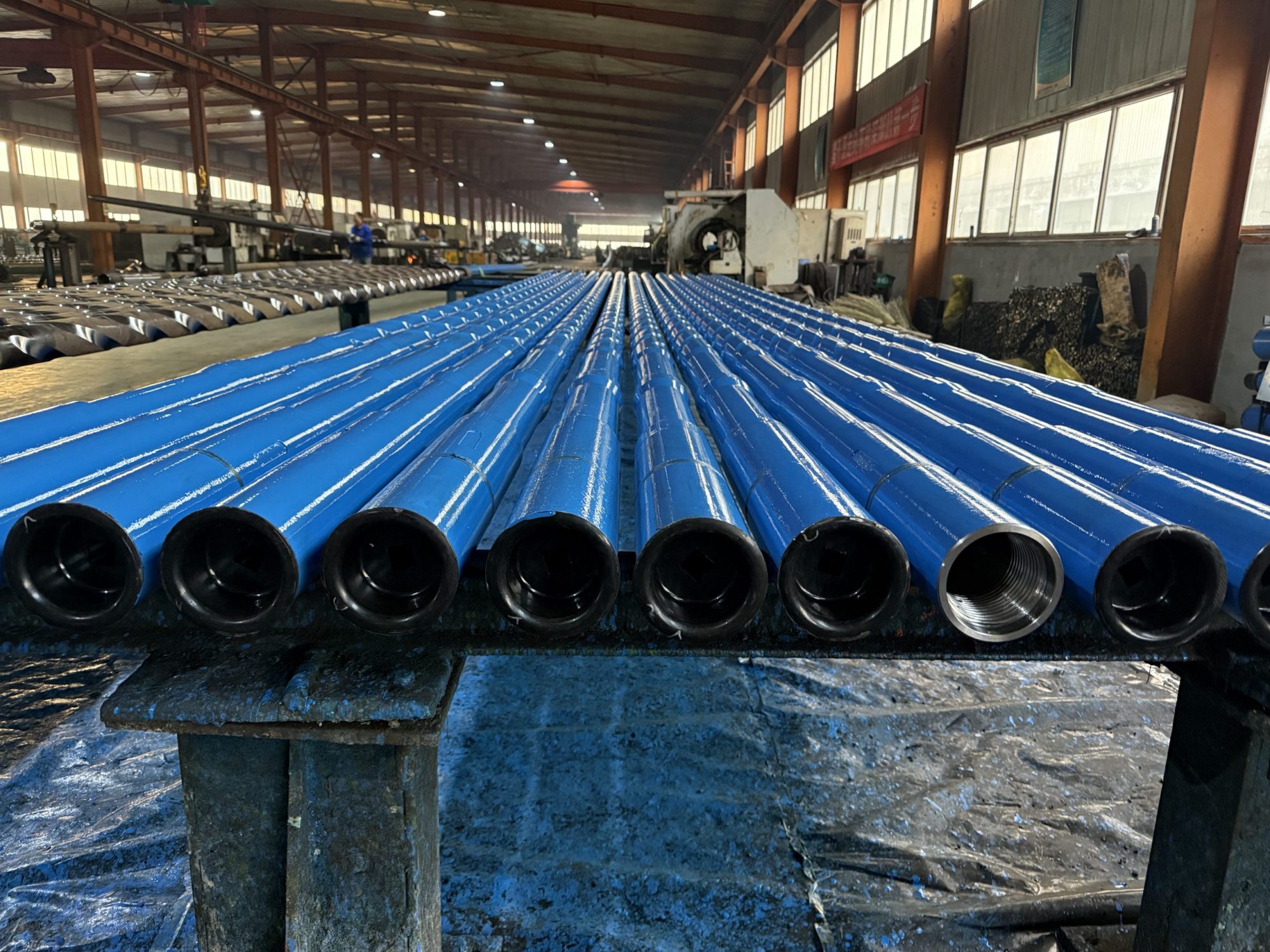
S135 drill pipe is selected for drilling strings that need higher tensile capacity, higher torque resistance and better fatigue control than lower API drill pipe grades. It is used in deep wells, directional wells, horizontal wells, and high-load drilling sections where the pipe body, tool joint, weld zone, and thread connection are all part of the acceptance risk.
Octal Steel supplies API 5DP S135 drill pipe with full specifications including size range, length range, upset type, tool joint connection, internal coating, hardbanding, and inspection documents. Buyers should verify that the delivered drill pipe can pass dimensional inspection, mechanical testing, NDT, thread inspection, and document review before field use.
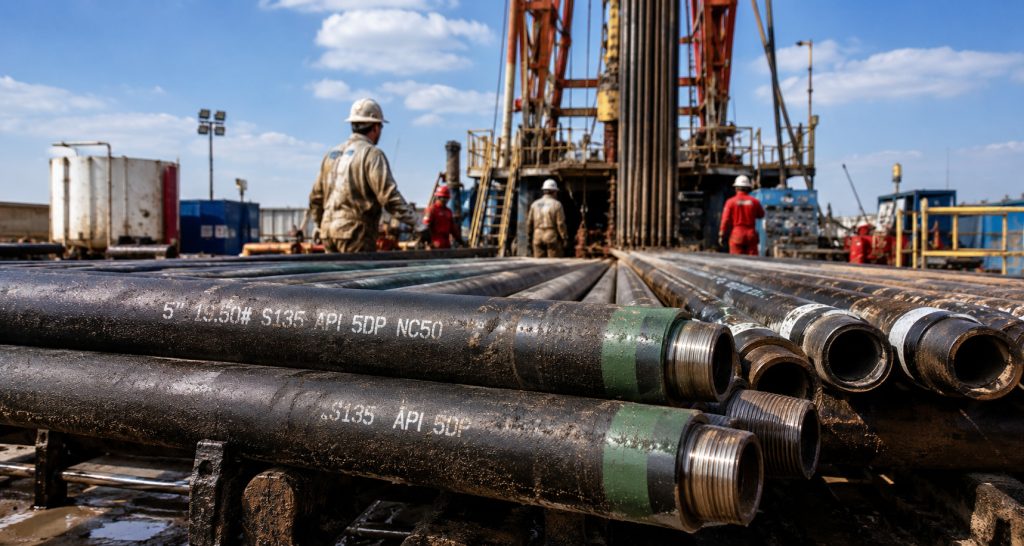
S135 Drill Pipe Material and Specification
S135 is a high-strength drill pipe grade under API 5DP. It is normally selected when the drilling program requires higher yield strength than G105, especially in wells with higher torque, higher tensile load, or greater fatigue risk.
Compared with G105 drill pipe, S135 provides a higher yield strength range and is better suited for deeper wells, higher torque demand, and more severe fatigue conditions. If the drilling program does not require S135-level strength, buyers can review our G105 Drill Pipe specification for lower-load drilling strings.
The S135 pipe body is designed with 135 ksi minimum yield strength. Buyers should also check maximum yield strength, tensile strength, elongation, impact energy, tool joint properties, and weld zone hardness. These values determine whether the drill pipe can pass project inspection and field acceptance.
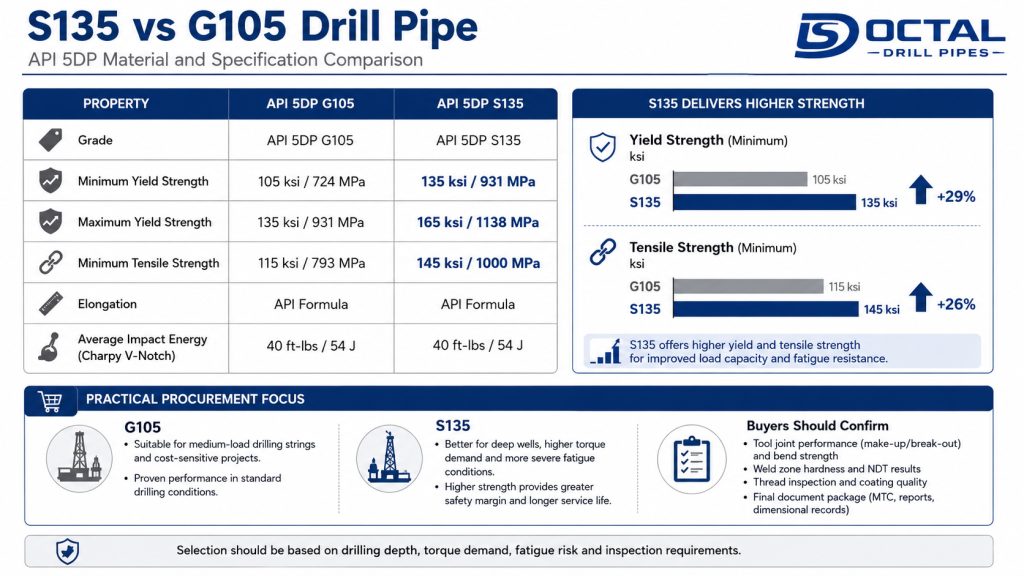
Table Code: S135 Drill Pipe Mechanical Properties
| Inspection Item | S135 Drill Pipe Requirement | Buyer Verification Point |
|---|---|---|
| Standard | API 5DP | Confirm API edition, PSL requirement and project inspection level before order release. |
| Minimum Yield Strength | 135 ksi / 931 MPa | Check MTC values by heat number and verify compliance with the purchase specification. |
| Maximum Yield Strength | 165 ksi / 1138 MPa | Confirm yield range to avoid uncontrolled hardness or reduced toughness. |
| Minimum Tensile Strength | 145 ksi / 1000 MPa | Review tensile test records and heat treatment batch consistency. |
| Elongation | API formula | Confirm ductility requirement for cyclic drilling load and fatigue resistance. |
| Average Impact Energy | 40 ft-lbs / 54 J | For low-temperature wells, specify test temperature and minimum absorbed energy. |
| Tool Joint Requirement | 120–165 ksi yield range or per approved tool joint design | Check tool joint MTC, thread inspection report and weld zone hardness record. |
S135 Drill Pipe Specs and Ordering
S135 drill pipe should be purchased by complete technical description, not by grade alone. A proper enquiry should include OD, nominal weight, wall thickness, upset type, connection, length range, internal coating, hardbanding, and inspection standard.
Common API drill pipe sizes include 2-3/8″, 2-7/8″, 3-1/2″, 4″, 4-1/2″, 5″, 5-1/2″, and 6-5/8″. The actual weight, ID, drift diameter, and tool joint OD/ID should be confirmed according to the selected API 5DP table or approved manufacturer datasheet.
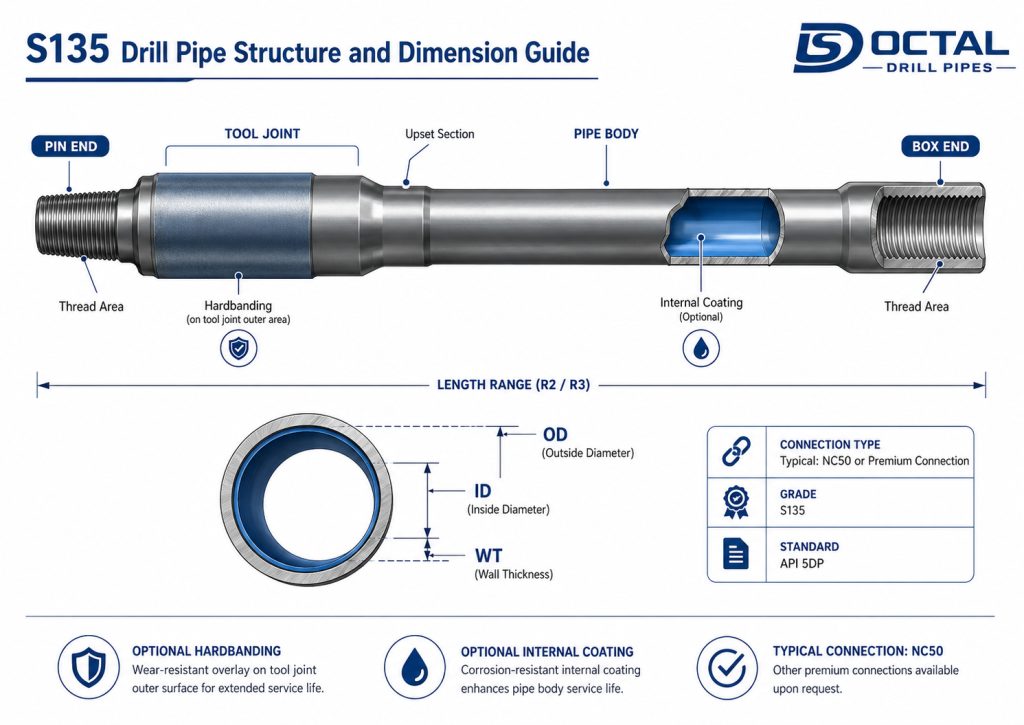
S135 Drill Pipe Ordering Specification
| Ordering Item | Common Options | Why It Matters for Procurement |
|---|---|---|
| Product | S135 Drill Pipe | Defines high-strength drill pipe grade for drilling string design |
| Standard | API 5DP | Controls mechanical properties, dimensions, marking and acceptance rules |
| OD Range | 2-3/8″ to 6-5/8″ | Must match rig capacity, well program and BHA design |
| Length Range | R1 / R2 / R3 | Affects handling, string design, shipping plan and rig floor operation |
| Upset Type | EU / IU / IEU | Influences connection strength, internal clearance and fatigue performance |
| Connection | NC, IF, FH, REG or project-specified connection | Must be compatible with existing drill string and tool joint design |
| Internal Coating | Optional DPC, TK-34, TK-34XT, TK-34P or equivalent coating | Used for corrosion control, wax prevention and lower friction loss |
| Hardbanding | ARNCO / ARMACOR or approved equivalent | Improves wear resistance and helps protect casing during rotation |
| Documents | MTC, NDT report, dimensional report, thread inspection report, coating report, packing list | Required for receiving inspection, traceability and field acceptance |
API 5DP S135 Drill Pipe Grade and Performance
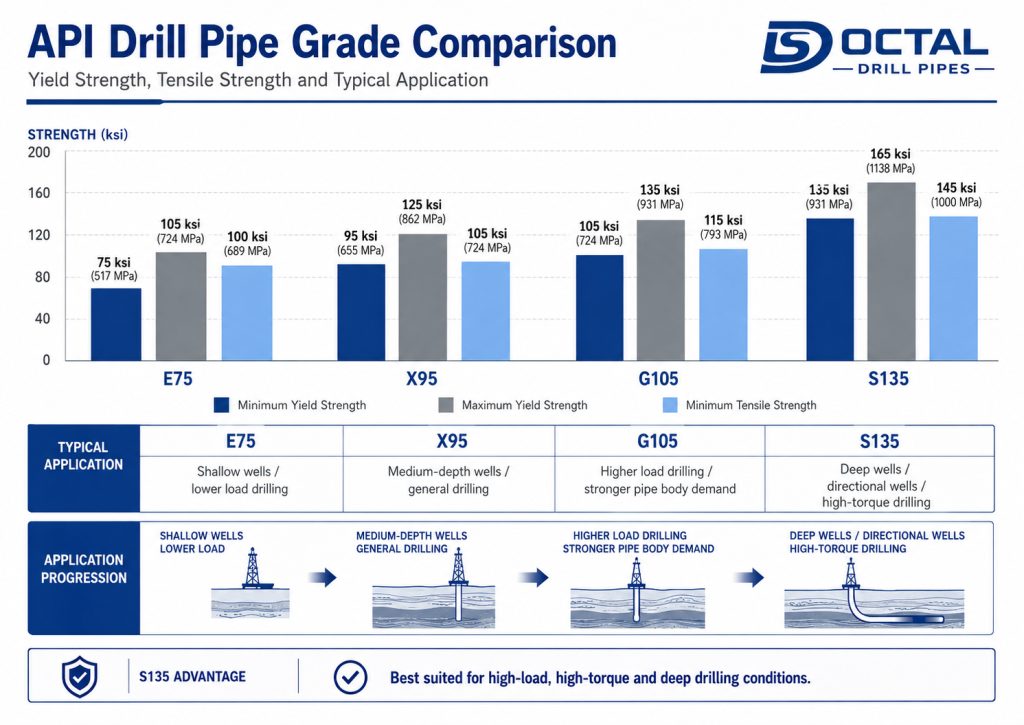
API drill pipe grades are not interchangeable by name only. E75, X95, G105, and S135 have different yield strength ranges and are selected according to drilling depth, torque demand, tensile load, and fatigue risk.
For buyers, grade comparison should be checked together with the final datasheet and inspection plan.
API Drill Pipe Grade Comparison
| Grade | Minimum Yield Strength | Maximum Yield Strength | Minimum Tensile Strength | Typical Use |
|---|---|---|---|---|
| E75 | 75 ksi / 517 MPa | 105 ksi / 724 MPa | 100 ksi / 689 MPa | Standard drilling conditions with lower load demand |
| X95 | 95 ksi / 655 MPa | 125 ksi / 862 MPa | 105 ksi / 724 MPa | Medium-depth wells and general drilling strings |
| G105 | 105 ksi / 724 MPa | 135 ksi / 931 MPa | 115 ksi / 793 MPa | Higher load drilling where stronger pipe body is required |
| S135 | 135 ksi / 931 MPa | 165 ksi / 1138 MPa | 145 ksi / 1000 MPa | Deep well, directional well and high-torque drilling applications |
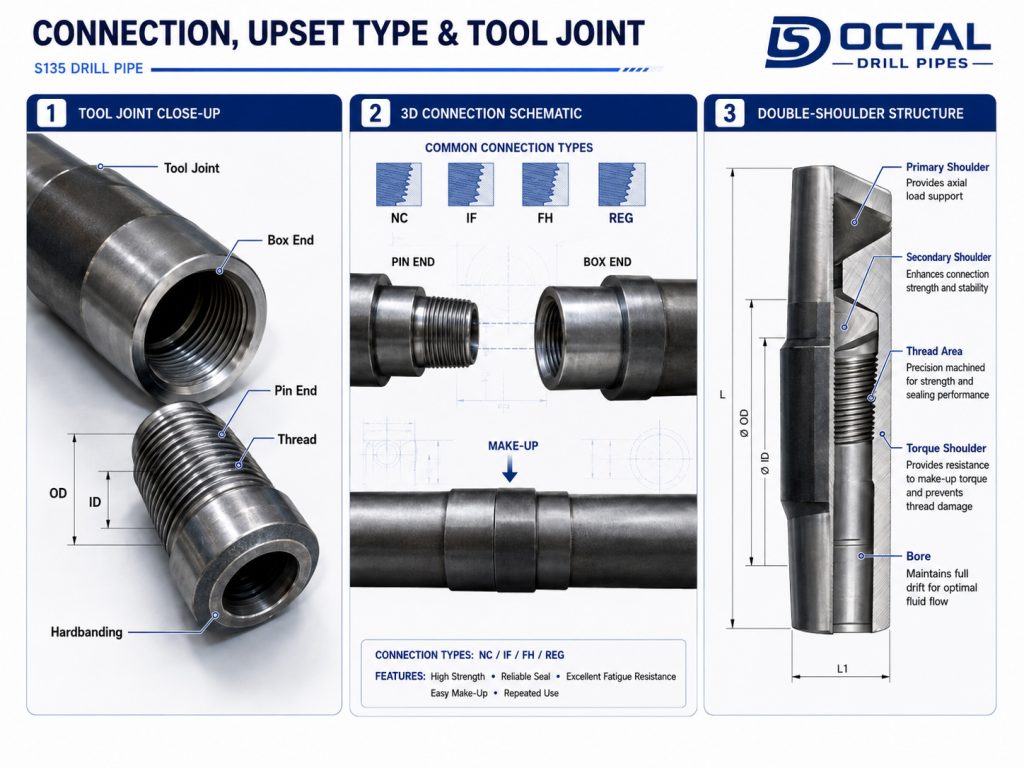
S135 Drill Pipe Connection, Upset Type and Tool Joint Control
For S135 drill pipe, connection control is more important than the grade name. The pipe body may meet API 5DP mechanical properties, but field failure can occur if the tool joint, upset transition, thread shoulder, or weld zone is not properly controlled.
Common connection options include NC, IF, FH, and REG. The final selection should be checked against the existing drill string, BHA components, torque requirement, ID clearance, and rig operation practice.
Where higher torque capacity is required, double-shoulder or premium tool joint designs may be considered. Buyers should confirm connection drawing, make-up torque, thread inspection record, tool joint dimensions, and compatibility with the existing drill string before order release.
Connection and Tool Joint Selection
| Connection / Design | Main Purpose | Buyer Should Confirm |
|---|---|---|
| NC / IF / FH / REG | Used where the existing string or drilling tool design requires matching connection | Interchangeability, torque rating, and compatibility with existing inventory |
| Double-Shoulder Connection | Improves torque capacity for high-torque drilling | Approved connection drawing, make-up torque, and field service history |
| Tool Joint Hardbanding | Improves wear resistance and reduces tool joint OD loss | Hardbanding type, casing-friendly requirement, and repair procedure |
| Internal Coating | Reduces corrosion risk and friction loss inside the drill pipe | Coating type, thickness, holiday test, and coating repair criteria |
Manufacturing Process and Automated Production Equipment
Each step should be controlled against the approved datasheet and inspection plan.
Drill Pipe Body Production Process
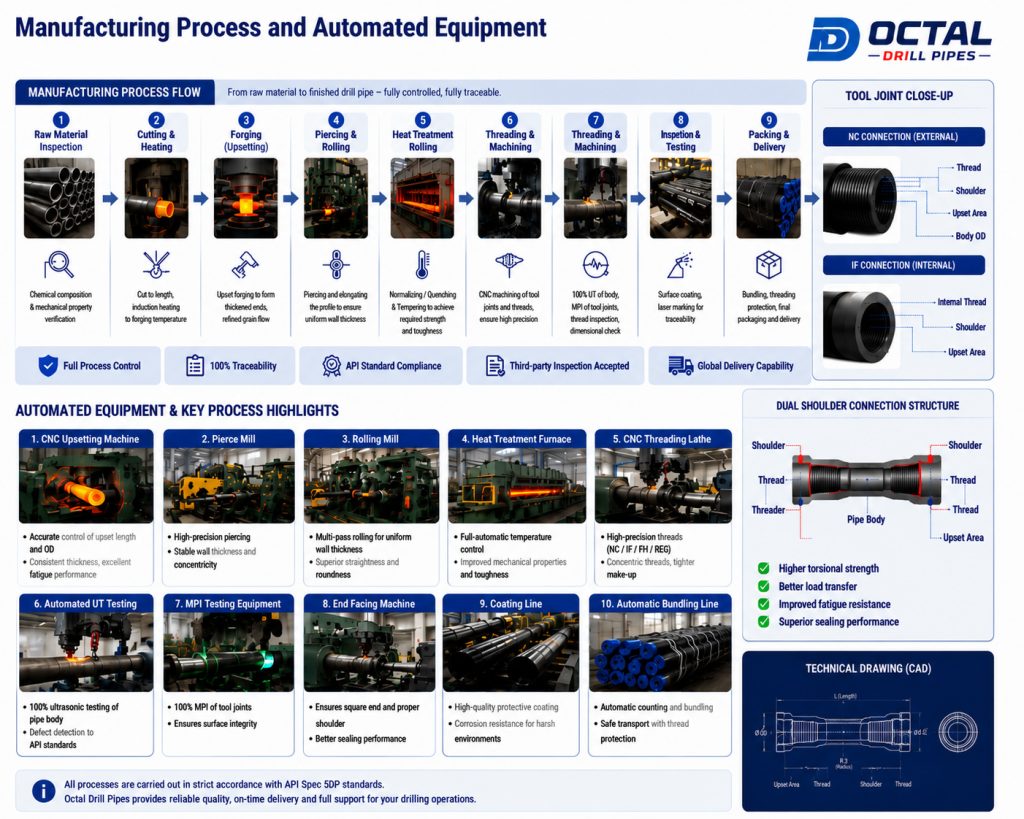
The drill pipe body production route normally includes billet heating, piercing, rolling, stretch reducing, NDT inspection, cutting, upsetting, heat treatment, straightening, and final dimensional inspection. This ensures wall thickness, straightness, pipe body strength, and upset transition quality.
Tool Joint Processing and Friction Welding
Tool joint production includes material preparation, heat treatment, CNC machining, thread processing, thread inspection, and dimensional verification. After tool joint preparation, the pipe body and tool joint are joined by friction welding. The weld zone then undergoes heat treatment, hardness inspection, NDT, and final finishing. Poor weld zone heat treatment or inaccurate thread machining can cause early field failure even when the pipe body grade is correct.
Automated Production Equipment for Stable S135 Drill Pipe Quality
Advanced equipment such as pipe end upsetting units, MFL testing equipment, continuous heat treatment furnaces, online hardness testing equipment, CNC tool joint machining centers, friction welding machines, and robotic handling systems helps improve dimensional consistency, heat treatment uniformity, weld zone reliability, and thread machining accuracy. Automated equipment supports stable wall thickness control, uniform heat treatment, repeatable weld zone quality, accurate thread machining, and consistent inspection records.
Inspection, Testing and Traceability Documents
A purchase order for S135 drill pipe should define inspection and document requirements before production. Recommended inspection points include pipe body visual inspection, dimensional check, wall thickness verification, straightness inspection, NDT, hardness test, mechanical test, impact test, tool joint dimensional inspection, thread gauging, weld zone inspection, coating inspection, and hardbanding inspection if required.
The final document package should include MTC, dimensional report, NDT report, thread inspection report, hardness test record, coating report, hardbanding record, packing list, and shipping marks. This ensures buyers can complete receiving inspection and reduce field acceptance disputes.
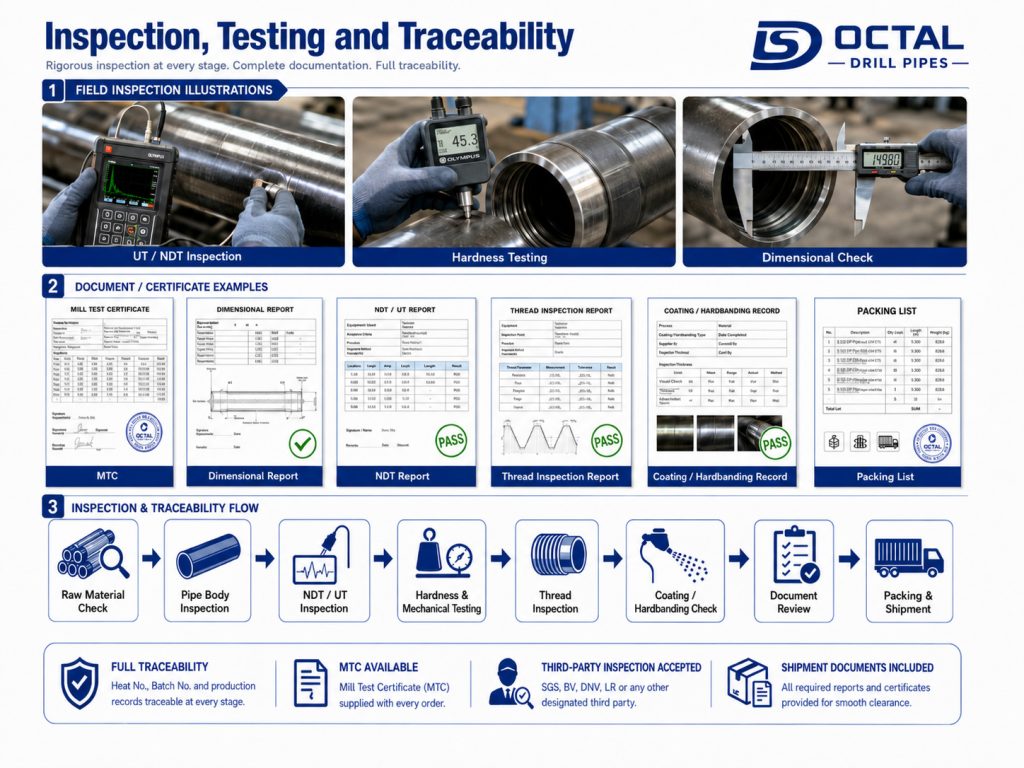
| Inspection Item | Control Point | Document Required |
|---|---|---|
| Dimensional Inspection | OD, wall thickness, length, straightness, tool joint OD/ID and drift | Dimensional inspection report |
| NDT | Pipe body, weld zone and tool joint inspection according to ITP | NDT report |
| Thread Inspection | Thread profile, shoulder, gauge, surface condition and protector fitting | Thread inspection report |
| Hardness Test | Pipe body, tool joint and weld zone hardness control | Hardness test record |
| Internal Coating | Coating type, visual condition, thickness and holiday test | Coating inspection report |
| Hardbanding | Hardbanding type, width, thickness, surface condition and repair rule | Hardbanding record |
| Packing and Shipment | Thread protectors, bundle marking, packing list and shipping marks | Packing list / photo record |
Internal Coating and Hardbanding Options
Internal coating and hardbanding should be selected according to corrosion risk, mud condition, friction loss, casing protection requirement, and expected drilling interval.
Internal coating options include DPC, TK-34, TK-34XT, TK-34P, TK-236, and TK-216 for corrosion control, friction reduction, and service life improvement. Buyers should specify coating type, thickness, holiday test, inspection report, and repair acceptance criteria.
Hardbanding options such as ARNCO and ARMACOR are used to reduce tool joint wear and help protect casing during rotation. Buyers should confirm hardbanding grade, width, thickness, hardness range, casing-friendly requirement, and repair procedure before order release.
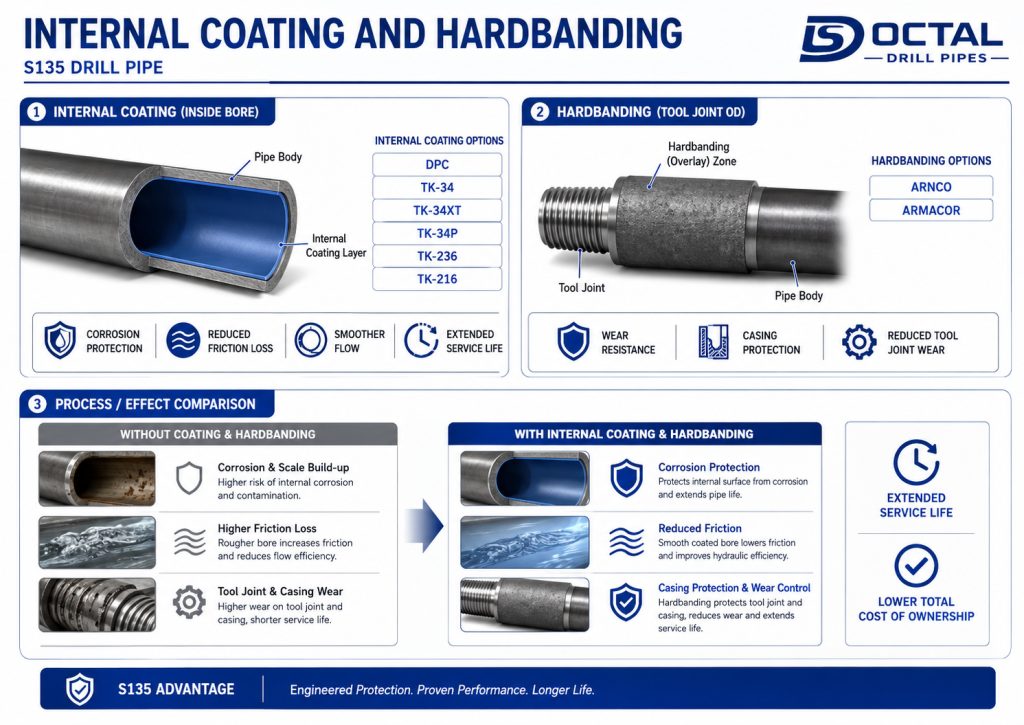
| Option | Main Function | Buyer Should Specify |
|---|---|---|
| TK-34 Internal Coating | Corrosion protection and reduced drilling power loss | Application environment, inspection report and coating certificate |
| TK-34XT Internal Coating | Improved wear resistance for severe service | Wear requirement, coating thickness and holiday inspection |
| TK-34P Internal Coating | Smoother surface and corrosion resistance for harsh environments | H2S condition, coating inspection and repair standard |
| ARNCO Hardbanding | Tool joint wear control with casing-friendly performance | Hardbanding grade, width, thickness and repair procedure |
| ARMACOR Hardbanding | Wear resistance with hardness control (45 HRC–60 HRC) | Hardbanding grade, casing protection and tool joint wear requirement |
High-Strength Drill Pipe for Deep Well and Directional Drilling
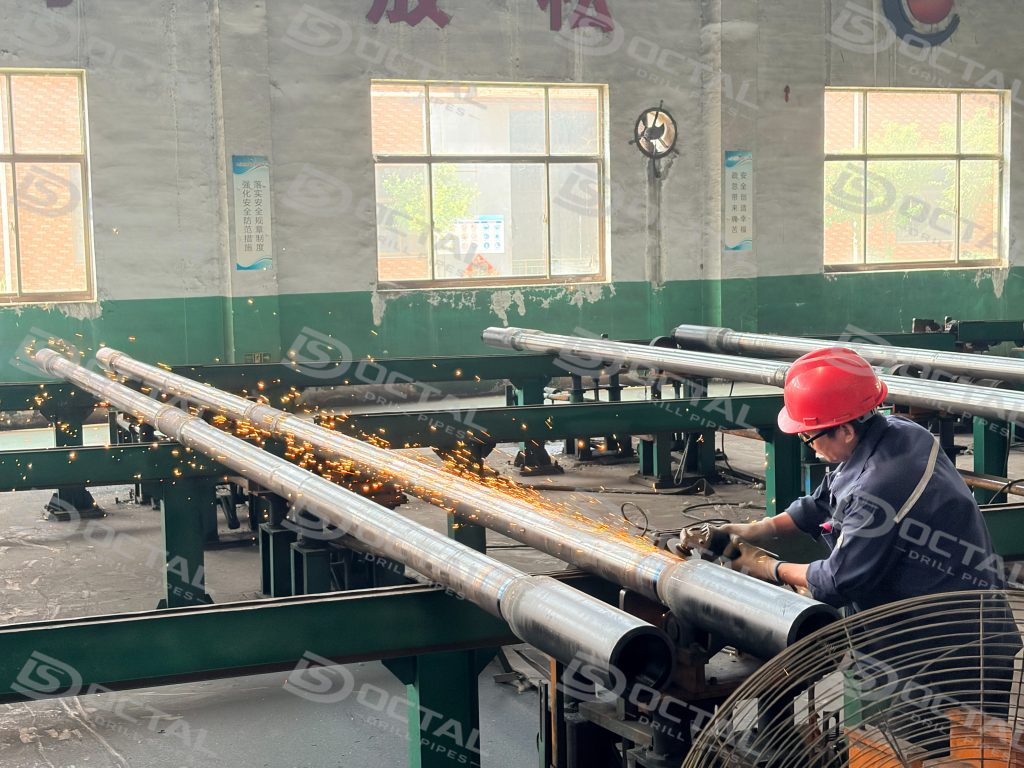
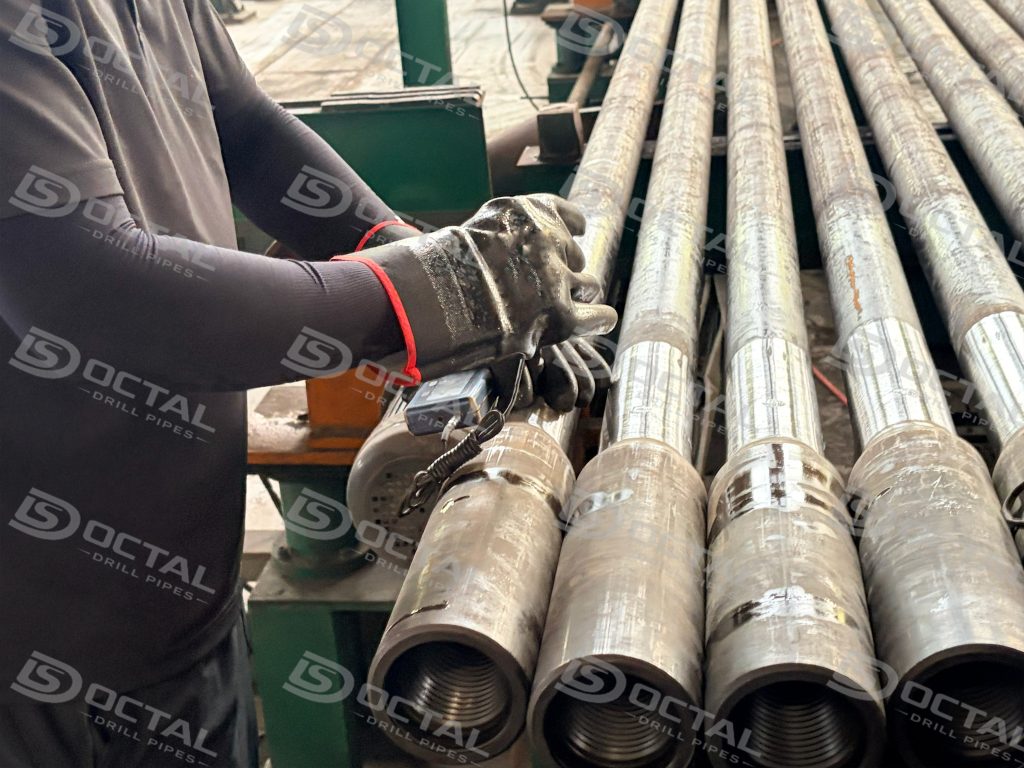
Typical working conditions include deep vertical wells, high-angle directional wells, horizontal wells, extended-reach drilling, and drilling sections with high rotary torque.
In these wells, the drill pipe may experience repeated bending near the build section, high surface torque, high tensile load during tripping, vibration during rotary drilling, and connection stress during make-up and breakout.
For more demanding conditions, high-torque or special-purpose drill pipe may be considered. Product options include high-torque double-shoulder designs, high-toughness BH135T, V150 / U165 high-strength drill pipe, sour-service drill pipe, and horizontal directional drilling drill pipe.
S135 Drill Pipe Equivalent: What Buyers Should Confirm Before Ordering
S135 drill pipe should not be replaced by another grade or “equivalent” product without checking the full technical condition. Equivalent comparison must include mechanical properties, connection type, tool joint design, impact toughness, hardness control, coating, hardbanding, and inspection level.
Higher-strength grades such as V150 or U165 may provide higher yield strength than S135, but they are not automatic replacements for every drilling program.
When a customer asks for an S135 drill pipe equivalent, the safest approach is to compare the full datasheet, including grade, OD, nominal weight, wall thickness, upset type, connection, torque capacity, inspection standard, and required documents.
Why Choose Octal Steel for S135 Drill Pipe
Octal Steel supports S135 drill pipe orders with specification review, mill coordination, inspection planning, and document preparation. Before production, we help buyers check whether the enquiry clearly defines size, grade, connection, upset type, length, coating, hardbanding, and inspection documents.
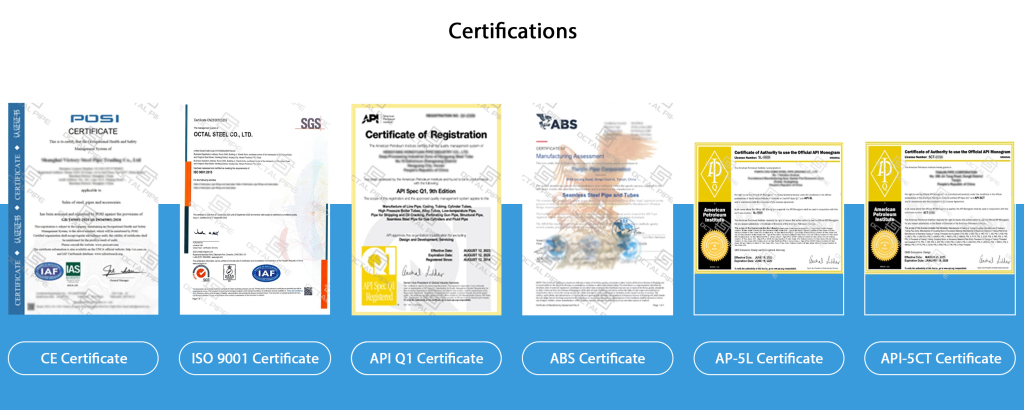
For project orders, Octal Steel can coordinate API 5DP drill pipe supply with full inspection documents and third-party inspection when required.
The goal is to make the delivered drill pipe match the drilling program, pass receiving inspection, and reduce avoidable field risk caused by unclear specifications or incomplete documents.
FAQ
Q1: What is S135 drill pipe used for?
A1: S135 drill pipe is used for deep wells, directional wells and high-torque drilling where higher pipe body strength is required.
Q2: What standard does S135 drill pipe follow?
A2: S135 drill pipe is normally supplied according to API 5DP, with material, dimensions, marking and inspection controlled by the order specification.
Q3: What should buyers confirm before ordering S135 drill pipe?
A3: Buyers should confirm OD, weight, wall thickness, length, upset type, connection, coating, hardbanding and required inspection documents.
Q4: Can S135 drill pipe be supplied with internal coating or hardbanding?
A4: Yes. Internal coating and hardbanding can be supplied according to corrosion risk, casing protection and drilling conditions.