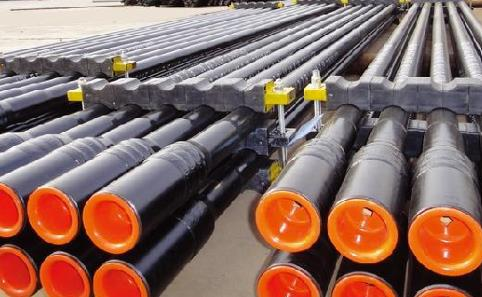
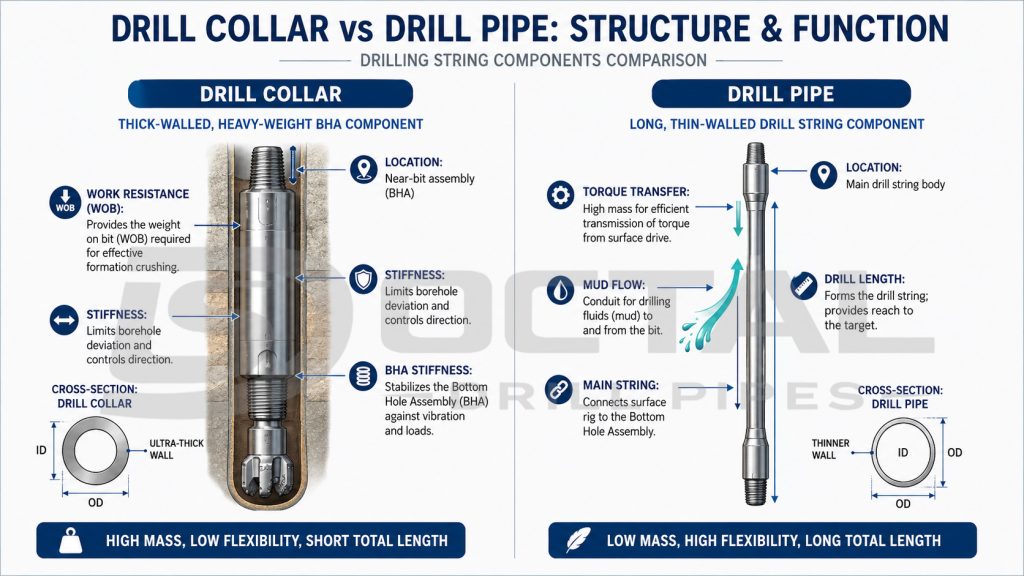
A drill collar is a heavy-wall drilling tool installed near the bit in the bottom hole assembly (BHA). Its main job is to provide weight on bit, add stiffness around the bit, and help stabilize the drilling assembly during rotation, compression and downhole vibration.
A drill pipe is the main tubular section of the drill string. It connects the surface drive system to the bottom hole assembly, transmits torque, and carries drilling fluid down to the bit. Compared with a drill collar, drill pipe is lighter and more flexible, so it can work through long vertical, deviated or horizontal well sections.
The core difference is simple: drill pipe moves power and drilling fluid through the string, while drill collar adds weight and rigidity near the bit. In a complete drill string, these components work together rather than replace each other.
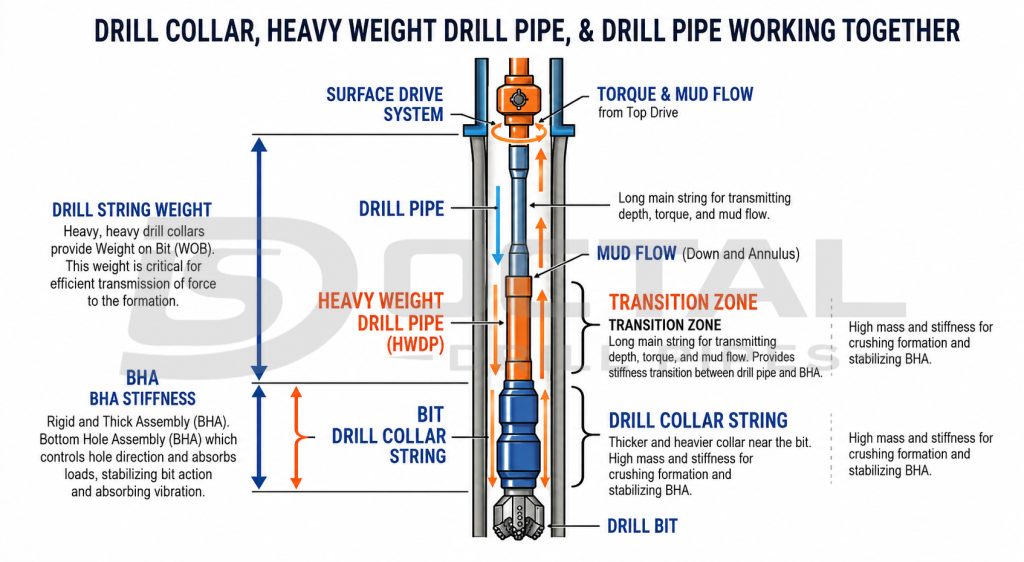
The drill collar supplies near-bit weight and stiffness. HWDP works as a transition section between the stiff collar and the more flexible drill pipe. Drill pipe then carries torque, drilling fluid and tensile load through the main string. This working relationship is the key to understanding drill collar vs drill pipe.
Drill Collar vs Drill Pipe: Key Differences
The main difference between a drill collar and a drill pipe is their role in the drill string. Drill pipe transmits torque and drilling fluid through the main string, while drill collar provides concentrated weight and stiffness near the bit to support stable weight on bit.
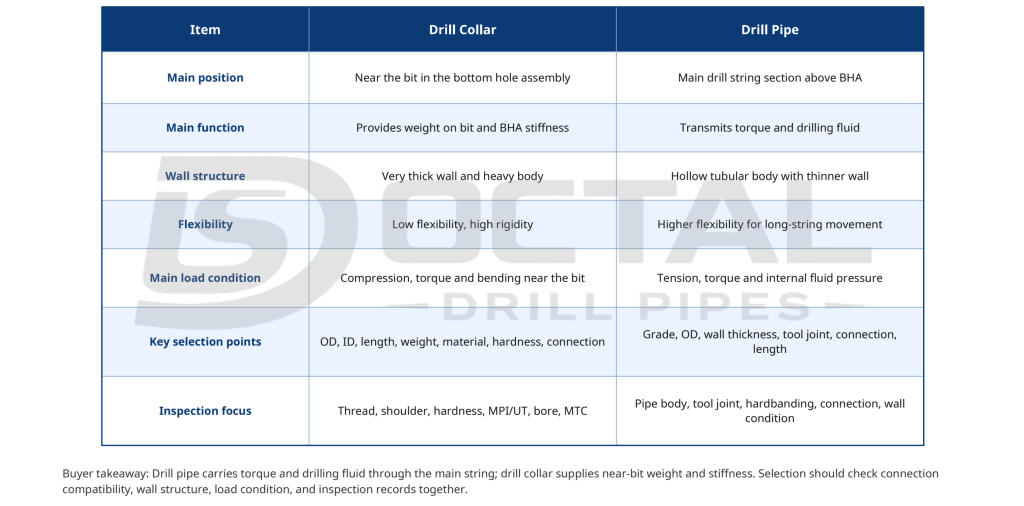
Download:Drill Collar vs Drill Pipe: Key Differences
How Drill Collar and Drill Pipe Work Together
In a drill string, the assembly sequence is not only a layout issue. Each component changes the way weight, torque, bending stress and drilling fluid move through the string. If the transition between drill collar, HWDP and drill pipe is not checked properly, the risk is usually not visible at surface, but it may appear downhole as thread damage, connection fatigue, unstable bit movement, poor directional control or restricted mud flow.
A typical bottom hole assembly is arranged from the bit upward, but the key point is the load path:
- Drill collars are placed near the bit because this is where concentrated weight and stiffness are needed.
- Heavy weight drill pipe works as a transition section, reducing the stiffness jump between the rigid collar section and the more flexible drill pipe.
- Drill pipe carries the long string load, transmits torque from surface, and provides the main flow path for drilling fluid.
- Bit subs, stabilizers and crossover subs must match the connection type, shoulder condition and bore requirement, otherwise the whole assembly may be correct in drawing but unreliable in field makeup.
For this reason, the assembly should be reviewed as a working system, not as separate tubular products.
| Check Point | Why It Matters in the Drill String | Main Risk if Ignored |
|---|---|---|
| Connection compatibility | Drill collar, HWDP, drill pipe and subs may use different connection sizes or thread forms. The pin and box must match before makeup. | Wrong connection, poor shoulder contact, thread galling or failed makeup |
| Shoulder face condition | Rotary shouldered connections transfer torque through the shoulder contact surface, not only through the threads. | Torque loss, connection loosening, shoulder damage or fatigue cracking |
| Stiffness transition | Drill collars are much stiffer than drill pipe. HWDP helps reduce the sudden stiffness change above the BHA. | Stress concentration, fatigue failure, pipe body bending damage |
| Internal bore continuity | Mud must pass through the drill pipe, HWDP, drill collar and bit without unexpected restriction. | Pressure loss, poor hole cleaning, reduced hydraulic performance |
| Tool position in BHA | Drill collars need to stay near the bit to provide weight on bit and stabilize the lower assembly. | Poor WOB control, vibration, bit whirl or unstable drilling direction |
| Traceability and records | Heat number, MTC, thread inspection and NDT records help verify that the supplied tools match the order and inspection scope. | Mixed material, unverified quality, receiving inspection rejection |
The practical selection question is therefore not only “drill collar or drill pipe.” The better question is whether the full assembly can transmit weight, torque and mud flow while keeping the connection and stiffness transition under control.
Drill Collar vs Heavy Weight Drill Pipe
Heavy weight drill pipe is often misunderstood as a substitute for drill collar. In most BHA designs, it is better understood as a transition component.
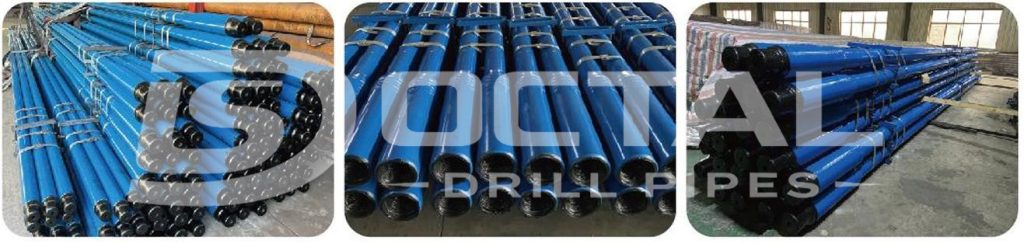
| Item | Drill Collar | Heavy Weight Drill Pipe |
|---|---|---|
| Main role | Maximum near-bit weight and stiffness | Transition between drill collar and drill pipe |
| Position | Close to bit | Above drill collar section |
| Stiffness | Highest | Between drill collar and drill pipe |
| Function in BHA | Apply WOB and stabilize bit | Reduce stiffness change and fatigue risk |
| Common concern | Hardness, thread, shoulder, magnetic property | Wear, hardbanding, tool joint, transition stress |
A drill collar provides the main BHA mass. HWDP helps reduce the sudden stiffness change between the drill collar section and drill pipe. For directional wells and deeper drilling programs, this transition can be important for fatigue control and drill string stability.
Function Comparison: Weight, Torque and Mud Flow
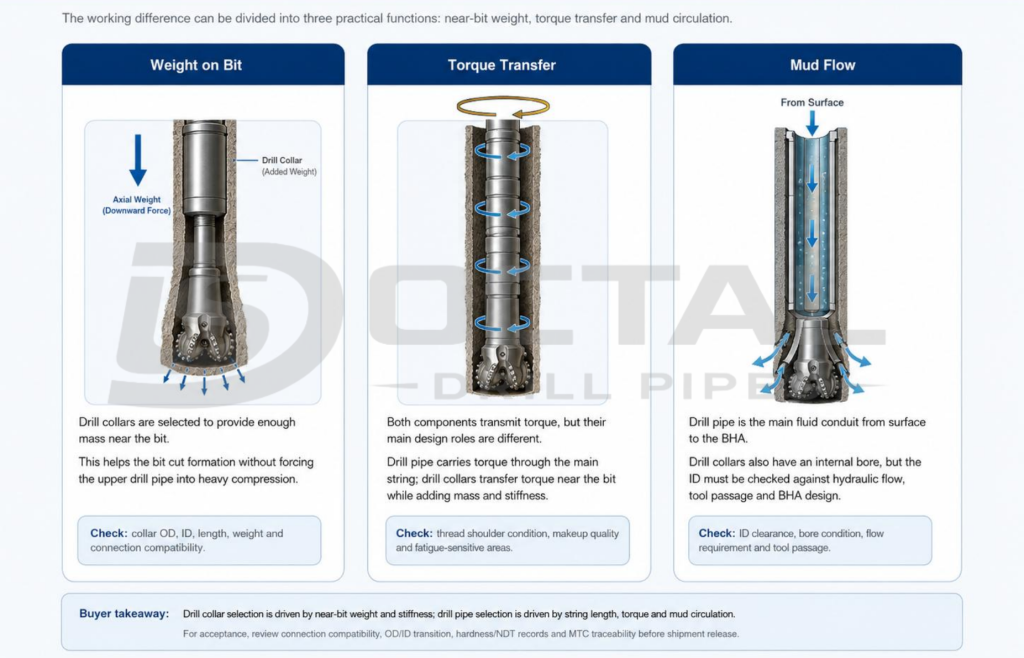
The working difference between drill collar and drill pipe can be understood through three main functions: weight placement, torque transfer and mud flow control.
Weight on bit:
Drill collars provide concentrated mass near the bit. This helps the bit cut the formation more steadily and keeps the lower BHA stiff under compression. By placing weight near the bit, the upper drill pipe can remain mainly in tension, reducing buckling and fatigue risk along the main string.
Torque transfer:
Both drill pipe and drill collars transmit torque, but drill pipe carries torque over the long drill string from the surface drive system. Drill collars transfer torque near the bit while also keeping the lower assembly rigid and stable. Connection shoulder condition, thread profile and proper makeup are important because poor contact can affect torque transmission and BHA stability.
Mud flow:
Drill pipe is the main path for drilling fluid from surface to the BHA. Fluid passes through drill pipe, HWDP and drill collars, then exits through the bit nozzles for cooling and cuttings removal. Drill collar ID should still be checked against hydraulic flow, tool passage and MWD/LWD requirements to avoid pressure loss or bore restriction.
In practice, these functions should be reviewed together. The drill collar provides near-bit weight and stiffness, the drill pipe carries the long string load and flow path, and HWDP helps smooth the transition between them.
When Drill Collar Selection Matters Most
Drill collar selection becomes more critical when the well condition increases load, vibration or survey sensitivity.
1.High WOB Drilling
When the drilling program requires higher weight on bit, the collar section must provide enough mass without creating connection mismatch or handling problems. OD, ID, length and connection type should be checked together.
2.Hard Formation Drilling
Hard formations can increase vibration and bit bounce. In this condition, the drill collar’s stiffness, connection quality and hardness control become more important because small defects around the thread or shoulder can develop into field problems.
3.Directional or Deviated Wells
In deviated wells, wall contact and torque/drag increase. Spiral drill collars or HWDP transition sections may be reviewed to reduce contact area, stiffness jump or fatigue risk.
4.MWD and LWD Assemblies
When survey tools are used, non-magnetic drill collars may be required around the measurement zone. In this case, magnetic property control, material route, connection compatibility and inspection records should be confirmed before shipment.
Connection Between Drill Collar and Drill Pipe
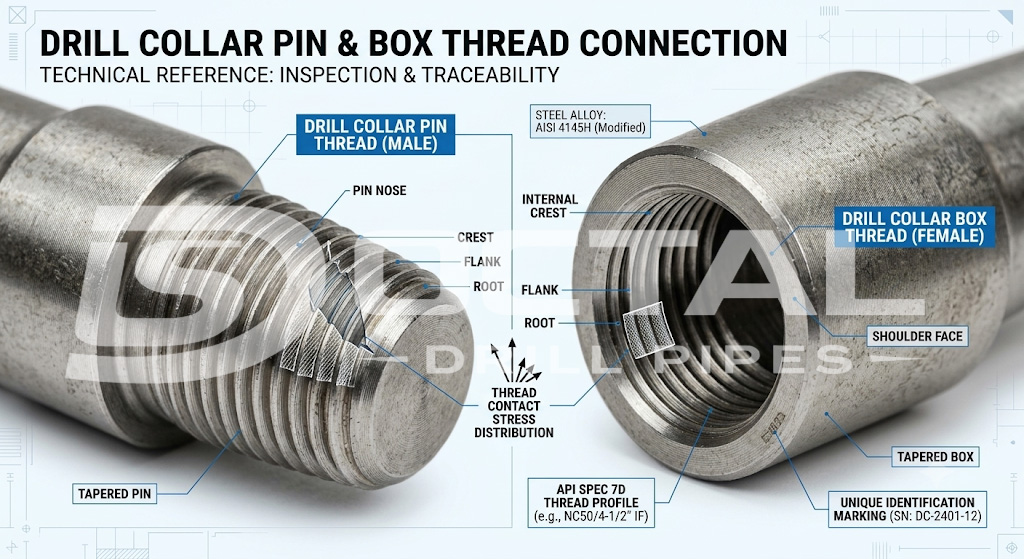
Drill collar and drill pipe are connected through threaded connections, but they may not always connect directly size-to-size. Depending on the BHA design, HWDP, crossover subs or other tools may be used to match connection type, OD, ID and stiffness transition.
For drill collars, the connection area should not be treated as a simple thread. The inspection focus should include thread profile, taper, lead, shoulder face, surface condition and gauge check. Wrong connection matching or poor shoulder condition can create makeup problems, galling, torque loss or early fatigue damage.
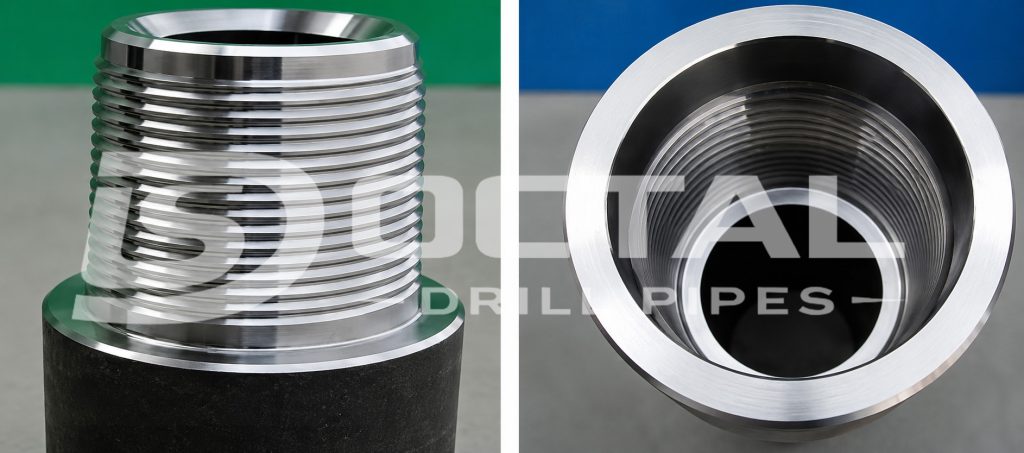
Inspection Focus: Why Drill Collar Is Checked Differently
Drill pipe inspection often focuses on pipe body condition, tool joint, wall thickness, hardbanding and connection wear. Drill collar inspection is more concentrated on heavy-body acceptance, connection integrity and heat-treatment consistency.
For drill collars, common inspection items include:
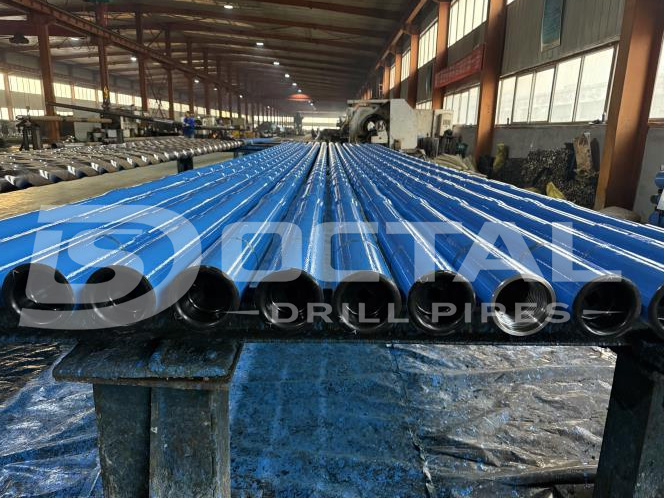
- OD, ID, length and bore verification
- Thread and shoulder inspection
- Hardness test
- Visual inspection for handling or machining damage
- MPI for surface or near-surface cracks when required
- UT if required by the project ITP
- Heat number and MTC traceability
- Packing list and marking consistency before shipment release
The traceability chain should be visible from marking to final documents:
Product marking → Heat number → MTC → Heat treatment / hardness record → Thread inspection → MPI / UT report → Packing list / Bundle photos → Shipment release
Product marking and heat number confirm the collar identity. The MTC verifies material grade, chemical composition and mechanical properties. Heat treatment and hardness records show whether the collar has reached the required strength condition. Thread inspection and MPI / UT reports check the areas most likely to affect makeup quality, shoulder contact and fatigue resistance.
Before shipment release, the packing list and bundle photos should match the marking and inspection records. If one link is missing, the product may still look correct, but the buyer may not be able to prove that the delivered drill collar is the same item that passed inspection.
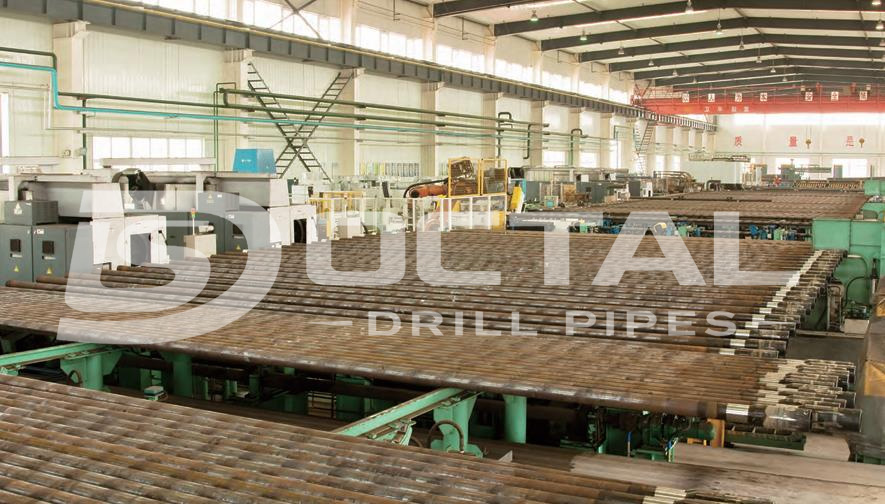
How to Choose Between Drill Collar and Drill Pipe
In real drilling design, the question is not which one is better. The question is what each component must do in the string.
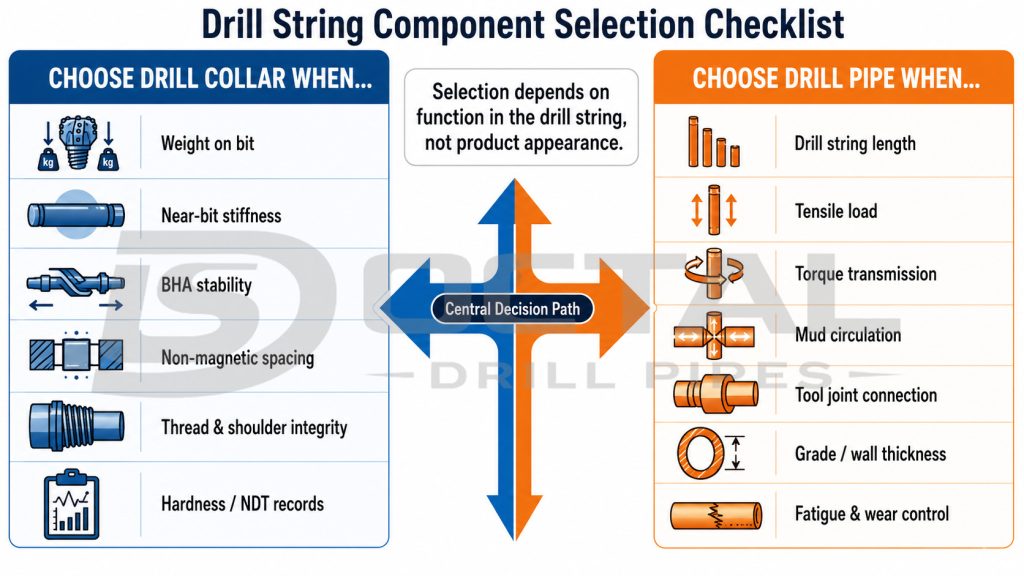
Choose or specify drill collars when the concern is:
- Required weight on bit
- Near-bit stiffness
- BHA stability
- Hole size and annular clearance
- Non-magnetic spacing for MWD/LWD
- Thread and shoulder integrity
- Hardness and NDT records
Choose or specify drill pipe when the concern is:
- Drill string length
- Tensile load
- Torque transmission
- Drilling fluid circulation
- Tool joint connection
- Grade and wall thickness
- Fatigue and wear along the main string
Download:How to Choose Between Drill Collar and Drill Pipe
For a complete drill string package, drill collar, HWDP and drill pipe should be reviewed together. Connection compatibility, OD/ID transition, tool joint type, hardness limits and inspection records should not be checked separately after production; they should be confirmed before release.
Common Mistakes in Drill Collar vs Drill Pipe Selection
1.Treating drill collar as simply a heavier pipe
A drill collar is not just a thicker version of drill pipe. Its BHA position, compression load, stiffness, material control and connection inspection make the acceptance logic different.
2.Ignoring HWDP transition
When the drill string moves from a very stiff collar section to a flexible pipe section, the stiffness change can increase stress concentration. HWDP helps control this transition.
3.Selecting only by OD
OD is important, but it is not enough. ID, weight, connection type, length, hardness, magnetic property and inspection scope all affect field suitability.
4.Missing document traceability
For international supply, product marking, heat number, MTC, inspection records and packing list should match. If these records do not align, the receiving team may face quarantine, recheck or delayed acceptance.
FAQ
Q1:What is the difference between a drill pipe and a drill collar?
A:A drill collar is a heavy, stiff BHA component placed near the bit to provide weight on bit and drilling stability. A drill pipe forms the main drill string and mainly transmits torque and drilling fluid from the surface.
Q2:What is the purpose of a drill collar?
A2:The purpose of a drill collar is to add near-bit weight, increase BHA stiffness and reduce unstable movement around the bit. It also helps keep the upper drill pipe mainly in tension, reducing buckling risk during drilling.
Q3:How do drill collars work with drill pipe and HWDP?
A3:Drill collars provide weight and rigidity near the bit, HWDP works as a transition section, and drill pipe carries the main string load, torque and drilling fluid. They are connected through threaded connections, with crossover subs used when connection size or stiffness transition needs adjustment.
Q4:What is the difference between drill collar and HWDP?
A4:A drill collar provides maximum weight and stiffness in the lower BHA. HWDP is lighter and more flexible than a drill collar, and is used above the collar section to reduce stiffness change, stress concentration and fatigue risk.
Q5:Can drill pipe replace drill collars?
A5:In normal BHA design, drill pipe does not replace drill collars because it is lighter and more flexible. Drill pipe is used for torque and fluid transmission, while drill collars provide the concentrated weight and stiffness needed near the bit.