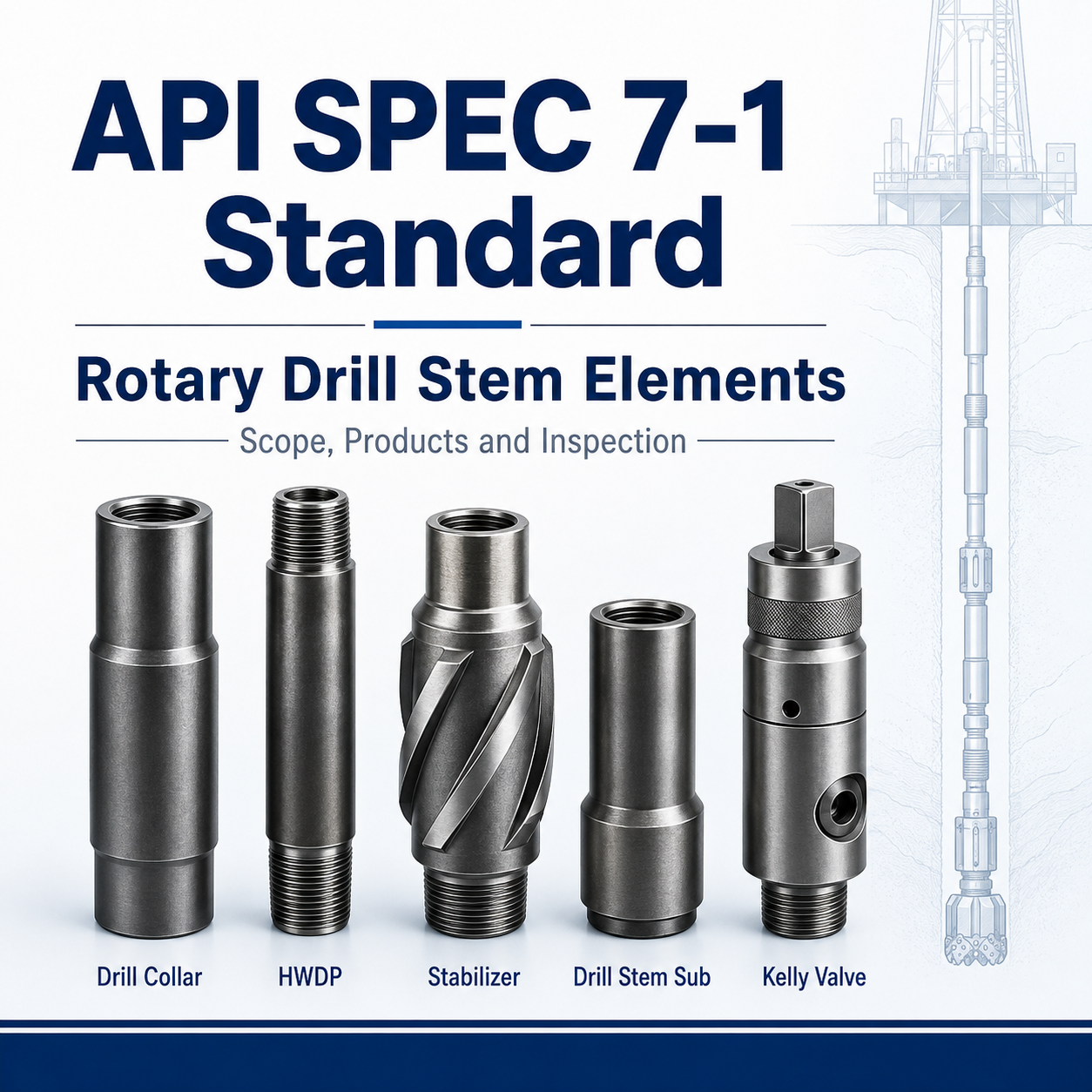
API SPEC 7-1 is the API specification for covered rotary drill stem elements used in the drill string and bottom-hole assembly, including drill collars, heavy weight drill pipe, kellys, drill stem subs, kelly valves and stabilizers. These components are not standard drill pipe,they are used to add weight and stiffness, transmit torque, connect drill-string sections, stabilize the BHA, or tensile, compressive and bending loads. The API SPEC 7-1 standard defines the main manufacturing, inspection, marking and release requirements for these products. In procurement documents, API SPEC 7-1 helps convert product names such as drill collar, HWDP or stabilizer into measurable ordering and acceptance requirements.In practical use, API SPEC 7-1 refers to the specification designation used in RFQs, quotations, purchase orders and product descriptions. The API SPEC 7-1 Standard refers to the complete technical document used to control production, inspection and delivery acceptance.
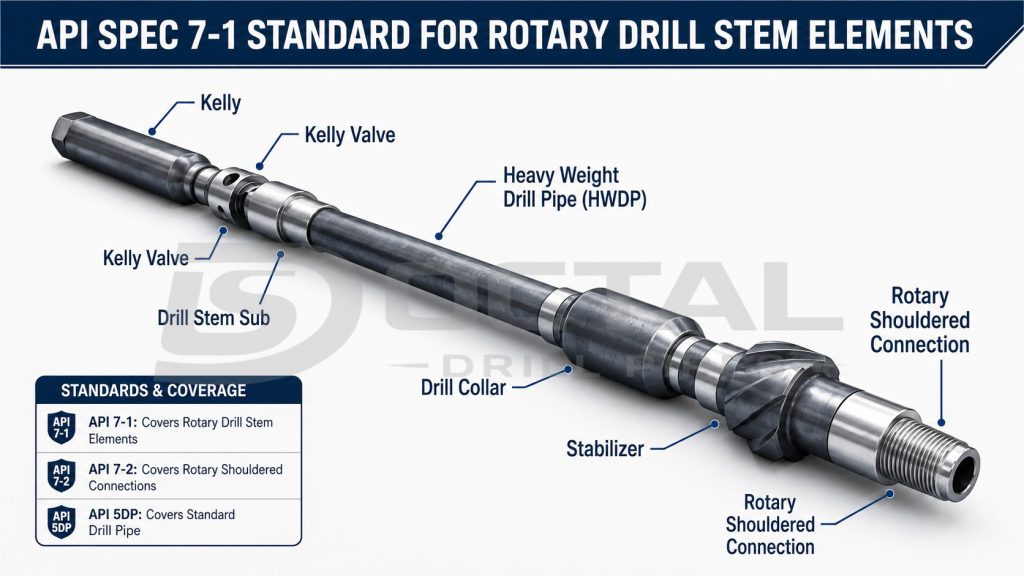
For buyers, the key point is to apply the correct standard to the correct product. API SPEC 7-1 is used for covered rotary drill stem elements. Standard drill pipe should normally be specified under API SPEC 5DP, while rotary shouldered connection threading and gauging should be reviewed under API SPEC 7-2.
API SPEC 7-1 Latest Edition and Document Status
For procurement and inspection planning, the applicable edition of API SPEC 7-1 should be confirmed before the RFQ or purchase order is issued. Current standard-store records list API Spec 7-1, Rotary Drill Stem Elements, Second Edition, February 2023, with later updates including Errata 1, Addendum 1 and Errata 2. API’s official Errata 2 notice also identifies the affected publication as API Specification 7-1, Rotary Drill Stem Elements, Second Edition, February 2023.
This edition check matters because the supplier, buyer and third-party inspector should work from the same controlled standard basis. If the purchase order only states “API 7-1” without edition or update requirements, acceptance details may be interpreted differently during production, inspection or final document review.
A clear RFQ should state the required API SPEC 7-1 edition, applicable addenda or errata, product type, connection requirement, inspection scope and release documents. This keeps the material certificate, NDT report, dimensional inspection, connection gauging record and marking review aligned with the same standard basis.
Products Covered by API SPEC 7-1
API SPEC 7-1 covers selected rotary drill stem elements used in the drill string and bottom-hole assembly. These products are not grouped only by name; they are controlled because they transmit torque, add stiffness or weight, connect different drill-string members, stabilize the BHA, or provide a defined interface for drilling and coring tools.
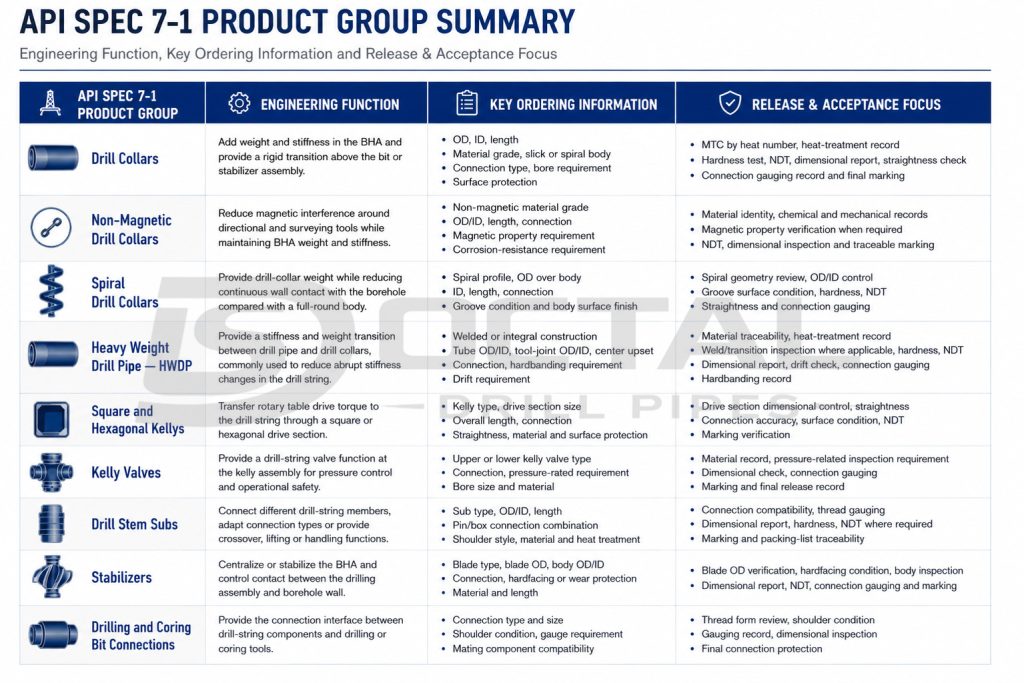
For procurement, the important point is to confirm whether the ordered item is actually within the API 7-1 product scope, and then define the correct material, geometry, connection, inspection and release documents. A product name alone is not enough for technical acceptance.
API SPEC 7-1, API SPEC 7-2 and API SPEC 5DP: Correct Stand
API SPEC 7-1, API SPEC 7-2 and API SPEC 5DP are often mentioned together in drill-string procurement, but they do not control the same part of the product. API SPEC 7- applies to seleAPI SPEC 7-2 controls rotarAPI SPEC 5 applies to standa
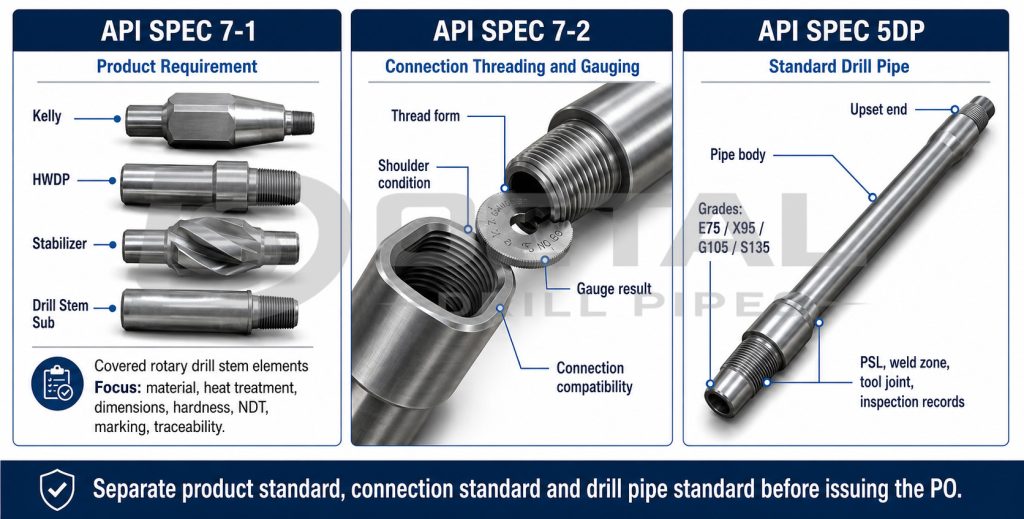
The simplest way to separate them is this: API SPEC 7-1 controls the covered drilling component, API SPEC 7-2 controls the rotary shouldered connection, and API SPEC 5DP controls standard drill pipe.
A drill collar, HWDP, kelly, sub or stabilizer may be ordered under API SPEC 7-1, but its connection should still be checked according to API SPEC 7-2 when a rotary shouldered connection is involved. Standard drill pipe should normally be specified under API SPEC 5DP, because the pipe body, grade, PSL, upset ends, welded tool joints and drill pipe delivery requirements belong to that standard logic.
For HWDP, API SPEC 7-1 should be used for the product body, material control, inspection and release requirements, while API SPEC 7-2 should be specified for rotary shouldered connection threading and gauging. For standard drill pipe, API SPEC 5DP should be used for the pipe body, grade, PSL, upset ends and welded tool joints, while API SPEC 7-2 should still be used for the connection. This prevents the supplier, buyer and third-party inspector from using different acceptance criteria during production, inspection and final document review.
API 7-2 connection acceptance should be supported by thread gauging records and shoulder-condition checks. API 5DP drill pipe should include drill pipe body, tool joint, weld-zone, grade, PSL and traceability records. This standard separation makes the purchase order easier to inspect and reduces disputes before shipment release.
RFQ and Standard Scope Review for API SPEC 7-1
Before issuing an RFQ or purchase order, the buyer should first confirm whether the ordered item belongs to API SPEC 7-1 scope or another API standard. API SPEC 7-1 applies to covered rotary drill stem elements such as HWDP, drill collars, kellys, drill stem subs and stabilizers. Standard drill pipe should normally be specified under API SPEC 5DP, while rotary shouldered connection threading and gauging should be controlled under API SPEC 7-2.
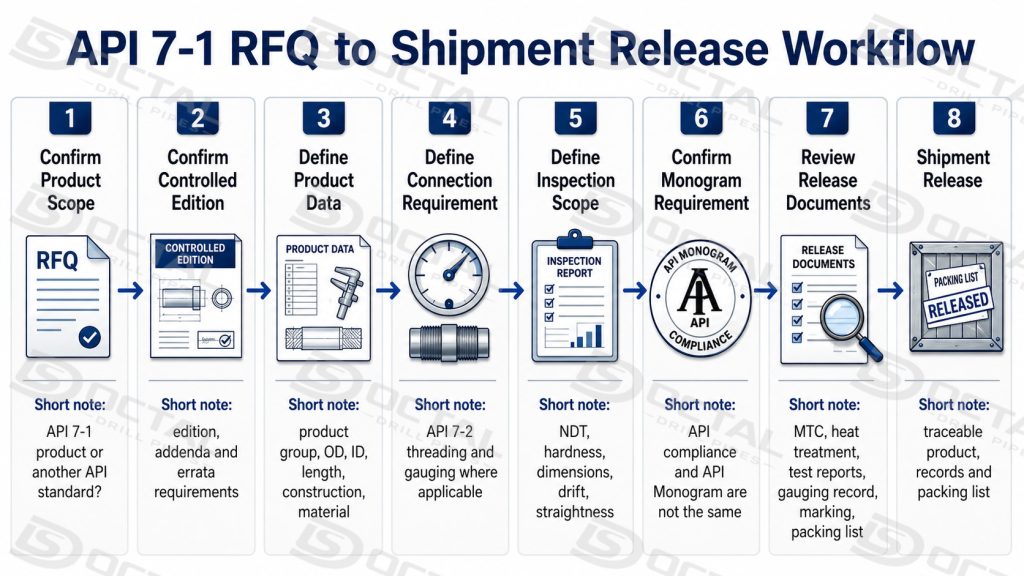
This standard separation is important because one drill-string package may include several different products. A standard drill pipe line may require API SPEC 5DP for the pipe body, grade, PSL, upset ends and welded tool joints. An HWDP or drill collar line may require API SPEC 7-1 for product manufacturing, inspection, marking and delivery release. The connection on either product may still require API SPEC 7-2 for thread form, shoulder condition, dimensional conformity and gauging records.
The purchase order should not rely only on a general product name such as “drill collar” or “HWDP.” It should state the applicable standard edition, OD, ID, length, connection type, material grade, NDT scope, dimensional inspection, connection gauging requirement and final document package.
A practical RFQ line may be written as follows:
Heavy Weight Drill Pipe, API SPEC 7-1, 5 in OD, NC50 connection, welded or integral construction as specified, API SPEC 7-2 thread gauging required, NDT and dimensional inspection per approved ITP, MTC, heat-treatment record, hardness report, connection gauging record, final inspection report and packing list required.
For drill collars, kellys, subs and stabilizers, the same logic applies: confirm the correct standard first, then define the product geometry, connection requirement, inspection scope and release records. If API Monogram marking is required, it should be written as a separate purchase requirement rather than assumed from API 7-1 compliance.
This approach helps the supplier, buyer and third-party inspector work from the same technical basis. It also reduces disputes during production, document review and shipment release, especially when API 7-1 products, API 5DP drill pipe and API 7-2 connections appear in the same order.
API Monogram Marking and API SPEC 7-1 Compliance
API SPEC 7-1 compliance and API Monogram marking are different purchase requirements.
API SPEC 7-1 compliance means the product is manufactured, inspected and released according to the applicable API 7-1 technical requirements. API Monogram marking means the product is marked by an API-licensed manufacturer within its approved license scope.
For procurement, the RFQ or purchase order should clearly state whether API Monogram marking is required. If API Monogram is not required, the buyer should still request complete API 7-1 compliance documents, including MTC, heat-treatment record, inspection reports, connection gauging record, marking verification and packing-list traceability.
API 7-1 Acceptance Checks and Required Release Records
API 7-1 acceptance is not only a document collection process. Each inspection item should prove that the delivered rotary drill stem element matches the purchase order, the approved product scope and the agreed technical requirements. For buyers and third-party inspectors, the main purpose is to confirm three things before shipment release: the product is correctly identified, the critical manufacturing steps are controlled, and the final records are traceable to the same heat number, lot number and product marking.
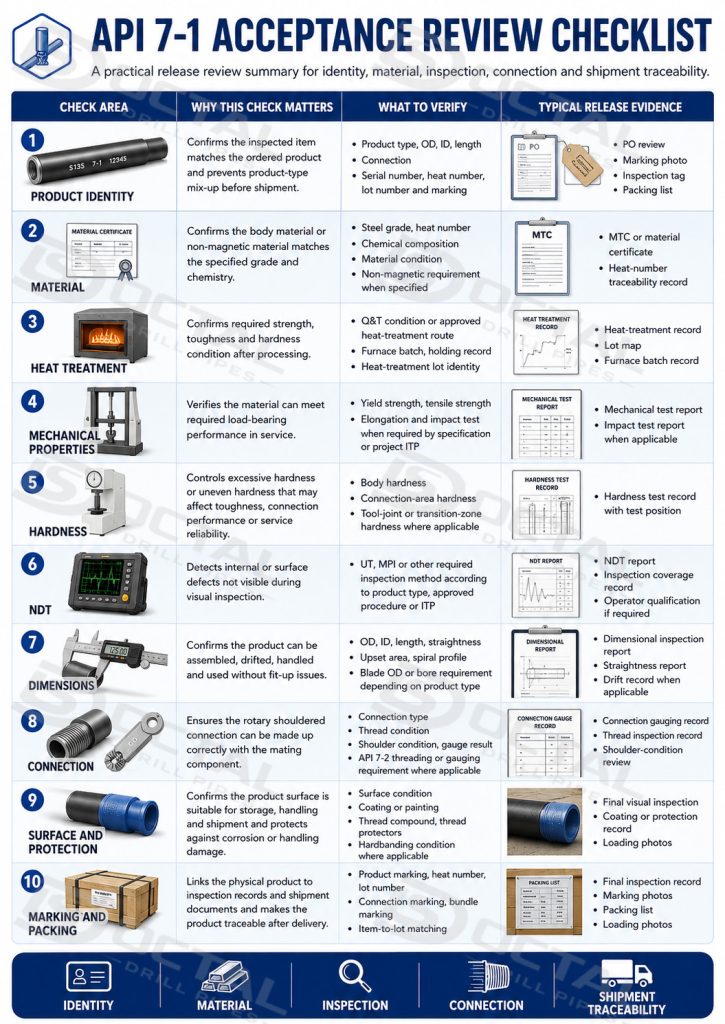
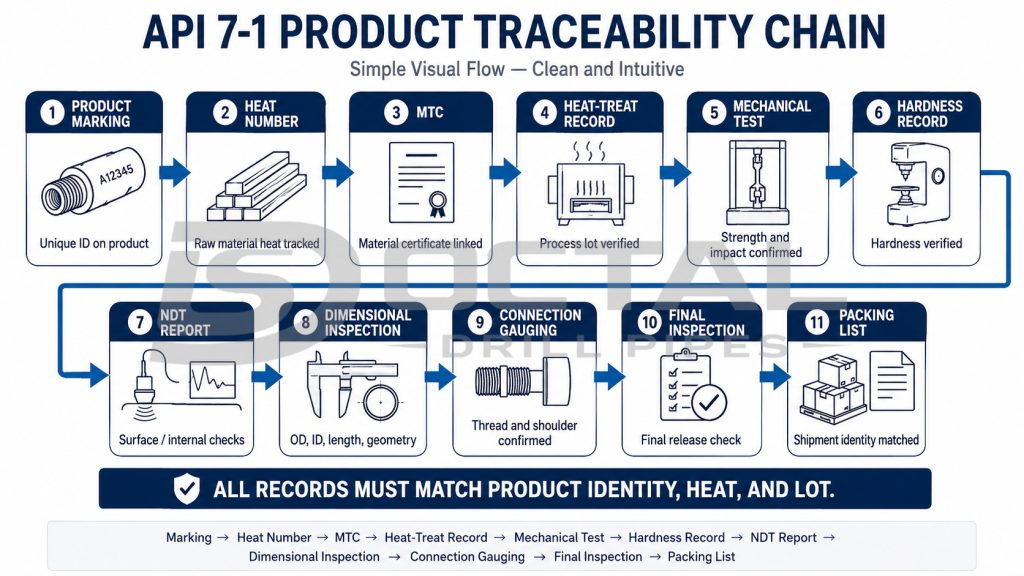
The release package should show one continuous traceability chain: product marking → heat number → MTC → heat-treatment record → mechanical test report → hardness record → NDT report → dimensional inspection → connection gauging record → final inspection → packing list.
Conclusion
API SPEC 7-1 should be used as a practical purchasing and inspection basis for covered rotary drill stem elements, not just as a standard name in a quotation. For products such as HWDP, drill collars, kellys, drill stem subs and stabilizers, buyers should confirm the product scope, material grade, heat treatment, dimensions, connection type, inspection requirements and final release documents before production starts.
The safest approach is to match each item with the correct standard. API SPEC 7-1 applies to covered rotary drill stem elements, API SPEC 7-2 should be used for rotary shouldered connection threading and gauging, and API SPEC 5DP should be used for standard drill pipe. This avoids confusion between product-body requirements, connection requirements and drill pipe delivery requirements.
Before shipment release, the buyer should review a complete traceability package, including MTC, heat-treatment record, mechanical test report, hardness record, NDT report, dimensional inspection, connection gauging record, marking verification and packing list. When these records match the product marking and purchase order, the API 7-1 product can be inspected, accepted and released with much less technical risk.
FAQ
Q: What is API SPEC 7-1 used for?
A: API SPEC 7-1 is used for rotary drill stem elements such as drill collars, HWDP, kellys, drill stem subs and stabilizers. It helps define product scope, material, manufacturing, inspection, marking and delivery requirements.
Q: What is the latest edition of API SPEC 7-1?
A: Current standard-store records list API Spec 7-1 as the Second Edition, published in February 2023, with Errata 1, Addendum 1 and Errata 2 updates included. Project teams should verify the controlled edition and updates before issuing a PO.
Q: Does API SPEC 7-1 cover standard drill pipe?
A: No. Standard drill pipe is normally specified under API SPEC 5DP. API SPEC 7-1 covers rotary drill stem elements such as HWDP, drill collars, kellys, subs and stabilizers.
Q: What is the difference between API SPEC 7-1 and API SPEC 7-2?
A: API SPEC 7-1 covers selected rotary drill stem elements as products. API SPEC 7-2 covers threading and gauging requirements for rotary shouldered connections.
Q: Should API Monogram be written in the purchase order?
A: Yes. If the project requires API Monogram marking, it should be stated clearly in the RFQ and PO. API 7-1 compliance and API Monogram marking are related, but they are not the same purchase requirement.