API 5DP 2nd Edition Addendum 1 has moved drill pipe orders into a more detail-controlled stage. For buyers, the update is not only a standards notice. It affects how drill pipe grade, sour-service review, hardness testing, tool joint requirements, inspection records, and marking requirements should be written into the purchase order before production starts.
API published Addendum 1 to API Specification 5DP, 2nd Edition in January 2025, with an API Monogram Program effective date of July 2, 2025. The current API 5DP update list also includes related errata for the same edition. For drill pipe procurement, this means the latest contract review should not simply say “API 5DP.” It should confirm the edition, addendum, applicable errata, PSL level, grade, tool joint requirement, inspection scope, and document package.
Why This Update Matters for Drill Pipe Buyers
Drill pipe is a fatigue-sensitive and connection-sensitive product. A purchase order that only confirms OD, weight, grade and connection may still leave risk in hardness control, sour-service suitability, tool joint testing, weld zone acceptance, and marking consistency.
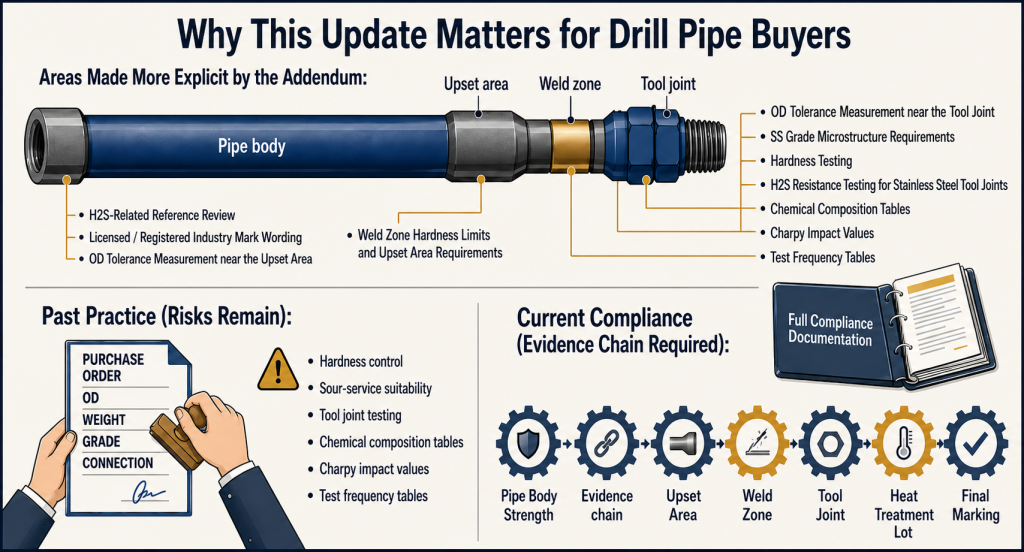
The Addendum makes several areas more explicit, including H2S-related reference review, licensed/registered industry mark wording, weld zone hardness limits, OD tolerance measurement near the upset area, SS grade microstructure requirements, hardness testing, H2S resistance testing for SS tool joints, chemical composition tables, Charpy impact values, and test frequency tables.
In practical terms, buyers should treat the update as a reminder: drill pipe compliance is not only about pipe body strength. It is also about the evidence chain behind the pipe body, upset area, weld zone, tool joint, heat treatment lot, and final marking.
Key Order Points Affected by the Addendum
More Attention on Sour-Service and SS Grade Control
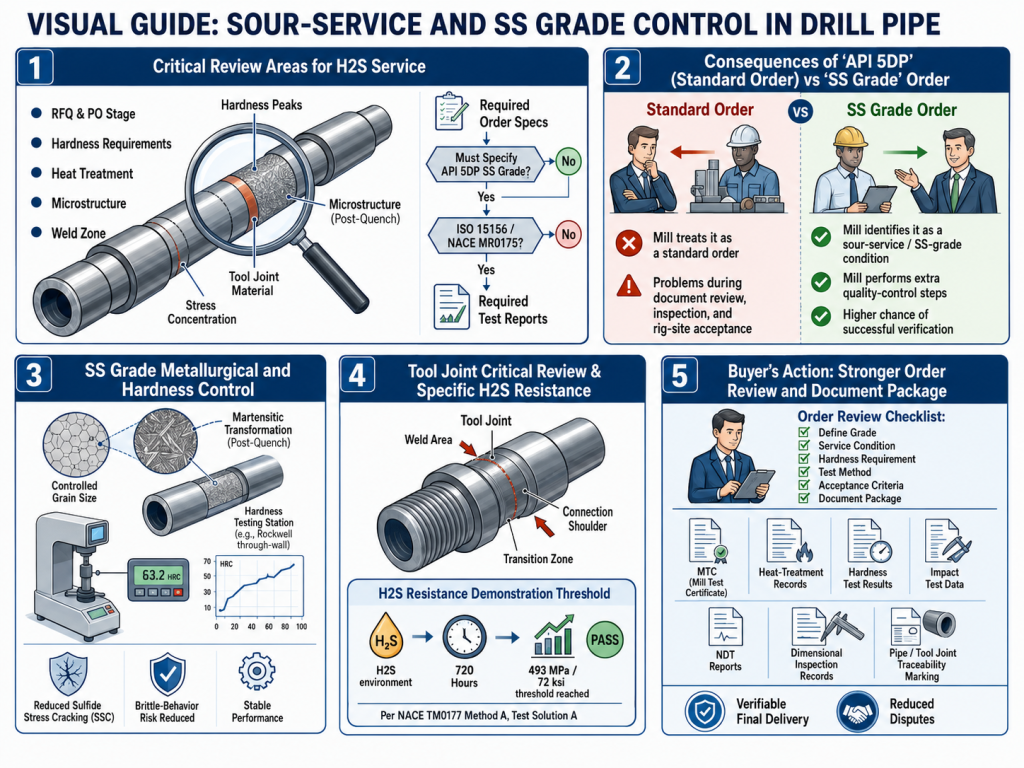
One of the most important signals in the update is the added reference to ISO 15156 / NACE MR0175 for drilling equipment used in H2S-containing fluids. This does not mean every drill pipe order automatically becomes a sour-service order. It means buyers should identify the service condition clearly when H2S exposure is possible.
For SS grades, the Addendum adds more detailed control points. Grain size, martensitic transformation after quenching, hardness limits, through-wall hardness testing, and H2S resistance requirements become more visible in order review. For SS tool joints, the H2S resistance specification includes a demonstrated minimum threshold of 493 MPa / 72 ksi for 720 hours under NACE TM0177 Method A using Test Solution A.
This level of detail matters because sour-service risk is rarely solved at the shipping stage. It must be defined before mill production, heat treatment, testing and document release.
For buyers, the practical action is simple: do not leave sour-service suitability as a general statement. The PO should define the grade, service condition, hardness requirement, test method, acceptance criteria, and required document package. A stronger order review should include MTC, heat-treatment records, hardness test results, impact test data, NDT reports, dimensional inspection records, and pipe / tool joint marking traceability. This makes the final delivery easier to verify and reduces disputes before shipment release.
What Should Be Written More Clearly in New Drill Pipe Orders
For new API 5DP drill pipe orders, Octal recommends that buyers confirm the following items before the purchase order is released:
- API 5DP edition, addendum and applicable errata
- Drill pipe size, weight, grade, upset type and length range
- PSL level and supplementary requirements, if any
- Tool joint grade, connection type and hardbanding requirement
- Sour-service or non-sour-service condition
- Required hardness test scope and acceptance basis
- Charpy impact test requirement and test temperature
- NDT method and coverage according to project ITP
- API Monogram / licensed mark requirement, if applicable
- MTC, inspection reports, heat treatment records, NDT records, dimensional report and packing list traceability
The key is consistency. The purchase order, MTC, pipe marking, tool joint marking, inspection reports, packing list and final shipping documents should describe the same product in the same way. If one document says only “API 5DP” while another refers to a different inspection basis or grade condition, shipment review may slow down.
Impact on Drill Pipe Supply and Delivery
- For manufacturers and suppliers, the Addendum increases the importance of internal document control. Production teams need to check whether their inspection procedures, hardness testing process, test frequency, SS grade controls and marking rules are aligned with the updated requirement.
- For buyers, the main impact is earlier technical clarification. A clean RFQ should now include not only size and grade, but also the intended service environment, PSL level, tool joint details, inspection scope and documentation expectations. This reduces the chance of rework after production or dispute during third-party inspection.
Octal Pipe will continue to review API 5DP drill pipe orders according to project specification, service condition, inspection plan and document requirements. For export orders, the release package can be organized with heat/lot traceability, MTC, dimensional inspection, NDT records, hardness records, packing list mapping and shipment documents, helping buyers complete technical review before cargo release.
Final Note
The API 5DP Addendum update does not change the basic reason buyers choose drill pipe: strength, connection reliability, fatigue resistance and field performance. What it changes is the level of detail that should be confirmed before ordering.
For API 5DP drill pipe procurement in 2025 and beyond, the safer approach is simple: define the standard version clearly, confirm service conditions early, control hardness and tool joint evidence carefully, and keep the document chain closed from mill production to shipment.
FAQ
F:What is API 5DP 2nd Edition Addendum 1?
Q:It is an official update to API 5DP for drill pipe, covering items such as sour-service review, SS grade control, hardness testing, tool joint requirements, marking and inspection details.
F:Does it affect all API 5DP drill pipe orders?
Q:Not equally. Standard orders mainly need a clear reference to the latest edition and addendum. SS grade, H2S service, special tool joint or stricter inspection orders need closer review.
F:What should buyers confirm before ordering?
Q:Buyers should confirm size, grade, upset type, connection, PSL level, tool joint grade, sour-service condition, hardness requirement, NDT scope, marking and document package.
F:Why is sour-service drill pipe more sensitive?
Q:H2S service requires more control over hardness, heat treatment, microstructure, tool joint suitability and traceability to reduce sulfide stress cracking risk.
F:What documents are needed for delivery?
Q:Key documents include MTC, heat treatment records, dimensional inspection reports, NDT records, hardness results, tool joint inspection records, packing list and shipment documents.