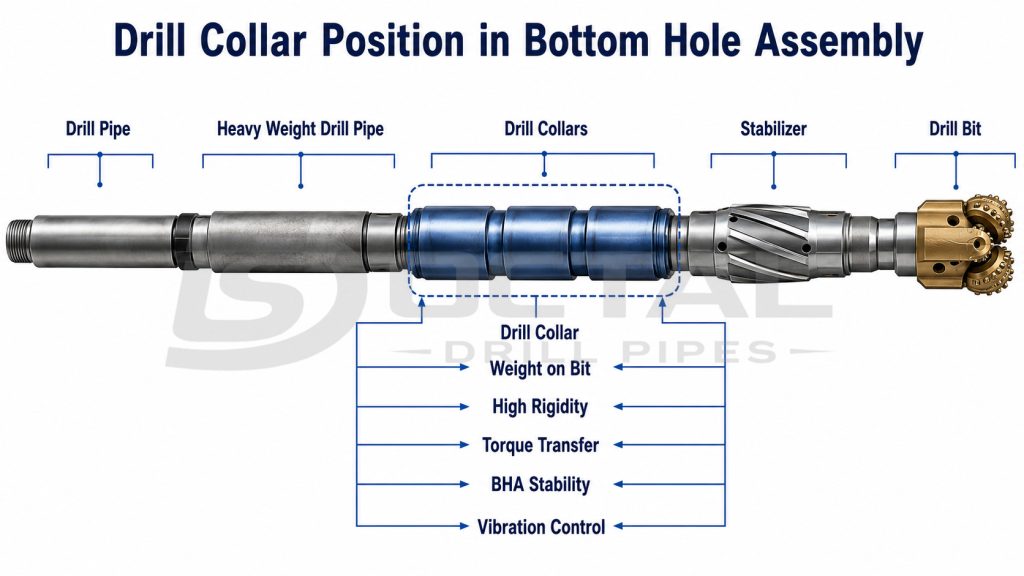
API 7-1 drill collar is a heavy-wall rotary drill stem component installed in the lower bottom hole assembly, close to the bit, where the drill string needs concentrated weight, high rigidity and stable torque transfer. Standard magnetic drill collars are commonly manufactured from AISI 4145H Modified alloy steel or equivalent material, followed by quench-and-temper heat treatment to obtain the required strength, toughness and hardness range. Unlike API 5DP drill pipe, which mainly carries tensile load and circulates drilling fluid through the main drill string, a drill collar works under compression, torsion, bending and downhole vibration. Its main function is to provide weight on bit, improve BHA stiffness, reduce unstable bit movement and support more controlled drilling performance in demanding oil and gas wells.
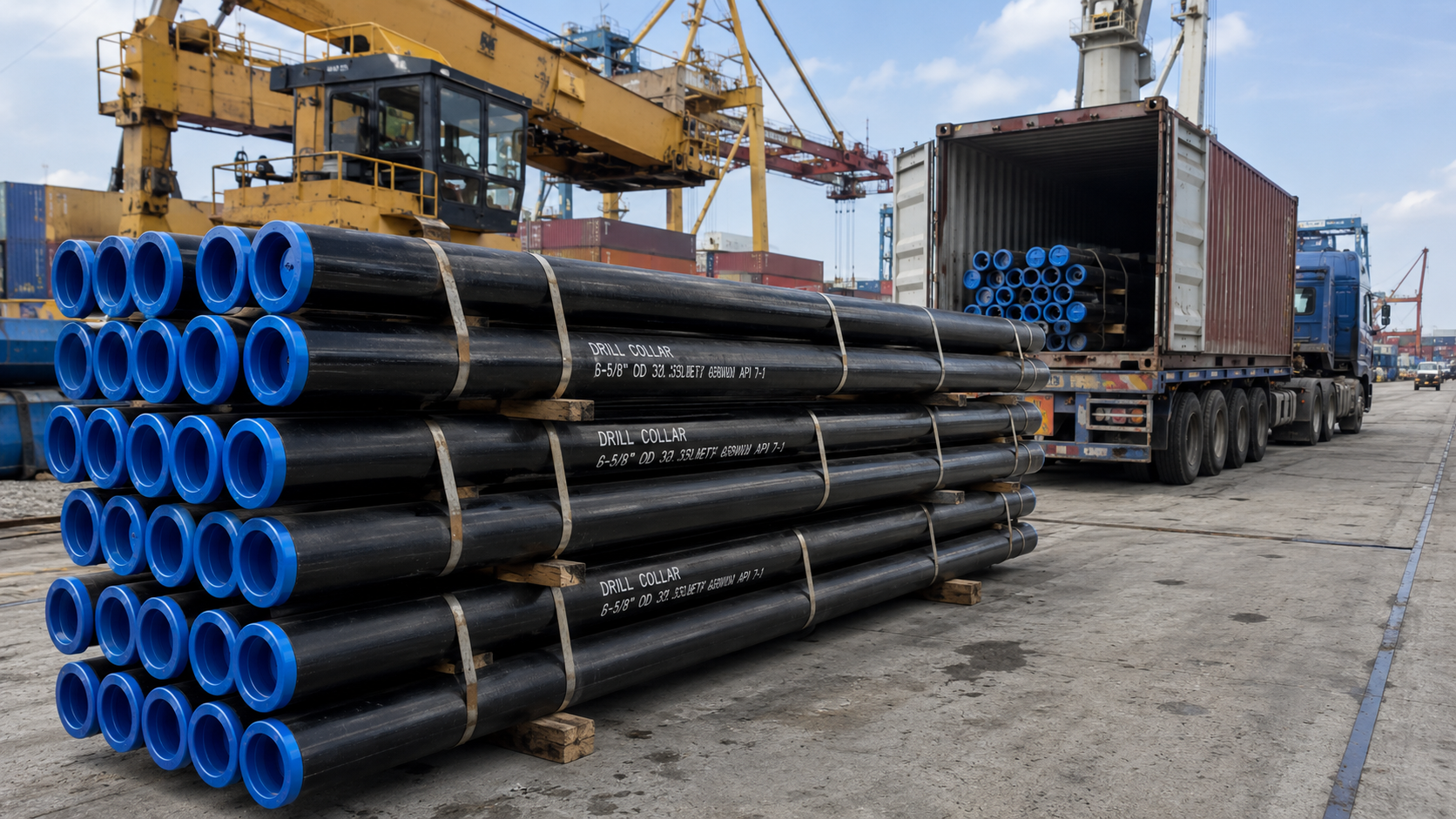
Project Shipment Details
| Item | Details |
| Destination | Nigeria |
| Destination Port | Onne Port, Nigeria |
| Product | API 7-1 Drill Collar |
| Product Type | Slick / spiral / project-specified drill collar |
| Standard | API Spec 7-1 |
| Material | AISI 4145H Modified alloy steel or approved equivalent |
| Heat Treatment | Quenched and tempered |
| Connection | As per approved purchase order |
| Size Range | As per approved purchase order |
| Application | Bottom hole assembly, weight on bit and drilling stability |
| Release Focus | Material traceability, hardness, connection inspection, dimensional review and packing control |
| Document Package | MTC, heat-treatment record, dimensional report, hardness record, NDT / MPI record when required, connection inspection record, packing list and loading photos |
This order was checked as a controlled drill collar shipment. The receiving team should be able to identify each collar by material, size, connection, heat number, inspection record and bundle reference after arrival.
For this shipment to Onne Port, Nigeria, the supplied drill collars were reviewed as finished BHA components rather than ordinary alloy steel bars. The release focus was placed on material identity, API 7-1 compliance, heat-treatment condition, dimensional accuracy, bore clearance, connection quality, hardness review, surface protection, packing stability and document traceability.
Drill Collar Product Configuration
A drill collar order should not be read by product name only. The workable configuration normally includes:
Drill collar type → OD → ID → length → material → heat treatment → connection → bore condition → hardness requirement → inspection records → packing list
Each item controls a different acceptance point.
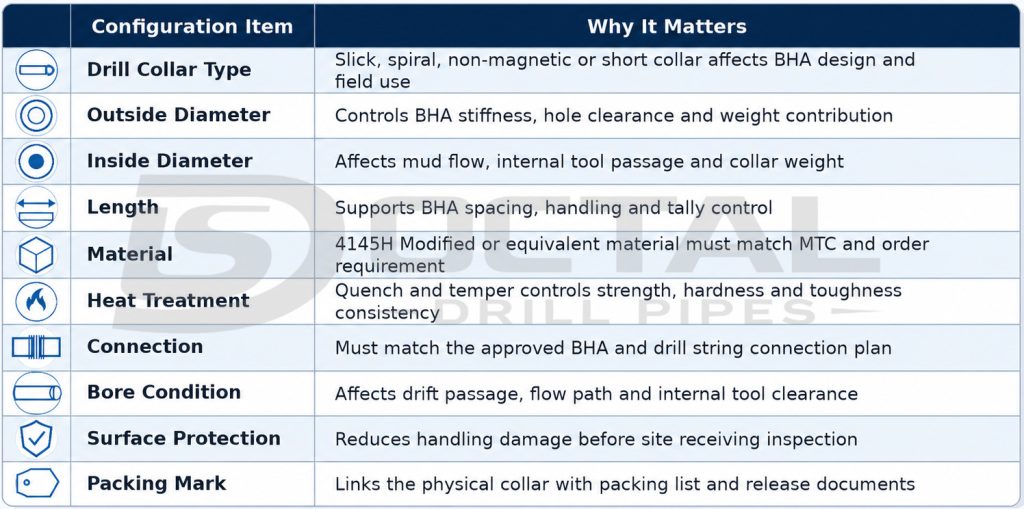
For this Nigeria delivery, the most important practical control was to keep the drill collar identity clear from machining to final packing. Because drill collars are often similar in appearance, unclear marking or missing connection information can delay receiving inspection and BHA allocation.
API 7-1 Drill Collar Material and Heat Treatment
The drill collars were reviewed according to the material and heat-treatment requirements specified in the approved order. For standard magnetic drill collars, 4145H Modified alloy steel is widely used because it provides a practical balance of strength, toughness and heat-treatment response for heavy BHA service.
Heat treatment is not only a strength process. For drill collars, quench and temper helps stabilize the body, reduce uneven hardness risk and support consistent mechanical performance along the collar length. This matters because the drill collar is placed near the bit, where compression, torque, bending and vibration are concentrated.
| Review Item | What to Confirm | Why It Matters |
| Material Grade | 4145H Modified or approved equivalent | Confirms correct alloy steel route |
| Heat Number | Matches MTC and product marking | Supports raw material traceability |
| Heat Treatment | Quenched and tempered condition | Controls strength and hardness consistency |
| Chemical Composition | Recorded in MTC | Confirms alloy content and material identity |
| Mechanical Properties | Per standard and purchase order | Supports load-bearing review |
| Hardness | Within approved range | Helps reduce cracking or premature wear risk |
| Surface Condition | Free from harmful visible defects | Supports final machining and field acceptance |
If hardness is too high, cracking sensitivity may increase. If hardness is too low or uneven, shoulder deformation, connection wear or body performance problems may appear earlier in service. Therefore, hardness review should be treated as a release item, not as a simple certificate line.
Drill Collar Types Supplied for BHA Service
Drill collars can be supplied in different forms according to drilling conditions and BHA design. The final selection should follow the drilling program, hole size, weight-on-bit requirement, sticking risk, survey tool arrangement and connection compatibility.
| Drill Collar Type | Structure | Main Function | Suitable Operating Condition |
| Slick Drill Collar | Smooth outside surface | Provides concentrated BHA weight and stiffness | Conventional vertical wells and standard BHA assemblies |
| Spiral Drill Collar | Spiral grooves machined on OD | Reduces wall contact area and helps lower differential sticking tendency | Deviated wells, directional sections and formations with sticking risk |
| Non-Magnetic Drill Collar | Non-magnetic alloy body | Reduces magnetic interference around survey tools | MWD, LWD and directional drilling assemblies |
| Short Drill Collar / Pony Collar | Shorter drill collar length | Adjusts BHA spacing, weight and tool position | Assemblies requiring fine length or stiffness adjustment |
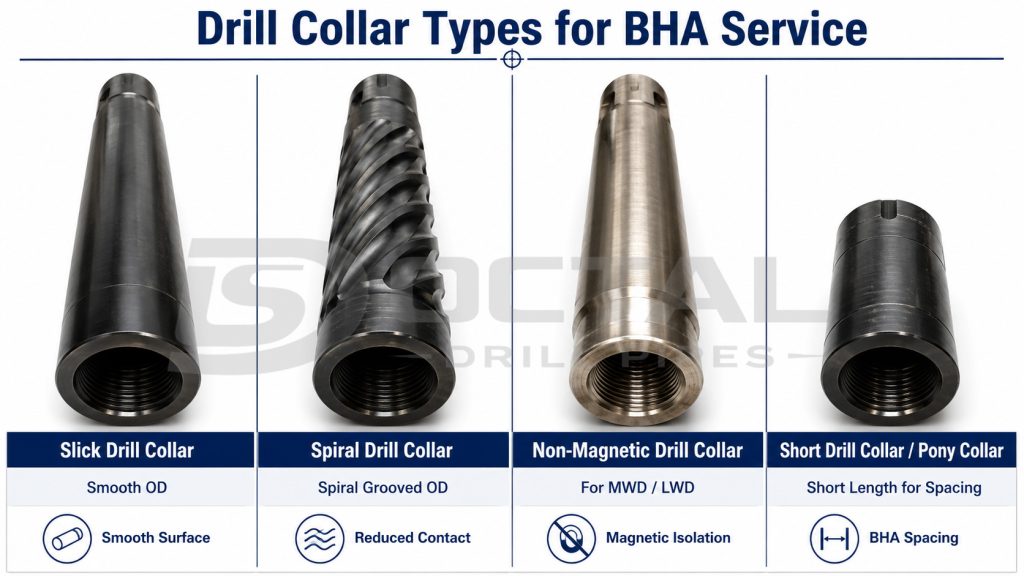
A spiral drill collar should not be treated as a visual design change only. The spiral groove changes wall contact behavior and helps reduce sticking tendency in certain wellbore conditions. A non-magnetic drill collar is a different technical route and should be reviewed by magnetic property, material certificate, dimensional accuracy and connection compatibility.
Dimensional and Bore Clearance Review
Before packing, dimensional inspection should confirm that the finished drill collar matches the approved order and is ready for receiving inspection. OD, ID, length, straightness, connection dimensions, bore condition and surface finish all affect whether the collar can enter the planned BHA without rework.
| Check Item | What to Confirm | Practical Meaning |
| OD | Matches approved drawing or order | Controls BHA stiffness and hole clearance |
| ID / Bore | Clean and unobstructed | Supports mud flow and internal tool clearance |
| Length | Matches project requirement | Supports tally and BHA spacing |
| Straightness | No abnormal bending | Reduces handling and assembly problems |
| Connection Area | Pin / box dimensions match approved connection | Supports compatibility with BHA components |
| Shoulder Face | Clean and undamaged | Supports torque transfer during make-up |
| Surface Condition | No harmful visible defects | Reduces receiving rejection risk |
For drill collars, the bore should be reviewed as a functional passage, not only as a dimension on the drawing. Local restriction, machining burrs, handling damage or bore contamination may affect internal tool passage and drilling fluid flow.
Connection and Thread Inspection
The connection is one of the most important acceptance points for drill collar shipment. A correct material grade cannot solve a wrong connection, damaged thread or poor shoulder condition.
| Review Point | What to Confirm | Risk Controlled |
| Connection Identity | Connection type matches order and marking | Prevents BHA compatibility errors |
| Thread Profile | Threads are complete and clean | Reduces make-up difficulty |
| Shoulder Face | Shoulder surface is clean and protected | Supports torque transfer |
| Pin and Box Ends | No visible impact damage | Reduces site rejection risk |
| Thread Protector | Correct protector installed tightly | Protects connection during transport |
| Marking Visibility | Size, material, connection and heat / lot identity remain readable | Supports receiving inspection |
Thread protectors are part of the shipment release condition. For drill collars, thread and shoulder damage can prevent the collar from entering the BHA even when material and hardness records are acceptable.
Pre-Shipment Inspection and Document Control
Before dispatch to Onne Port, the drill collars were reviewed from both physical product and document sides. The purpose was to confirm that product marking, material identity, inspection records and packing information remained consistent before export delivery.
| Review Area | What Was Checked | Release Basis |
| Product Identity | Size, material, connection and heat / lot marking | Product marking matched order and records |
| Material Control | MTC, chemical composition and heat number | Material traceability was maintained |
| Heat Treatment | Quench-and-temper record or batch reference | Heat-treatment route matched order requirement |
| Dimensional Review | OD, ID, length, straightness and bore condition | Finished collar matched approved configuration |
| Hardness Review | Representative hardness values | Hardness was controlled for service reliability |
| Connection Inspection | Thread, shoulder, pin / box condition and protectors | Connection ends were protected for export handling |
| Packing Condition | Bundle stability, end protection, visible tags and packing list | Shipment condition matched release documents |
The document chain should remain clear:
Collar marking → heat number → MTC → heat-treatment record → hardness record → dimensional report → NDT / MPI record when required → connection inspection → packing list → loading photos.
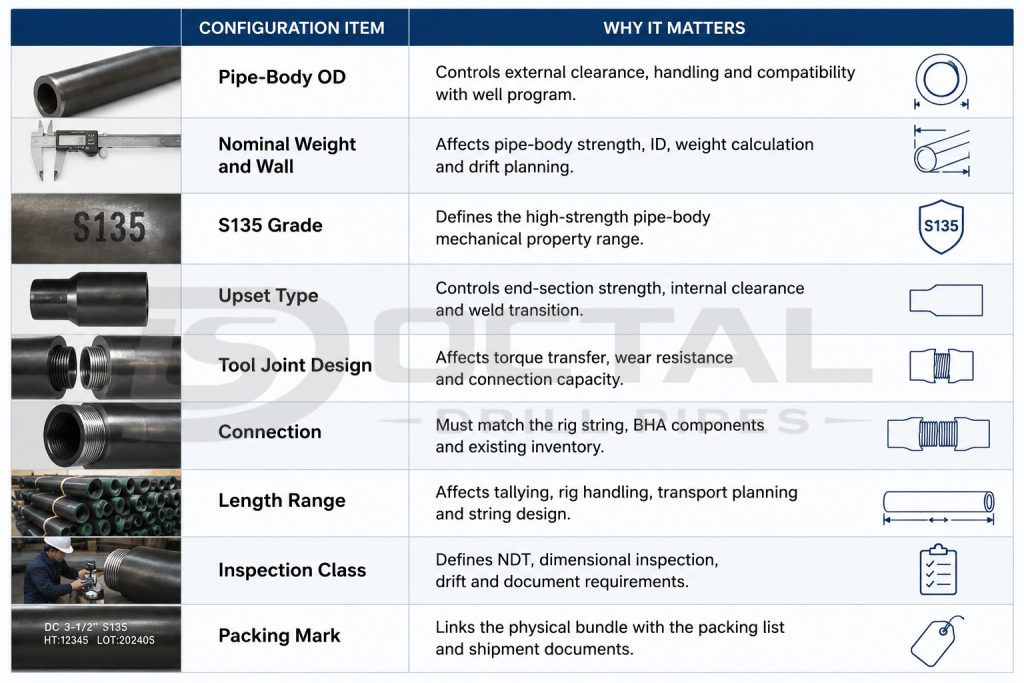
This chain helps prevent mixed lots, unclear material identity, connection disputes and receiving inspection delays after arrival.
PO Review and Shipment Release Checklist
For API 7-1 drill collar shipments, the final PO review should confirm that the physical product, inspection scope and release documents describe the same drill collar configuration. This is especially important for Nigeria oilfield deliveries, where drill collars may look similar after machining but differ in OD, ID, connection, material route, hardness requirement and BHA position.
Before export packing, the release team should check the approved order against product marking, MTC, heat-treatment records, dimensional inspection, connection inspection and packing list. Any mismatch in material, thread type, length or heat number should be clarified before shipment release.
| Review Item | What Must Be Confirmed | Release Risk Controlled |
|---|---|---|
| Drill Collar Type | Slick, spiral, non-magnetic or short drill collar | Prevents wrong BHA component allocation |
| Size | OD, ID and finished length | Controls BHA spacing, stiffness and internal clearance |
| Material | 4145H Modified, non-magnetic alloy or approved equivalent | Prevents material identity mismatch |
| Standard | API Spec 7-1 and project specification | Confirms the correct acceptance basis |
| Connection | NC, REG, FH or project-specified connection | Prevents wrong make-up with BHA components |
| Heat Treatment | Quenched and tempered condition or specified treatment route | Supports strength, toughness and hardness consistency |
| Inspection Scope | Dimensional inspection, hardness, MPI / NDT and thread inspection | Confirms release status before packing |
| Surface Protection | Rust prevention, thread compound and protector requirement | Reduces handling and transport damage |
| Document Package | MTC, heat-treatment record, inspection report, packing list and loading photos | Keeps shipment traceability complete |
A controlled release package should prove one simple point: the marked drill collar, material heat, heat-treatment batch, inspection record, connection review and packing list all refer to the same product. This helps reduce receiving inspection delay, connection disputes and material traceability questions after arrival at Onne Port.
FAQ
Q1: What is the main function of a drill collar in the drill string?
A: A drill collar provides weight on bit, increases stiffness near the bit and helps stabilize the bottom hole assembly during drilling.
Q2: What material is commonly used for standard magnetic drill collars?
A: Standard magnetic drill collars are commonly made from AISI 4145H Modified alloy steel or an approved equivalent, usually in quenched and tempered condition.
Q3: Why is hardness inspection important for drill collars?
A: Hardness inspection helps confirm heat-treatment consistency. Excessive hardness may increase cracking risk, while low or uneven hardness may affect wear resistance and connection performance.
Q4: What documents should be checked before drill collar shipment?
A: Common documents include MTC, heat-treatment record, hardness record, dimensional report, NDT or MPI record when required, connection inspection record, packing list and loading photos.
Q5: Why is Onne Port suitable for oilfield drill collar shipment?
A: Onne Port is a practical oil and gas logistics destination in Nigeria. For drill collar shipments, stable packing, connection protection and document traceability help support receiving inspection after arrival.