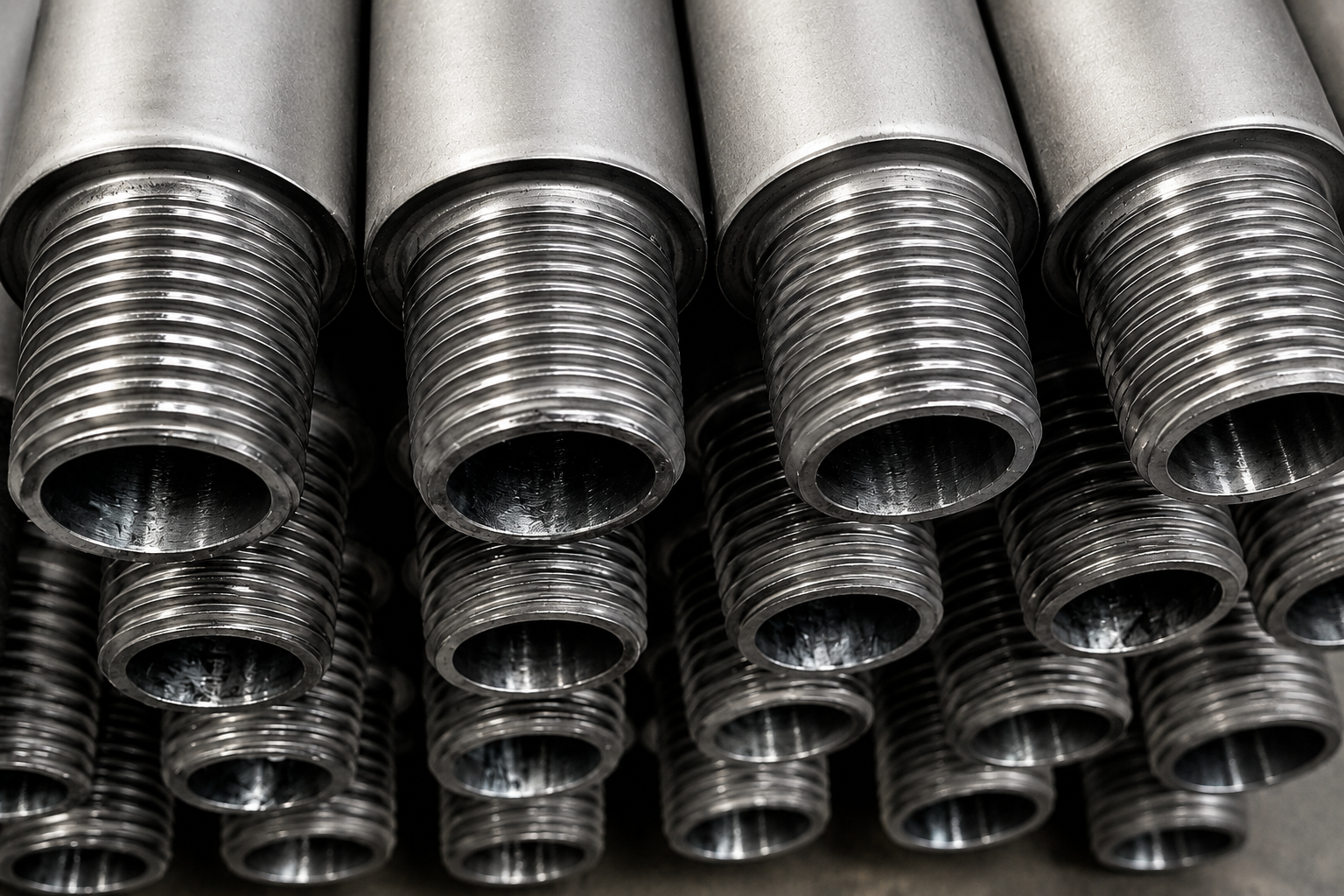
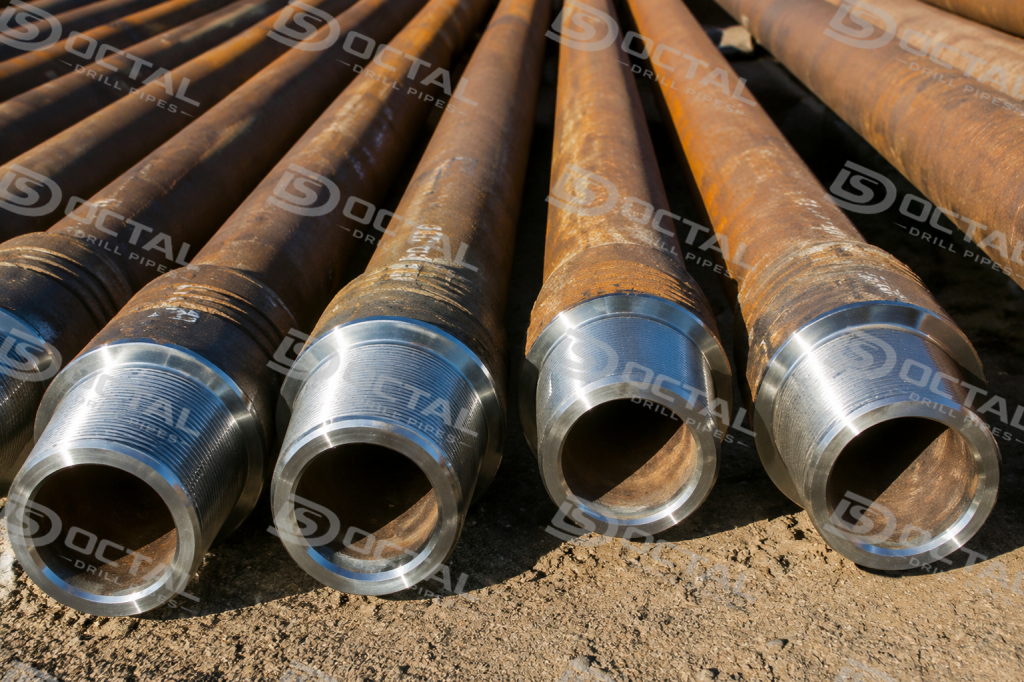
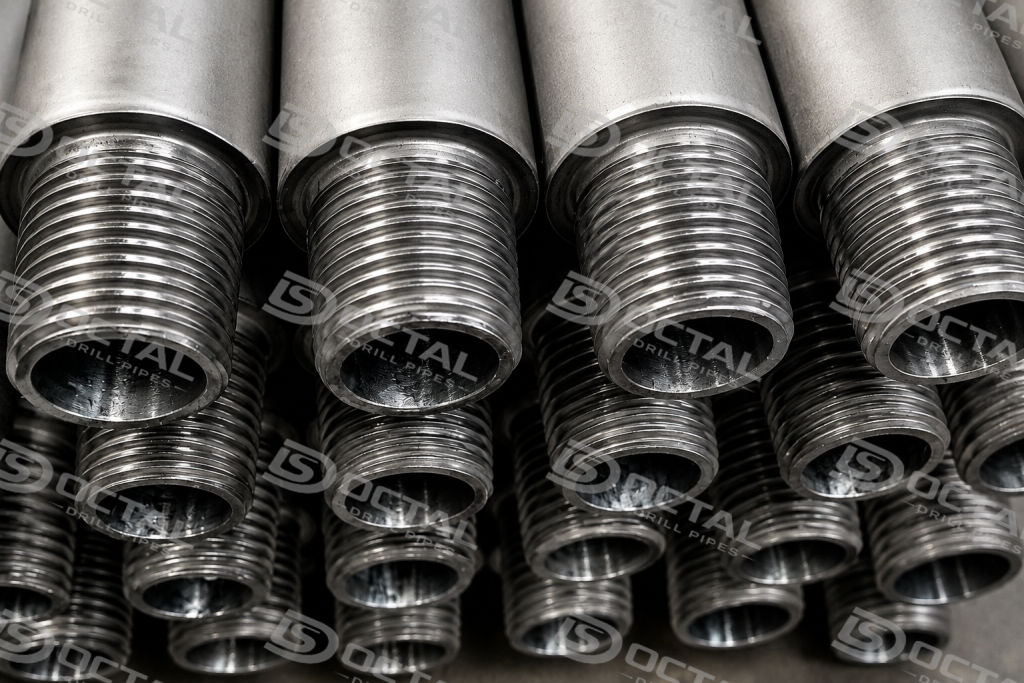
API Drill Pipe Connections and Premium Drill Pipe Connections are two major types of rotary shouldered connections used in drill string assemblies to connect drill pipe joints and transfer drilling loads during rotary operations. Both connection systems consist of critical structural elements including the pin, box, thread profile, shoulder, and sealing area, but they are designed for different operating requirements. API connections focus on standardized geometry, field interchangeability, and reliable performance for general drilling applications, while Premium connections optimize connection design to improve torque capacity, fatigue resistance, and reliability under more demanding drilling conditions.
The difference between API vs Premium Drill Pipe Connections is mainly determined by how the connection manages mechanical loads during drilling. Torque transmission, bending stress, fatigue exposure, and connection integrity are influenced by thread geometry, shoulder design, and load distribution. API connections provide a proven solution where standardization and compatibility are important, while Premium connections are selected when drilling conditions such as extended reach wells, high torque operations, and complex directional drilling create additional performance requirements.
For drilling contractors and procurement teams, connection selection should not be based only on the highest available performance level. The correct choice depends on well design, operating conditions, expected loading, connection compatibility, and inspection requirements.、
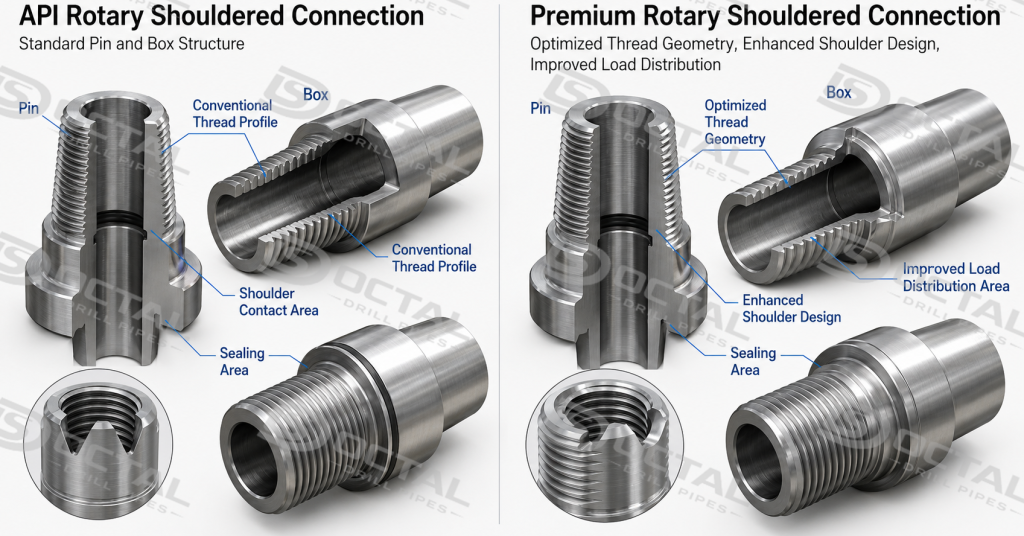
API and Premium Drill Pipe Connections: Different Design Approaches
A drill pipe connection is more than a threaded joint. It is a mechanical system designed to transfer rotary torque, support tensile loads, withstand bending forces, and maintain drilling fluid circulation throughout the drilling process.
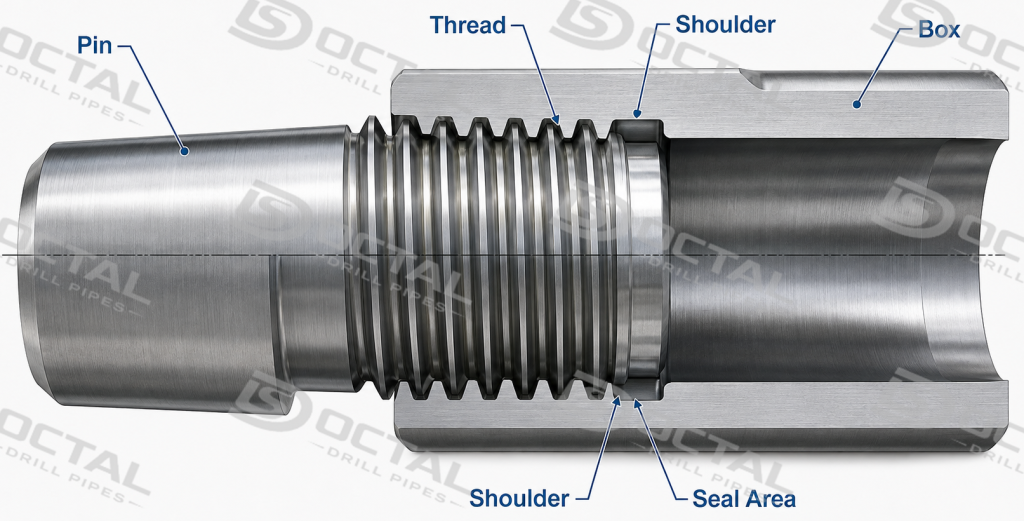
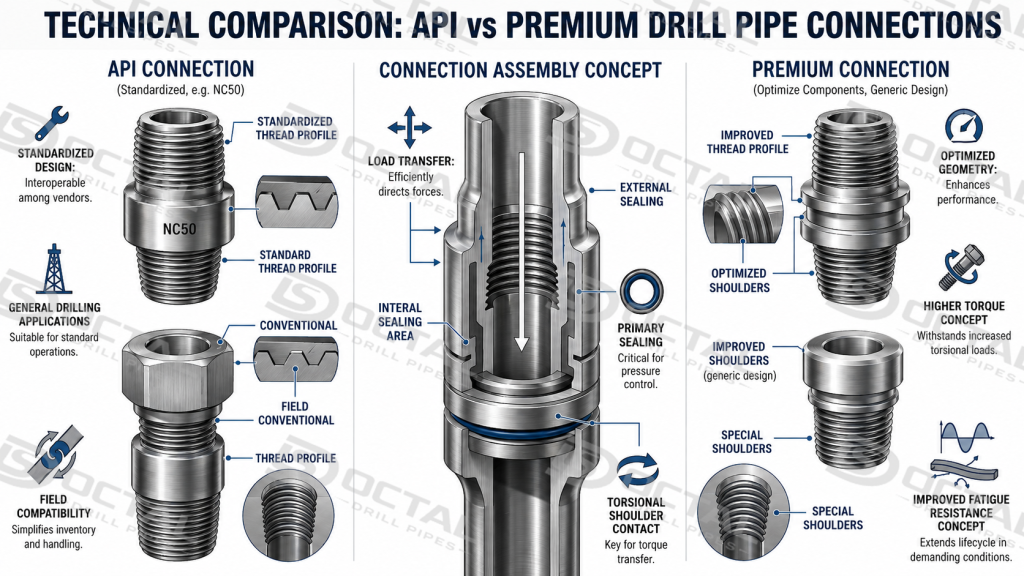
The connection works through the interaction between several key areas. The pin and box provide mechanical engagement, while the thread profile controls how loads are distributed between the two connection components. The shoulder area provides the primary torque-bearing surface during make-up, and the sealing area helps maintain pressure integrity during drilling operations.
Although API and Premium connections share the same basic connection concept, their design approaches are different. API connections are developed around standardized requirements to provide reliable and repeatable performance across different drilling operations. Premium connections focus on optimizing specific performance characteristics, especially when conventional connection designs may experience higher stress levels.
This difference does not mean Premium connections are always better. Instead, Premium connections are engineered solutions for specific drilling challenges where additional performance capability can justify the increased cost and specialized requirements.
API Drill Pipe Connections: Standardized Design and Connection Types
API Drill Pipe Connections are standardized rotary shouldered connections manufactured according to API requirements. Their primary advantage is standardization, which allows drilling contractors to use widely available connection types with established inspection procedures and field compatibility.
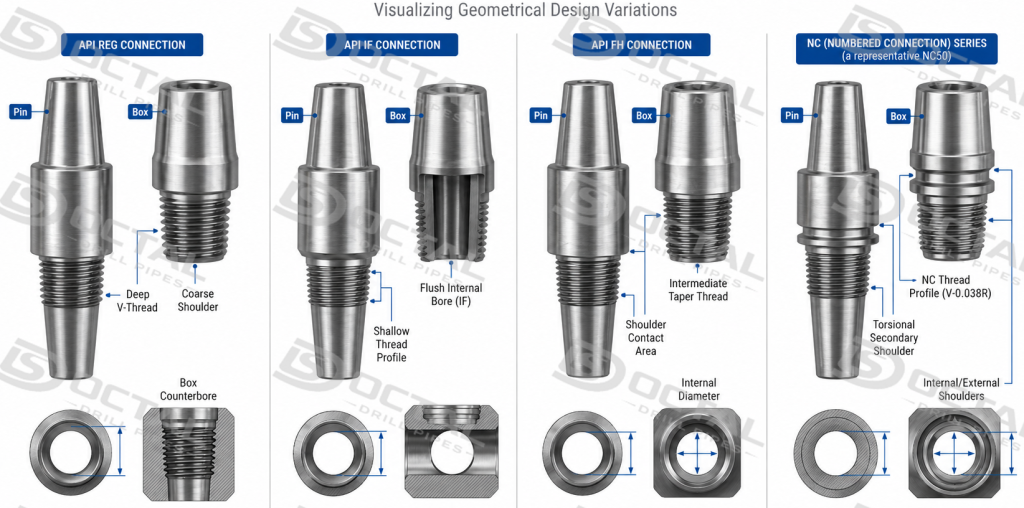
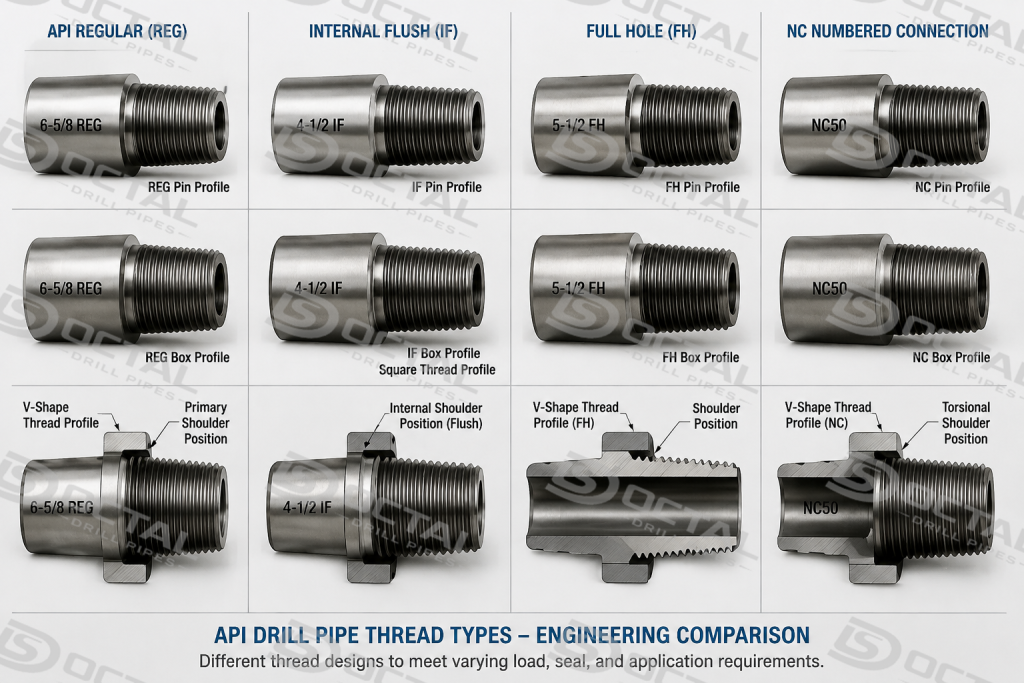
Common API Thread Types used for drill pipe include:
- API Regular (REG);
- Internal Flush (IF);
- Full Hole (FH);
- NC (Numbered Connection) series.
Among these connection families, NC connections have become widely adopted because they provide a balanced combination of mechanical performance and hydraulic characteristics. NC connections are identified by numbered designations, such as NC38 and NC50, representing different connection sizes and performance characteristics.
The main advantage of API connections is their standardized geometry. This standardization provides several practical benefits:
Easier Replacement and Compatibility
Because API connection designs are widely recognized, drilling contractors can more easily manage replacement drill pipe and maintain compatibility within existing drill string systems.
Established Inspection Procedures
API connections have mature inspection practices, including thread gauging, dimensional verification, and visual examination to confirm connection condition before field operation.
Broad Field Application
API connections are commonly used in conventional drilling operations where operating loads remain within standard design requirements.
However, standardized design also defines their application limits. When drilling conditions involve higher torque, repeated bending cycles, or long horizontal sections, additional connection performance may be required.
Premium Drill Pipe Connections: Optimized Performance for Challenging Wells
Premium Drill Pipe Connections are optimized rotary shouldered connection designs developed to improve performance in more demanding drilling environments. Unlike API connections, which prioritize standardization, Premium connections focus on improving mechanical efficiency through advanced connection geometry.
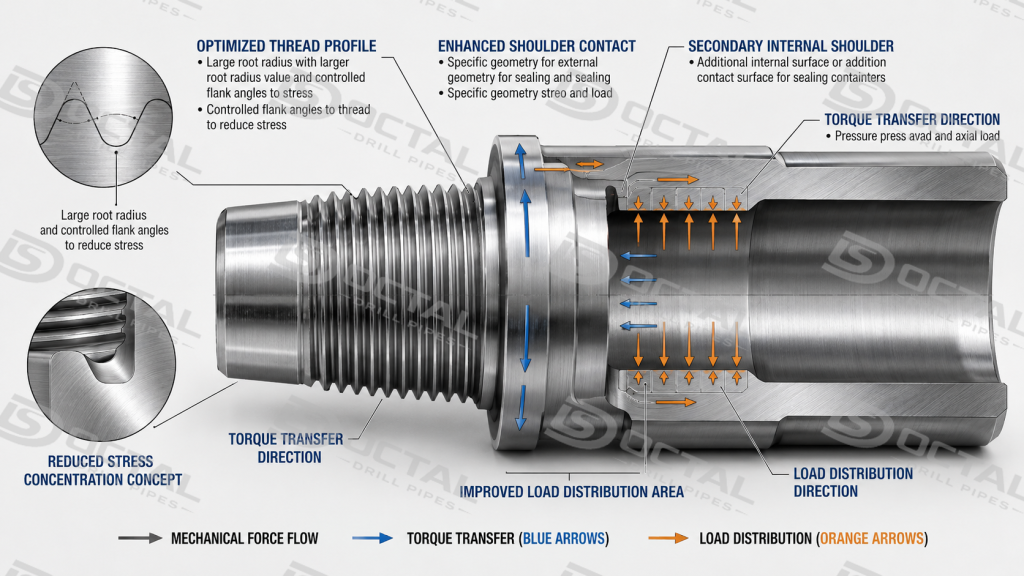
The performance improvements typically come from design optimization rather than simply using stronger materials. Key improvements may include:
- Modified thread geometry;
- Optimized shoulder configuration;
- Improved load distribution;
- Reduced stress concentration;
- Increased torque operating margin.
During complex drilling operations, connection areas experience repeated mechanical loading. For example, extended reach drilling creates higher friction, torque, and bending exposure because of the longer horizontal section. These conditions increase stress concentration around thread roots and shoulder areas.Premium connection designs aim to improve connection performance by controlling these stress conditions and increasing resistance to repeated loading.
Connection Design Differences Between API and Premium Drill Pipe Connections
The main difference between API and Premium Drill Pipe Connections is not the drill pipe body itself, but how the connection design manages mechanical loads during drilling operations.
A drill pipe connection transfers torque through the interaction between the pin, box, thread profile, and shoulder. When operating torque increases, the connection must distribute stress effectively to prevent excessive deformation, thread damage, and fatigue failure.
API connections provide reliable performance under standard drilling conditions because their geometry is developed around proven operational requirements. Their standardized design supports consistent manufacturing, inspection procedures, and field replacement.
Premium connections focus on improving specific performance areas through optimized connection design. These improvements may include:
- Improved contact efficiency between connection components;
- Reduced stress concentration around thread and shoulder areas;
- Enhanced resistance to repeated mechanical loading;
- Increased torque operating margin.
These design differences become increasingly important when drilling conditions become more demanding. For example, during extended reach drilling, the longer horizontal section increases friction, torque, and bending exposure on the drill string. Under these conditions, connection designs with improved fatigue resistance and torque capability can help reduce operational risks and improve drilling reliability.
API vs Premium Drill Pipe Connections: Performance Comparison
The selection between API and Premium connections depends on the balance between drilling requirements, operational risk, and cost considerations.
| Performance Factor | API Drill Pipe Connections | Premium Drill Pipe Connections |
| Design Purpose | Standardized solution for general drilling | Optimized solution for demanding applications |
| Connection Geometry | API-defined design | Enhanced geometry based on performance requirements |
| Torque Capacity | Suitable for conventional drilling loads | Higher operating margin for high torque conditions |
| Fatigue Resistance | Designed for normal drilling cycles | Improved resistance under repeated loading |
| Compatibility | High interchangeability | Requires specific connection matching |
| Cost Consideration | Lower initial investment | Higher cost with additional performance benefits |
| Typical Application | Conventional drilling operations | Directional, extended reach, high torque drilling |
How to Select Drill Pipe Connections for Different Drilling Conditions
The correct Drill Pipe Connection Selection should be based on actual drilling requirements, including well trajectory, torque demand, fatigue exposure, and connection performance requirements. API and Premium connections each have their own application advantages, and the appropriate choice depends on the actual operating environment.
Conventional Drilling
For conventional vertical drilling operations, API connections are often a practical choice because the drilling environment usually involves moderate torque, limited bending stress, and standard operating conditions. The standardized design of API connections provides reliable performance, easier replacement, and broad compatibility with existing drill string components. In these applications, selecting Premium connections may not provide significant additional benefits compared with the increased cost.
Directional Drilling
Directional drilling creates additional mechanical loading because the drill string follows a curved well trajectory. During operation, the connection experiences repeated bending cycles, changing torque loads, and increased fatigue exposure. For moderate directional applications, API connections may still meet operational requirements. However, when the well profile becomes more complex or fatigue loading increases, Premium connections may provide additional reliability through improved stress distribution and fatigue performance.
Extended Reach Drilling
Extended reach drilling places higher demands on drill pipe connections because long horizontal sections increase torque, drag, and rotational resistance. These conditions create greater stress on the thread and shoulder areas during drilling operations. Premium connections are often considered for extended reach applications because their optimized geometry can provide improved load transfer and additional operating margin under repeated mechanical loading.
High Torque Drilling
High torque drilling requires careful evaluation of connection capability because increased rotary loads directly affect connection performance. When operating torque approaches the practical limit of standard API connections, Premium connections may provide additional torque capacity and improved connection reliability. However, the final selection should still consider the complete drill string configuration, compatibility requirements, and project specifications.
Choosing Between API and Premium Drill Pipe Connections
Selecting the right drill pipe connection depends on actual drilling conditions rather than simply choosing a higher-performance connection. Engineers typically evaluate factors such as well trajectory, torque requirements, fatigue exposure, connection compatibility, and project requirements to determine whether an API or Premium connection is more suitable.
| Selection Factor | Consideration |
| Well Type and Trajectory | Vertical wells with moderate loading may use API connections, while directional and extended reach wells may require additional connection performance due to increased bending and fatigue loading. |
| Torque Requirement | Standard drilling conditions may be suitable for API connections, while high-torque operations may require Premium connections with improved torque capacity. |
| Fatigue Exposure | Frequent rotation, bending cycles, and long drilling periods increase connection fatigue demands and may influence the selection toward optimized connection designs. |
| Connection Compatibility | The selected connection must match the drill pipe size, thread type, tool joint configuration, and existing drill string system. |
| Project Requirements | API specifications, customer requirements, inspection procedures, and operational conditions should be considered before final connection selection. |
The most suitable drill pipe connection is the one that provides the required performance while maintaining operational reliability, compatibility, and cost efficiency. API connections remain a practical choice for many conventional drilling applications, while Premium connections provide additional performance capability for more demanding drilling environments.
Inspection and Quality Control Considerations
The performance of both API and Premium Drill Pipe Connections depends not only on connection design but also on manufacturing accuracy and inspection control. Proper quality verification ensures that thread geometry, shoulder contact, and connection dimensions meet the required specifications before the drill pipe enters field operation.
| Quality Control Item | Inspection Purpose |
|---|---|
| Thread Inspection | Thread profile and surface condition are verified through visual inspection, thread gauging, and dimensional measurement to confirm proper engagement between pin and box components. |
| Connection Dimension Verification | Critical connection features, including thread dimensions, shoulder condition, connection diameter, and alignment, are checked to ensure the connection can transfer loads correctly during drilling. |
| Material and Manufacturing Traceability | Inspection records, material certificates, and manufacturing documentation provide traceability for each drill pipe joint and support quality verification throughout the supply process. |
| Compliance Verification | Connection manufacturing and inspection requirements should follow applicable API specifications, customer requirements, and project-specific inspection plans. |
A reliable drill pipe connection requires the combination of correct design, accurate manufacturing, and effective inspection control. Whether selecting API or Premium connections, quality verification plays an essential role in maintaining connection integrity and reducing operational risks during drilling.
OCTAL Drill Pipe Connection Supply
OCTAL provides drill pipe connection solutions for different drilling requirements, including API and Premium connection configurations with common API Thread Types such as REG, IF, FH, and NC series.
Based on project specifications, OCTAL can support drill pipe supply with suitable connection matching, dimensional verification, thread inspection, and quality documentation to ensure connection reliability and compatibility for various drilling applications.
FAQ
What is the difference between API and Premium Drill Pipe Connections?
API connections use standardized rotary shouldered connection designs for broad compatibility, while Premium connections optimize connection geometry to improve torque performance, fatigue resistance, and reliability in demanding drilling conditions.
Are Premium Drill Pipe Connections always better than API connections?
No. Premium connections are designed for specific drilling challenges. API connections remain suitable for many conventional drilling applications where standard performance requirements are sufficient.
How do I select the right drill pipe connection for directional drilling?
Selection should consider well trajectory, torque requirements, fatigue exposure, and connection compatibility. Premium connections are often evaluated for longer directional sections and high-load drilling conditions.
Why is Drill Pipe Connection Compatibility important?
Connection compatibility ensures proper thread engagement, torque transfer, and operational reliability. Incorrect connection matching can reduce performance and increase the risk of premature failure.