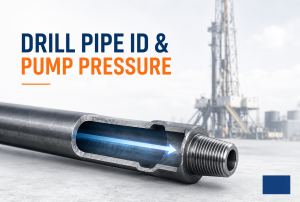
How Does Drill Pipe ID Affect Pressure Loss and Drilling Hydraulics?

Drill pipe pressure loss is closely related to the size of the internal flow passage inside the drill string. When the drill pipe ID, or internal diameter, becomes smaller, the same amount of drilling fluid has less space to pass through. Fluid velocity increases, and more pump pressure is required to overcome friction inside the …

What Size Drill Bit for 1/8 Pipe Thread Tap?

Choosing the correct drill bit size before using a 1/8 pipe thread tap is essential for creating accurate internal threads and achieving reliable sealing performance. For the commonly used 1/8-27 NPT tap, the recommended drill bit size is 11/32 inch (8.73 mm). The correct 1/8 NPT tap drill size depends on the thread standard, material …

G105 vs S135 Drill Pipe

G105 drill pipe and S135 drill pipe are high-strength API 5DP drill pipe grades used in rotary drilling strings to carry axial load, transmit torque, circulate drilling fluid and connect the rig to the bottom-hole assembly. Both are normally manufactured from heat-treated seamless alloy steel pipe bodies with upset ends, then friction-welded to alloy steel …

X95 vs G105 Drill Pipe

X95 and G105 are API 5DP drill pipe body grades with minimum yield strengths of 95,000 psi and 105,000 psi respectively. X95 and G105 are API 5DP drill pipe grades defined by minimum yield strength: 95,000 psi (655 MPa) for X95 and 105,000 psi (724 MPa) for G105. With the same outside diameter and wall …

API 5DP Drill Pipe Grade Selection: E75, X95, G105 and S135 Compared

API 5DP Drill Pipe Grade Selection compares E75, X95, G105 and S135 by strength level, load condition and drill string performance. E75 starts at 75 ksi minimum yield strength, X95 at 95 ksi, G105 at 105 ksi and S135 at 135 ksi, but grade selection should not move upward only because the number is higher. …

How to Choose API 5DP Drill Pipe Grades for Deep and Directional Wells

API 5DP Drill Pipe Grade Selection for deep and directional wells requires two different review paths. Deep-well selection is governed mainly by buoyed drill string weight, maximum hook load, planned overpull and the tensile capacity of the upper string. Directional-well selection adds torque-drag, dogleg-related bending, rotation time and fatigue near the upset transition, tool joint …

Special Material Drill Pipe vs API 5DP Drill Pipe

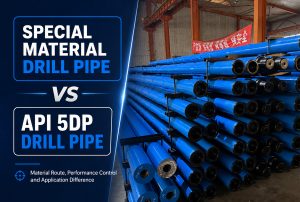
Special Material Drill Pipe vs API 5DP Drill Pipe should be understood from drill-string service conditions, not only from grade names. During drilling, the pipe body and tool joint work under combined tensile load, rotary torque, cyclic bending, internal pressure, impact loading and connection make-up stress. API 5DP Drill Pipe provides the standard grade system …

Special Threaded Drill Pipe Advantages

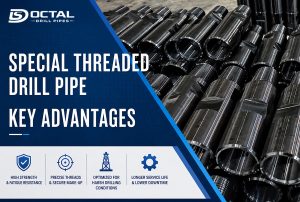
Special threaded drill pipe is selected when a normal drill pipe connection may not provide enough torque reserve, make-up stability, hydraulic performance, or fatigue control for demanding drilling programs. In deep wells, high-deviation wells, extended-reach drilling, HDD crossings, and long horizontal sections, the weak point is often not the pipe body alone. The connection area—thread …

Drill collar vs Drill pipe

A drill collar is a heavy-wall drilling tool installed near the bit in the bottom hole assembly (BHA). Its main job is to provide weight on bit, add stiffness around the bit, and help stabilize the drilling assembly during rotation, compression and downhole vibration. A drill pipe is the main tubular section of the drill …